
Chandrayaan-3’s Electrifying Discovery: Rewriting Our Understanding of the Moon’s South Pole
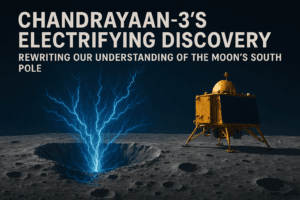
Chandrayaan-3’s Electrifying Discovery: Rewriting Our Understanding of the Moon’s South Pole
The Moon’s south pole, long envisioned as a silent, frozen wasteland, has revealed a startling secret. India’s Chandrayaan-3 mission, through its brief but brilliant 12-day surface operation, has uncovered that this enigmatic region is in fact a crackling hub of electrical activity—a discovery that fundamentally alters our scientific models and reshapes the blueprint for humanity’s future on the lunar surface.
For the first time in history, the Radio Anatomy of Moon Bound Hypersensitive ionosphere and Atmosphere – Langmuir Probe (RAMBHA-LP) instrument delivered direct, “in-situ” measurements of the plasma environment just above the lunar regolith. This ground truth data, analyzed over the past two years, paints a picture of a dynamic and energetic world, far removed from the placid, inert satellite we once imagined.
The Mission and the Instrument: A Quest for Ground Truth
Before understanding the discovery, one must appreciate the technological triumph that made it possible. Chandrayaan-3 was India’s determined follow-up to the Chandrayaan-2 lander mission, designed explicitly to demonstrate “end-to-end capability in safe landing and roving on the lunar surface”. On August 23, 2023, the Vikram lander achieved a historic soft landing at 69.373°S, 32.319°E—a site now named Shiv Shakti Point—making India the first nation to land successfully near the lunar south pole.
The mission’s scientific success hinged on sophisticated, locally developed instruments. The RAMBHA-LP, designed and built by the Space Physics Laboratory at the Vikram Sarabhai Space Centre, was a key payload on the lander. Its purpose was deceptively simple yet revolutionary: to directly measure the density and energy of charged particles in the ultra-thin envelope of gases and plasma just above the Moon. Previous data came from orbiters using indirect methods like radio occultation, which inferred conditions by observing how radio signals bent through the lunar atmosphere. Vikram lander’s measurements were the first from the surface itself, providing an unambiguous “ground truth”.
The Shocking Data: A World of Energy and Charge
The results from RAMBHA-LP, collected between August 23 and September 3, 2023, surprised scientists with their intensity. The table below summarizes the key findings that contradict prior remote estimates:
| Measurement Parameter | Chandrayaan-3’s Finding | Previous Understanding & Significance |
| Electron Density | 380 to 600 electrons per cubic centimeter | Significantly higher than estimates from orbital data. Reveals plasma is denser and “hugs” the surface more tightly than models predicted. |
| Electron Kinetic Temperature | 3,000 to 8,000 Kelvin | Equivalent to the temperature of the Sun’s photosphere. Indicates electrons are highly energized, creating a “hot” plasma in an otherwise frigid environment. |
| Primary Influences | 1. Solar Wind (lunar daytime). 2. Earth’s Magnetotail (3-5 days/month). | Confirms a dual-driver system, switching between solar and terrestrial particle sources based on the Moon’s orbital position. |
| Plasma Composition | Includes molecular ions (e.g., from CO₂, H₂O) | Suggests complex chemistry involving surface volatiles, hinting at active processes in the “airless” lunar exosphere. |
The Vexing Nature of Lunar Plasma: Plasma, often called the fourth state of matter, is a soup of charged particles (ions and free electrons) that is highly conductive and responsive to electromagnetic fields. On the airless Moon, this plasma environment, or lunar ionosphere, is created by two primary processes: the constant barrage of charged particles from the solar wind, and the photoelectric effect, where solar ultraviolet light knocks electrons loose from surface atoms.
Chandrayaan-3’s masterstroke was revealing how this plasma is not static but rhythmically variable. During most of the lunar day, when the Moon is outside Earth’s magnetic influence, the solar wind dominates. However, for roughly 3 to 5 days each lunar orbit, the Moon passes through the elongated geomagnetic tail of Earth. During this passage, the plasma environment near the south pole is flooded with and dominated by charged particles streaming from Earth itself, creating a distinctly different electrical regime.
Implications for the Future of Lunar Exploration
The discovery of this active electrical environment is not merely an academic curiosity; it has profound, practical implications for the coming decade of lunar exploration, particularly for crewed missions targeting the resource-rich south pole.
- Dust Mitigation and Hardware Survival: Lunar dust is famously abrasive and clingy. In a highly charged plasma environment, this dust becomes electrostatically levitated, making it even more likely to coat and degrade solar panels, clog machinery, and infiltrate habitats. Understanding the plasma’s density and fluctuations is critical to designing electrostatic shields or other mitigation technologies to protect equipment and astronaut health.
- Communication and Navigation Systems: Plasma can interfere with radio wave propagation. An accurate model of the lunar ionosphere is essential for designing reliable communication links between surface assets, orbiters, and Earth, especially for missions operating in the topographically complex and electromagnetically “noisy” south pole.
- In-Situ Resource Utilization (ISRU): The detection of molecular ions potentially linked to water vapor and carbon dioxide adds a crucial piece to the volatile puzzle of the south pole. It reinforces the scientific interest in permanently shadowed craters as reservoirs of water ice. Furthermore, understanding the local plasma is vital for any industrial process, like extracting water or oxygen, that might be affected by electrostatic phenomena.
The global impact of this finding is evident in the planning for future missions. Notably, NASA’s Artemis IV mission, scheduled for 2028, will deploy a suite of instruments specifically designed to study the dust and plasma environment (DUSTER) at the lunar south pole. Led by the University of Colorado Boulder’s Laboratory for Atmospheric and Space Physics, DUSTER will build directly upon the kind of pioneering measurements Chandrayaan-3 first made, aiming to characterize how human activity alters this natural environment and to develop protection strategies. This represents a perfect synergy of global exploration: an Indian robotic mission providing the foundational data that informs the planning of a subsequent American crewed mission.
Conclusion: A Silent World That Speaks Volumes
In just under two weeks of operation, the Chandrayaan-3 lander has fundamentally rewritten a chapter of lunar science. It has revealed a south pole that is electrically dynamic, bathed in a dense and searing-hot plasma that rhythmically shifts its allegiance between the Sun and the Earth. This “ground truth” provided by the RAMBHA-LP instrument is a gift to the entire global space community—a critical dataset that makes future missions safer, more resilient, and more scientifically productive.
The discovery underscores a deeper truth about modern space exploration: the most valuable lunar resources may not only be the water ice hidden in dark craters, but also the knowledge of the environment itself. As nations and private entities prepare for a sustained human presence on the Moon, understanding the invisible forces—like the crackling plasma at the south pole—will be just as important as mapping the visible terrain. Chandrayaan-3’s final act was to lift the veil on this hidden, energetic world, proving that even in the profound silence of space, the Moon has a vibrant, electric story to tell.
You must be logged in to post a comment.