
Canada’s Immigration Wait Times: What the March 2026 Update Really Means for Your Plans
The latest IRCC processing times for March 2026 show significant improvements for Indian nationals, including a dramatic eight-month drop in dependent child sponsorship (now 8 months) and a two-week reduction for visitor visas (now 57 days), alongside modest gains for US applicants. However, the update presents a mixed picture overall, with work permit applications from Nigeria increasing by two weeks, Quebec spousal sponsorship times rising to 36 months, and the Atlantic Immigration Program remaining stagnant at 33 months, highlighting ongoing regional and categorical disparities even as some temporary and permanent residence categories show positive movement.
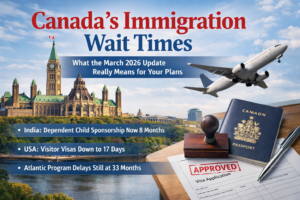
Canada’s Immigration Wait Times: What the March 2026 Update Really Means for Your Plans
If you are in the midst of the Canadian immigration process—or even just contemplating the first step—the bi-weekly update from Immigration, Refugees and Citizenship Canada (IRCC) can feel like checking the score of a game you desperately want to win. The latest figures, released for March 2026, bring a mixed bag of hope and patience, with significant movement for applicants from key countries like India and the United States.
While the headlines often focus on the numbers—a week shaved off here, a month added there—it is essential to understand the story behind the statistics. Whether you are an Indian national hoping to visit family in Toronto, a skilled worker in Lagos awaiting a permit, or a spouse in Montreal separated from your partner, these processing times dictate the rhythm of your life.
Here is a breakdown of the latest IRCC updates, what has changed, and what it realistically means for your application.
The Big Winners: Indian Nationals See a Spring Breeze
For applicants from India, the March 11, 2026, update brings some of the most welcome news in recent months. Canada has been working to clear backlogs, and the data suggests that applicants from the subcontinent are feeling the benefits.
The most staggering improvement is in the Dependent Child Sponsorship category. Processing times for applications originating from India have been slashed by a dramatic eight months, dropping from 16 months to just 8 months. For families separated from their children, this isn’t just a statistic; it is eight fewer months of birthdays, holidays, and milestones missed.
Visitor visas for Indian nationals also saw the most significant drop across the board. Wait times fell by a full two weeks, from 71 days to 57 days. While this is still above the 14-day service standard IRCC aims for, it signals a major stride toward normalizing travel between the two nations. If you are a parent hoping to attend a graduation or a businessperson needing to travel for meetings, the odds of getting a quicker answer just improved substantially.
Furthermore, work permit applications from India were trimmed by one week, now sitting at a swift 7 weeks. For a country that sends a massive number of students and temporary foreign workers to Canada, faster work permits mean faster integration into the labor market.
The US and Philippines: Consistency and Speed
North American applicants also have reason to smile. Visitor visa processing for US-based applicants plummeted from 23 days to 17 days—a six-day drop that edges closer to the 14-day dream target. Similarly, study permits for American students dipped slightly to 5 weeks, making the pathway to Canadian classrooms a little clearer.
For the first time in this reporting period, IRCC included data for The Philippines across several categories. Filipino applicants can now benchmark their expectations with current visitor visas sitting at 14 days (meeting the service standard), study permits at 5 weeks, and work permits at a very competitive 7 weeks. This transparency is a welcome change for a community that is a vital part of Canada’s immigration fabric.
The Waiting Game: Where Patience is Still Required
While some numbers are falling, other categories remain stubbornly static or have even regressed, serving as a reminder that immigration is a marathon, not a sprint.
Family Reunification: A Bittersweet Update
Family sponsorship remains the most emotionally charged category, and the latest update reflects its complexity. In-land spousal sponsorship for those living in Quebec saw a slight increase, moving from 35 months to 36 months. For couples already living together in the province, that extra month can feel like an eternity as they wait for permanent residence status to stabilize their lives.
However, there is a silver lining for those sponsoring parents. The Parent and Grandparent Program (PGP) saw a one-month reduction across the board. Outside Quebec, times dropped to 34 months, while inside Quebec they now sit at 46 months. Though still agonizingly long—nearly four years for Quebec residents—any downward trend is a positive signal for families praying for reunification.
The Atlantic Immigration Program (AIP)
The AIP was designed to funnel skilled workers into Canada’s eastern provinces, but its processing times tell a story of strain. Wait times remain stuck at a staggering 33 months. This is nearly triple the 11-month service standard. For employers in New Brunswick or Nova Scotia trying to fill critical roles, this bottleneck continues to hamper economic growth.
Understanding the Numbers: A Human Perspective
To truly grasp the impact of these changes, it helps to look beyond the spreadsheet.
The Nigerian Applicant: While visitor visa times for Nigeria dropped slightly (56 to 53 days), work permit applicants saw an increase from 11 to 13 weeks. Nigeria remains a key source of francophone immigration and skilled labor, but these fluctuations can disrupt job offers. If a Canadian employer is waiting for you to fill a position, a two-week delay on a permit can mean lost revenue and logistical headaches.
The Quebec Reality: Consistently, Quebec-based applications (especially sponsorships) take longer than those in the rest of Canada. The current 36-month wait for an in-land spouse in Quebec versus 21 months elsewhere highlights the additional layer of provincial scrutiny (the Certificat de sélection du Québec). For couples, understanding that this isn’t just a federal backlog but a bi-level process is crucial for mental preparation.
The Citizenship Milestone: For those at the finish line, the news is good. Citizenship grant processing times dropped from 14 to 13 months, finally dipping below the 14-month mark after a long period of stagnation. This means the final step to voting, obtaining a passport, and full participation in Canadian society is getting slightly closer.
Processing Times vs. Service Standards: Why the Gap Matters
The article mentions the distinction between processing times and service standards, but it is worth diving deeper because this gap is the source of most applicant anxiety.
- Service Standards are IRCC’s promise. They are the “ideal world” scenario. For example, the standard says an outside-Canada work permit should take 60 days.
- Processing Times are the reality. They are a “look back” or a “look forward” at how long it actually took to finish 80% of applications.
When you see a work permit from Nigeria taking 13 weeks (roughly 91 days) against a 60-day standard, you are experiencing that gap. The recent improvements suggest IRCC is actively trying to close that gap, but high demand and complex security checks ensure the standard remains an aspiration rather than a guarantee.
Final Thoughts: Navigating the March 2026 Landscape
The March 2026 update from IRCC paints a picture of an immigration system in flux, slowly righting itself after years of pandemic-related turbulence.
For Indian nationals, this is a moment of optimism. The eight-month drop in child sponsorships and the two-week drop in visitor visas suggest that the bilateral issues that once slowed processing are easing. For Americans, the path to a visitor visa is now almost back to pre-pandemic efficiency.
However, the static nature of Express Entry (still at 7 months) and the crippling delays in the Atlantic program remind us that Canada is still playing catch-up. If you are applying for a spousal visa in Quebec or waiting for an AIP nomination, the advice remains the same: submit a complete, “perfect” application on day one to avoid being part of that 20% of complex cases that drag the average up.
As always, the key is to use these updates not as a source of stress, but as a tool for planning. If you are in India and planning a visit, the current 57-day wait gives you a clearer timeline. If you are in Nigeria and applying for a work permit, budgeting for 13 weeks of waiting is smarter than hoping for the 60-day standard.
Immigration is a journey measured in months and years. The March 2026 update proves that while the road can be long, it is moving in the right direction.
You must be logged in to post a comment.