
Canada’s Great Pivot: Inside Carney’s High-Stakes Diplomatic Gamble Across the Indo-Pacific
Canadian Prime Minister Mark Carney is embarking on a high-stakes diplomatic tour of India, Australia, and Japan as part of a strategic effort to reduce Canada’s heavy economic reliance on the United States, which currently absorbs 75% of Canadian exports. The trip carries particular significance in India, where Carney aims to rebuild ties severely damaged in 2023 when his predecessor Justin Trudeau accused New Delhi of involvement in the killing of a Sikh separatist on Canadian soil. Against the backdrop of ongoing US tariffs and uncertainty surrounding the USMCA trade agreement renewal, Carney is pursuing trade diversification across energy, critical minerals, AI, and maritime security—a calculated pivot that signals to Washington that Canada has alternatives while acknowledging that true economic reorientation will take years of sustained diplomatic investment.
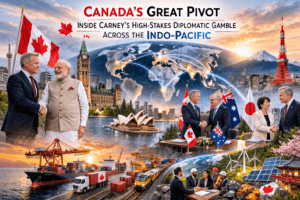
Canada’s Great Pivot: Inside Carney’s High-Stakes Diplomatic Gamble Across the Indo-Pacific
The photograph captured a moment of calculated diplomacy: Mark Carney, Canada’s newly installed prime minister, standing alongside Narendra Modi against the majestic backdrop of the Canadian Rockies. It was June 2025, and the two leaders had just shared what aides described as a “constructive” conversation on the sidelines of the G7 Summit in Kananaskis, Alberta. But for those tracking the subtle choreography of international relations, the image represented something far more significant—the first tentative steps toward mending a relationship that had frozen solid after one of the most explosive diplomatic ruptures in recent Canadian history.
Eight months later, Carney is boarding a government jet bound for New Delhi, and the stakes could not be higher.
The Weight of History: Repairing What Was Broken
When Justin Trudeau stood in the House of Commons in September 2023 and alleged that Indian government agents had been involved in the killing of Hardeep Singh Nijjar on Canadian soil, he set in motion a chain of events that would see diplomats expelled, visas suspended, and decades of careful diplomatic work reduced to ashes. The accusation—which India vehemently denied as “absurd” and politically motivated—turned the Canada-India relationship into a diplomatic wasteland.
For Carney, a former central banker who has built his political identity around冷静, measured decision-making, the path to reconciliation has been deliberately incremental. The Kananaskis meeting was never announced in advance; it simply happened, captured by photographers who were told only later the significance of what they had documented. Anita Anand’s trip to India late last year was similarly low-key, described by officials as a “working visit” focused on “shared priorities” rather than the elephant in the room.
But make no mistake: Carney’s upcoming arrival in New Delhi represents a full-throated attempt to turn the page. The prime minister’s office has carefully framed the visit around trade, energy, critical minerals, and artificial intelligence—the substance of future partnership rather than the recriminations of the past. Whether the Indian government is prepared to meet him halfway remains an open question, but the very fact that Modi has agreed to receive him suggests a mutual recognition that the estrangement has served neither country well.
Beyond America: The Economics of Necessity
To understand why Carney is spending precious political capital on a multi-nation Indo-Pacific tour, one need only examine a single statistic: approximately 75 percent of Canadian exports currently flow to the United States. For decades, this arrangement felt like security—a friendly border, integrated supply chains, and a trading partner that shared a continent and a cultural inheritance. The election of Donald Trump shattered that complacency.
Trump’s tariffs on Canadian steel, aluminum, and automobiles were not merely policy disagreements; they represented an existential threat to Canadian industries built around the assumption of unfettered access to the American market. When the US Supreme Court struck down the most sweeping of these tariffs last Friday, Canadian officials allowed themselves a moment of relief before recognizing the deeper truth: the underlying vulnerability remains. Sector-specific tariffs continue to bite, and the broader renegotiation of the USMCA trade agreement looms like a storm cloud on the horizon.
“We are diversifying our trade,” Carney said in a statement Monday, “and attracting massive new investment to create new opportunities for our workers and businesses.” The language is measured, but the subtext is unmistakable: Canada can no longer afford to put all its economic eggs in the American basket.
This is where the Indo-Pacific strategy takes on its urgency. India represents a market of 1.4 billion people with a rapidly expanding middle class. Australia shares not only Commonwealth ties but also a strategic outlook on maritime security and critical mineral supply chains. Japan offers technological sophistication and investment capital. Together, they form a counterweight to American economic dominance—not as a replacement, but as a hedge against the unpredictability that has come to define Washington’s trade policy.
The Man Behind the Mission
Mark Carney does not fit the traditional mold of Canadian prime ministers. He arrived at the country’s highest office not through decades of grinding parliamentary work, but through the rarefied corridors of global finance—Governor of the Bank of Canada, Governor of the Bank of England, United Nations Special Envoy for Climate Action. His suits are bespoke, his résumé glittering with Davos panels and central bank governors’ meetings.
This background has equipped him with relationships that most politicians could only dream of. When he addresses the Australian parliament—the first Canadian prime minister to do so in nearly two decades—he will speak to legislators who already know his reputation from his time steering the Bank of England through the Brexit turmoil. When he meets with Japanese Prime Minister Sanae Takaichi, he brings the credibility of someone who has managed monetary policy through multiple global crises.
But those same credentials also create expectations. Carney is not merely another politician making the rounds; he is a figure who has built his career on the proposition that expertise matters, that careful analysis should guide decision-making, and that the complexities of global economics can be navigated by those willing to do the work. His speech in Davos earlier this year, calling on nations to resist economic “coercion” by “great powers,” was vintage Carney—principled, slightly academic, and unmistakably directed at the Trump administration without ever mentioning it by name.
The question now is whether these qualities translate into tangible results. Trade diversification sounds sensible in theory, but in practice it requires overcoming entrenched business relationships, logistical challenges, and the simple gravitational pull of geography. The United States shares a 5,525-mile border with Canada; India is separated by an ocean and a half-continent. Changing the direction of trade flows is not accomplished through speeches and handshakes, no matter how skilled the diplomat.
The India Challenge: Separating Trade from Tensions
Of all the stops on Carney’s itinerary, India presents the most complex calculus. The Nijjar affair did not simply create diplomatic inconvenience; it tapped into deep currents of domestic politics in both countries. For India, the issue of Sikh separatism remains intensely sensitive, with memories of the Insurgency in Punjab in the 1980s and 1990s shaping official attitudes toward any expression of Khalistani sentiment abroad. For Canada, with its large and politically active Sikh diaspora—particularly in ridings around Brampton and Surrey that can swing elections—the perception of standing up for constituents’ concerns carries its own electoral weight.
Carney has attempted to navigate this by separating the relationship into compartments. Security and rule-of-law concerns will continue to be raised, as Anita Anand emphasized when she told reporters she had “repeatedly raised issues related to domestic rule of law concerns” during her own visit. But these discussions will happen in parallel with trade negotiations, energy partnerships, and cooperation on critical minerals—not as preconditions for them.
This approach reflects a pragmatic recognition that Canada cannot afford to let a single issue—however serious—define the entirety of its relationship with the world’s most populous nation. India’s economy is projected to become the world’s third-largest by 2030. Its demand for energy, technology, and educational partnerships is growing exponentially. Canadian pension funds already have billions invested in Indian infrastructure. The opportunity cost of continued estrangement is simply too high.
Whether the Indian government shares this view remains to be seen. New Delhi has shown increasing willingness to leverage its market size for diplomatic advantage, and Canadian officials privately acknowledge that the relationship will require sustained attention, not merely a single prime ministerial visit. But the fact that Carney is arriving with specific proposals—on critical minerals, on AI collaboration, on maritime security—suggests that both sides have identified enough common ground to justify the effort.
Australia and Japan: The Easier Partners
If India represents the challenge, Australia and Japan represent the opportunity. Both countries share Canada’s anxiety about over-reliance on any single partner, both have sophisticated economies that complement rather than compete with Canadian strengths, and both have demonstrated interest in deeper engagement with like-minded middle powers.
Carney’s address to the Australian parliament carries symbolic weight that should not be underestimated. In the Westminster tradition, invitations to address parliament are extended sparingly, reserved for leaders with something significant to say and relationships worth honoring. The last Canadian prime minister to receive this honor was Paul Martin in 2006—nearly twenty years ago, as Carney’s office noted. The intervening years have seen Canada and Australia cooperate closely on intelligence-sharing, military operations, and diplomatic coordination, but rarely with the visibility that a parliamentary address provides.
Japan, meanwhile, offers a pathway into Asian supply chains and investment networks that Canada has struggled to access. Japanese automakers have significant operations in Ontario, Japanese technology firms are increasingly interested in Canadian AI research, and Japanese capital has flowed steadily into Canadian resource extraction and real estate. The meeting with Takaichi—herself a relatively new leader navigating Japan’s complex relationship with both China and the United States—provides an opportunity to deepen these ties at a moment when strategic alignments are shifting rapidly across the region.
The American Elephant in the Room
For all the focus on diversification, no one in Carney’s government believes that Canada can simply replace the United States as a trading partner. The integration between the two economies is too deep, too structural, too embedded in the physical infrastructure of pipelines, power lines, and highways that connect them. What diversification offers is not substitution but insurance—a hedge against the possibility that American policy continues to fluctuate with electoral cycles and presidential temperament.
The ongoing USMCA renegotiation underscores this reality. This summer, the three partners must decide whether to extend the existing agreement, which was negotiated during Trump’s first term and reflects the priorities of that era. Canada and Mexico have made clear they want to keep the pact intact. The Trump administration’s signals have been more ambiguous, with officials floating the possibility of separate bilateral deals that would almost certainly favor American interests at the expense of Canadian leverage.
Carney’s Indo-Pacific tour should be understood, in part, as a message to Washington: Canada has options. The prime minister is not threatening to abandon the relationship, but he is demonstrating that the automatic assumption of Canadian compliance—the idea that geography leaves Canada no choice but to accept whatever terms the United States offers—no longer holds. It is a delicate message, delivered through actions rather than words, but one that sophisticated observers in Washington will certainly register.
What Success Looks Like
When Carney returns to Ottawa, the metrics of success will not be immediately apparent. Trade diversification is measured in years and decades, not days and weeks. A single trip does not reroute supply chains or redirect investment flows. What it can do is establish the relationships, build the trust, and create the momentum that makes those longer-term shifts possible.
The meetings with Modi, Albanese, and Takaichi will generate memoranda of understanding, joint statements, and photo opportunities. But the real work happens in the margins—in the conversations over tea where officials identify the specific regulatory barriers that have prevented Canadian companies from competing effectively, in the quiet agreements to share intelligence on maritime security threats, in the understanding that when the next crisis comes, these leaders will have a relationship to call upon.
For Canadians watching from home, the trip offers something more intangible but no less important: a sense that their country is actively shaping its future rather than simply reacting to events. The anxiety provoked by Trump’s tariffs, by the uncertainty of American politics, by the sense that the world is becoming more dangerous and less predictable—all of this finds a partial answer in the image of their prime minister engaging with leaders across the Indo-Pacific, making Canada’s case, building Canada’s connections.
Carney’s statement that “in a more uncertain world, Canada is focused on what we can control” captures this sentiment perfectly. The United States will do what it does. China will pursue its interests. Great powers will maneuver for advantage. But Canada can control its own outreach, its own relationships, its own determination to build a more diversified and resilient economy. This trip is an exercise in that control—a bet that the future belongs not only to the largest players, but to those smart enough to adapt.
The Road Ahead
The government jet will touch down in New Delhi on Thursday, beginning a journey that will cover three countries, multiple time zones, and conversations that could shape Canadian economic policy for a generation. Mark Carney will shake hands, deliver speeches, and pose for photographs. He will raise difficult issues where necessary and find common ground where possible. He will represent a country trying to find its footing in a world where old certainties have crumbled and new alignments are still taking shape.
Whether the trip succeeds will depend on what happens after the jet returns home—on whether the memoranda translate into contracts, whether the relationships survive the inevitable setbacks, whether Canadian businesses actually seize the opportunities that diplomatic engagement creates. But for now, the very fact of the journey matters. It signals that Canada understands the moment it faces, that it is willing to invest in relationships beyond its traditional comfort zone, and that it intends to be an active participant in shaping the economic architecture of the Indo-Pacific.
In a world where trade increasingly follows strategic alignments, where economic relationships carry geopolitical weight, and where the old certainties of the post-Cold War era have given way to something more fluid and uncertain, that signal is itself a form of progress. Carney’s gamble is that showing up, building bridges, and diversifying connections will eventually pay dividends—not tomorrow, not next month, but over the long arc of Canada’s future in a changing world.
The prime minister is betting on that future. The next ten days will show whether the world is ready to bet on Canada in return.
You must be logged in to post a comment.