
Can AI Predict the Next Outbreak? Inside India’s Climate-Health Tech Frontier
This article explores the transformative potential of Artificial Intelligence in shifting India’s approach to climate-driven health crises from a reactive to a predictive model, detailing how AI can enable hyper-local disease surveillance, optimize healthcare infrastructure, and deliver personalized early warnings to vulnerable populations. However, it critically examines the formidable barriers to this vision, including fragmented data silos, algorithmic bias, the immense energy footprint of AI, the digital divide in last-mile delivery, and significant privacy risks. The piece concludes that while the technological capability exists, its successful and equitable deployment hinges on building a robust governance framework that mandates transparency, sustainability, data interoperability, and inclusive design, ensuring that AI serves as a tool for justice rather than exacerbating existing inequalities.
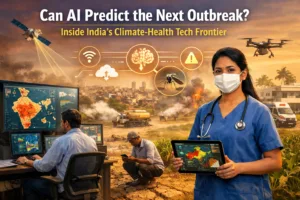
Can AI Predict the Next Outbreak? Inside India’s Climate-Health Tech Frontier
India stands at a critical juncture where two existential challenges—climate change and public health resilience—are colliding with unprecedented force. The numbers tell a stark story: in 2024, Indians experienced nearly 20 heatwave days, with 6–7 of those directly attributable to climate change . As temperatures rise, so does the burden of vector-borne diseases like dengue, which now follows the monsoon with predictable yet poorly managed regularity.
For too long, the nation’s approach has been reactive—water tankers roll out only after heat-related deaths are reported, fogging operations begin only after dengue cases surge past critical thresholds. This is not strategy; it is desperation disguised as disaster management . But a powerful new tool is emerging that could fundamentally rewrite this script: Artificial Intelligence.
The convergence of AI with climate science now makes it possible to forecast hyper-local health risks months in advance, transforming public health from a reactive crisis response system into an anticipatory, precision-driven network capable of saving countless lives. Yet, as with any transformative technology, the path from potential to practice is fraught with institutional, ethical, and infrastructural challenges that demand careful navigation.
From Reaction to Prediction: The AI-Powered Health Revolution
The fundamental promise of AI in the climate-health domain lies in its ability to shift paradigms. Instead of asking “where did the outbreak occur?”, AI enables us to ask “where will the next outbreak occur, and how can we stop it before it starts?” This predictive capacity is not theoretical—it is already being demonstrated across India in diverse and innovative ways.
Hyper-Local Surveillance and Early Warning Systems
Traditional weather models provide district-level alerts, but vulnerability to climate stress operates at the street level. Urban heat islands—areas with sparse tree cover and high concrete density—can experience temperatures several degrees higher than neighbouring parks or water bodies. AI bridges this granularity gap by integrating high-resolution satellite imagery with socio-economic data to create hyper-local risk maps .
The indigenous Bharat Forecasting System (BharatFS) now delivers village-level rainfall forecasts at an impressive 6km resolution, representing a 30% improvement in extreme rainfall prediction accuracy . When combined with health data, such precision allows municipal corporations to identify exactly which wards need cooling shelters, which communities require early mosquito control interventions, and which hospitals should stock additional intravenous fluids before a heatwave peaks.
In the realm of vector-borne diseases, Kerala has emerged as a pioneering laboratory. Researchers have deployed Random Forest and Long Short-Term Memory (LSTM) models to detect dengue and malaria hotspots with remarkable precision. These models outperform traditional statistical methods because they capture the complex, non-linear relationships between climatic variables—temperature spikes in March, humidity levels in April, and rainfall patterns in May—that collectively determine outbreak severity during the monsoon months .
Real-World Applications Taking Shape
The India Health Fund, a Tata Trusts initiative, is supporting Khushi Baby to develop the Climate Health Vulnerability Index (CHVI), an AI-based real-time decision support tool that integrates climate stressors, population sensitivity, and adaptive capacity into a single composite vulnerability score at the village level . This tool builds on Khushi Baby’s existing CHIP platform, which has already transformed healthcare delivery for over 45 million people across Rajasthan by equipping 75,000 community health workers with digital tools .
Meanwhile, Delhi’s battle against toxic winter smog has entered a high-tech era with the AIRWISE framework. Developed by the Indian Institute of Tropical Meteorology and the India Meteorological Department, AIRWISE provides 72-hour advance warnings of pollution spikes by integrating satellite data with high-resolution emissions inventories . This allows authorities to plan interventions—including cloud seeding operations costing Rs. 37.93 lakh—with surgical precision rather than reactive desperation .
In the agricultural heartland, SukhaRakshak AI, or “drought protector,” is transforming drought governance. Leveraging Google’s Gemini 2.0 Flash and Retrieval-Augmented Generation, this chatbot integrates real-time drought indicators from the South Asia Drought Monitoring System with India’s district-level contingency plans. It delivers personalized, multilingual advisories—in over 22 Indian languages—to farmers, extension officers, and government managers, ensuring that drought preparedness reaches the last mile .
The Hidden Constraints: Why Technology Alone Is Not Enough
For all its promise, the deployment of AI in climate-health governance faces formidable obstacles that cannot be solved by better algorithms alone. These constraints are structural, ethical, and institutional, and ignoring them risks creating a system that is technologically sophisticated yet operationally useless—or worse, harmful.
The Data Silos Problem
India’s data landscape remains deeply fragmented. The India Meteorological Department issues district-level heat alerts, but the Integrated Disease Surveillance Programme under the Ministry of Health releases data on heat-related illnesses with weeks or months of lag . ISRO’s satellites generate daily high-resolution land surface temperature imagery, but this data is not interoperable in real-time with municipal health systems. The result is a patchwork of disconnected information that prevents AI models from accessing the unified, real-time data streams they require for accurate predictions.
Even when data exists, it often suffers from what might be called “metadata friction”—incompatible formats, inconsistent collection methodologies, and varying temporal resolutions that make integration a technical nightmare. Without standardized interoperability protocols and open Application Programming Interfaces (APIs) across meteorological, environmental, and health agencies, even the most sophisticated AI remains hamstrung.
Algorithmic Bias and the Digital Colonialism Trap
A more insidious challenge lies in the data itself. Many AI models deployed in the Global South are trained on datasets from high-income countries, reflecting epidemiological patterns, genetic diversity, and environmental conditions that bear little resemblance to Indian realities . This “digital colonialism” produces systems that systematically underperform for marginalized communities—precisely those most vulnerable to climate shocks.
Research on AI/ML forecasting for mosquito-borne diseases reveals that 63 out of 98 studies are rated at high risk of bias, with limited external validation . When models are trained on hospital data that underrepresents rural populations, or on air quality monitors concentrated in affluent urban neighbourhoods, they encode and amplify existing inequalities. The informal settlement dweller, the migrant worker, the tribal community—these populations become invisible to AI systems, their risks underestimated, their needs unaddressed.
The Energy Paradox
Perhaps the cruelest irony of AI-driven climate action is its massive carbon footprint. Training and running advanced AI models requires immense computational power, with data centres currently accounting for 1–2% of global electricity consumption—a figure projected to double by 2030 . A single generative AI query can consume several times the electricity of a traditional web search .
For India, this presents a profound paradox: the very infrastructure needed to mitigate climate-driven health crises may exacerbate the climate problem. India’s data centre operational electricity demand is projected to grow from 1 GW in 2025 to 13 GW by 2031–32 . During heatwaves, when households and healthcare facilities desperately need electricity for cooling, AI-driven data centres remain always-on, their cooling requirements intensifying precisely when grids face maximum strain . Without a deliberate strategy to power AI infrastructure with renewable energy, the cure risks becoming indistinguishable from the disease.
The Last-Mile Delivery Gap
Even perfect predictions are useless if they cannot reach those who need them. India’s digital divide means that the populations most vulnerable to climate shocks—the rural elderly, migrant labourers, tribal communities—often lack the smartphones and internet connectivity required to receive AI-generated alerts . During the COVID-19 pandemic, the Aarogya Setu app highlighted precisely this gap: those with access to technology were served, while those without were left behind.
Moreover, many primary health centres in high-risk districts still lack reliable electricity, let alone the computational infrastructure to run AI models. An AI system that predicts a dengue outbreak with 95% accuracy is meaningless if the block-level health officer cannot access the prediction, or if the prediction arrives in English rather than the local language, or if it provides probabilistic risk scores that field staff are not trained to interpret.
The Explainability Deficit
Healthcare professionals are rightfully hesitant to trigger expensive emergency protocols based on algorithmic outputs they cannot understand. Complex neural networks often operate as “black boxes,” producing predictions without offering insight into their reasoning . This lack of explainability undermines trust and adoption.
Over 40% of clinicians in India now use AI in practice, but transparency and accountability remain significant concerns . When a model recommends pre-positioning medical supplies in a particular district, doctors and public health officials need to understand why. Which variables drove the prediction? How confident is the model? What are the potential false positive and false negative rates? Without Explainable AI (XAI) layers that make algorithmic reasoning transparent, even accurate predictions will struggle to translate into action.
The Privacy and Surveillance Risk
Integrating granular climate data with sensitive personal health records under the Ayushman Bharat Digital Mission creates unprecedented privacy risks. As of July 2025, India had created 79.71 crore Ayushman Bharat Health Accounts and linked 65.09 crore health records . Combining this data with ward-level heat or disease risk maps could enable “climate-based profiling”—insurance companies denying coverage to residents of high-risk zones, or state agencies intensifying surveillance in communities labelled as vulnerable.
In the absence of robust, health-specific AI governance, hotspot mapping could lead to stigmatization rather than support. Communities identified as high-risk may face discrimination rather than targeted welfare interventions, undermining the very purpose of predictive systems .
Building a Responsible AI Ecosystem for Climate and Health
Addressing these challenges requires more than technical fixes; it demands a fundamental reimagining of how AI is governed, deployed, and integrated into public health infrastructure. The building blocks of a responsible AI ecosystem are already taking shape, but they must be deliberately and systematically strengthened.
Treating Health Data as Critical National Infrastructure
The first imperative is to dismantle data silos through a unified, real-time data-sharing protocol across meteorological, environmental, and public health ministries. This requires standardized API handshakes, metadata harmonization, and a legal framework that mandates data sharing while protecting privacy . The goal is a synchronized national data grid that allows predictive algorithms to process holistic environmental stressors without latency or fragmentation.
Initiatives like the BODH (Benchmarking Open Data Platform for Health AI), launched in 2026, point the way forward. By enabling systematic evaluation of AI models using anonymized real-world health datasets, BODH creates the infrastructure for rigorous, transparent model validation . Such platforms must be expanded and institutionalized, becoming the norm rather than the exception.
Mandating Transparency and Explainability
To bridge the trust gap among healthcare professionals, India must mandate the integration of Explainable AI layers within all predictive health dashboards. This means moving away from opaque algorithmic “black boxes” toward transparent models that clearly delineate the weighted variables—specific thermal spikes, rainfall anomalies, humidity thresholds—that trigger outbreak alerts .
The IndiaAI Mission, approved in March 2024 with an outlay of ₹10,372 crore, provides a policy framework for such governance. Its seven strategic pillars include the development of governance frameworks for responsible AI, offering an opportunity to embed explainability requirements from the outset .
Powering AI Sustainably
The environmental footprint of AI must be brought within India’s climate accounting framework. This requires mandatory environmental impact assessments for compute-intensive AI systems, coupled with incentives for energy-efficient model architectures and renewable-powered data centres .
Green building standards like GRIHA should be extended to include dedicated sustainability ratings for data centres, specifying norms for renewable energy sourcing, water recycling, zero-liquid discharge, and waste management . Rather than retrofitting sustainability after large-scale expansion, India can develop demonstrator projects that define best practices from the outset, informing regulation and investment decisions.
Designing for Inclusion and Accessibility
AI systems must be engineered to reach the last mile. This means building communication interfaces that are culturally nuanced, multilingual, and functional without continuous high-speed internet. Predictive insights should be automatically translated from complex meteorological jargon into actionable, localized advisories delivered through low-bandwidth channels like SMS, radio broadcasts, and community-based offline networks .
The SukhaRakshak AI chatbot demonstrates what inclusive design looks like in practice. By leveraging AI4Bharat’s language models and Sarvam AI’s translation capabilities, it delivers voice and text advisories in over 22 Indian languages, ensuring that critical information transcends linguistic barriers . Such approaches must become standard across all climate-health AI applications.
Building Bilingual Workforces
Bridging the gap between AI innovation and public health execution requires a new cadre of professionals fluent in both domains. Medical curricula and disaster management training programmes must integrate climate-AI modules, producing graduates who can contextualize algorithmic outputs within complex epidemiological realities .
The Union Budget 2025-26 allocated ₹500 crore for a Centre of Excellence in AI for Education, while Budget 2026 proposed a high-powered “Education to Employment and Enterprise” Standing Committee to strengthen links between education and jobs . These initiatives should be leveraged to create specialized training pathways at the intersection of climate science, public health, and AI.
Protecting Privacy Through Decentralized Analytics
As climate and health data become increasingly intertwined, robust cryptographic guardrails are essential. Federated learning—which allows AI models to train across decentralized datasets without ever extracting or centralizing personally identifiable information—offers a promising approach . By keeping sensitive data at the source while enabling model improvement, federated learning neutralizes the threat of mass surveillance or data breaches.
Strong data protection laws, transparent and auditable AI models, bias testing with equity metrics, and participatory system design involving affected communities must form the ethical foundation of all climate-health AI initiatives .
Conclusion: Intelligence with Ethics
The convergence of AI and climate science offers India a historic opportunity to transform public health from a reactive crisis response system into an anticipatory, precision-driven network capable of protecting millions. The technological building blocks are increasingly within reach: hyper-local forecasting, predictive outbreak surveillance, real-time resource optimization, and personalized, multilingual last-mile communication.
Yet technology alone cannot deliver justice. Without deliberate governance, AI risks reinforcing existing inequalities, consuming unsustainable resources, and eroding privacy and trust. The central policy question is not whether AI should be used, but how it should be governed—with whose data, toward whose benefit, and within what ethical boundaries .
India’s AI Impact Summit 2026 brought 88 countries together to sign the New Delhi Declaration on AI, emphasizing voluntary commitments, democratic diffusion of AI, and AI for economic growth and social good . This global consensus provides a platform for leadership. By weaving climate-health early warning systems into the fabric of public infrastructure, by treating health data as a national asset, by mandating transparency and sustainability, and by keeping human judgment at the centre of critical decisions, India can demonstrate that real impact means fewer people collapsing in the heat and fewer children suffering in packed hospital wards .
As the heat season tightens its grip and the monsoon approaches with its annual burden of disease, the choice is urgent and clear. India can continue its reactive cycle of water tankers and fogging operations, responding after the damage is done. Or it can embrace a future where AI enables proactive, data-driven preparedness—where predictions translate into protection, where intelligence serves equity, and where the climate crisis meets its match in human ingenuity guided by ethical purpose.
You must be logged in to post a comment.