
Budget 2026: India’s Pivotal Moment to Secure a Self-Reliant and Clean Energy Future
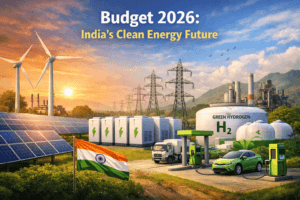
Budget 2026: India’s Pivotal Moment to Secure a Self-Reliant and Clean Energy Future
The upcoming Union Budget for 2026 is not merely another fiscal exercise; it is widely seen as a defining moment for India’s energy and economic destiny. As the nation stands at the crossroads of massive industrial growth and pressing climate commitments, the budget presents a critical opportunity to engineer a system-level transformation of its energy ecosystem. With ambitious targets of achieving 500 GW of non-fossil fuel capacity by 2030 and net-zero emissions by 2070, the focus must shift from ambitious goal-setting to the granular execution that will make these targets a reality . Expectations are high for a budget that moves beyond declarations, actively deploying policy, fiscal firepower, and strategic vision to balance the critical triumvirate of energy security, affordability, and a just transition.
The Unavoidable Imperative: Building a Resilient Grid and Storage Backbone
The rapid growth of renewable energy has exposed a fundamental weakness in India’s power infrastructure: an inadequate grid and storage system. Industry leaders unanimously identify this as the most pressing bottleneck, risking the stability of the entire green energy mission. The intermittent nature of solar and wind power necessitates massive investments in grid modernization and energy storage to ensure reliable power delivery .
- Modernizing the Grid: The budget is expected to prioritize investments in smart grid technologies and flexible transmission networks. Incorporating advanced forecasting tools and demand-response mechanisms is essential to manage the variability of renewable sources and prevent curtailment of clean power . This is not just about hardware; it’s about building an intelligent, responsive nervous system for the country’s energy flow.
- Accelerating Energy Storage: While India’s non-fossil capacity has impressively crossed 259 GW, its cumulative energy storage capacity stood at a meager 490 MWh by mid-2025—a glaring disparity that threatens to stall progress . The Central Electricity Authority estimates a need for 411.4 GWh of storage by 2031-32 . The budget must provide a clear deployment roadmap with robust financial mechanisms.
Recent policy moves, such as mandating a minimum 20% domestic content for battery storage projects seeking Viability Gap Funding (VGF), signal a strategic intent to build domestic capability alongside capacity . Budget 2026 is expected to expand such VGF schemes and introduce concessional financing and clear payment security mechanisms to de-risk projects and attract private capital at scale .
Key Storage and Grid Modernization Needs for Budget 2026
| Policy Area | Specific Industry Ask | Rationale & Expected Impact |
| Financial Support | Enhanced Viability Gap Funding (VGF), concessional financing lines, payment security mechanisms. | Reduces high capital costs and perceived risks, making large-scale storage projects bankable . |
| Fiscal Incentives | Rationalized GST and direct tax benefits for battery storage system manufacturing and deployment. | Improves project viability and encourages domestic manufacturing across the storage value chain . |
| Grid Infrastructure | Dedicated funding for smart grid tech, flexible transmission, and forecasting systems. | Ensures renewable power can be efficiently evacuated and integrated, maintaining grid stability . |
| Demand Creation | Clear tender timelines, offtake mechanisms, and storage procurement mandates for distribution companies. | Provides market certainty for developers and ensures created storage capacity is utilized . |
From Import Dependence to Industrial Leadership: Fortifying the Domestic Supply Chain
True energy security is impossible without technological and manufacturing sovereignty. The pandemic and global geopolitical shifts have underscored the dangers of over-reliance on imported components, particularly from a single geography. Budget 2026 is anticipated to double down on the ‘Make in India’ initiative within the energy sector, moving beyond final assembly to developing deep, competitive domestic supply chains.
- Solar Manufacturing Depth: India has made strides in solar module production, but the upstream stages—polysilicon, ingot, and wafer manufacturing—remain dominated by other countries. Industry bodies are advocating for an enhanced Production Linked Incentive (PLI) scheme specifically targeting these high-tech, capital-intensive upstream segments . This would create a truly integrated and self-reliant solar manufacturing ecosystem.
- Critical Minerals for Storage and EVs: The battery and electric vehicle revolutions hinge on access to critical minerals like lithium, cobalt, and nickel. As highlighted by EY’s analysis, securing these supply chains through strategic international partnerships, investing in domestic exploration, and establishing urban mining (recycling) initiatives is vital for long-term resilience . The budget could announce funds for sovereign acquisition of overseas mineral assets or incentives for recycling infrastructure.
- Incentivizing Capital Investment: To attract large-scale investments in manufacturing, industry seeks the reintroduction of accelerated depreciation benefits (up to 80%) for new industrial plants and machinery . This would significantly lower the upfront capital cost burden and improve returns on investment, encouraging businesses to commit to building futuristic capacity.
Green Hydrogen and Beyond: Scaling the Next Frontier of Decarbonization
While solar and wind form the bedrock, green hydrogen is emerging as the strategic wildcard for decarbonizing hard-to-abate sectors like refining, fertilisers, steel, and long-haul transport. For green hydrogen to move from pilot projects to commercial scale, it requires a powerful demand push, as the cost gap with conventional ‘grey’ hydrogen remains substantial .
The Confederation of Indian Industry (CII) has proposed a powerful tool: government-mandated consumption quotas. A phased mandate for sectors like refining and fertilisers to procure a certain percentage of green hydrogen would create guaranteed, large-scale demand . This would be coupled with cost-offset mechanisms like carbon credit allocations or targeted VGF to bridge the initial cost gap and provide certainty to producers . Budget 2026 is the perfect platform to announce such a Green Hydrogen Consumption Mandate, alongside dedicated R&D grants and infrastructure funding for electrolyzer manufacturing and hydrogen refueling networks.
Financing the Transition: Mobilizing Capital for a Sustainable Future
The scale of investment required is staggering. Achieving the 500 GW target alone demands tens of billions of dollars annually. This cannot be met by public funding alone; it requires a concerted effort to mobilize global and domestic private capital.
- Green Bonds and Sustainable Finance: The budget should encourage the issuance of sovereign green bonds and create a favorable tax and regulatory environment for corporate green bonds and ESG (Environmental, Social, and Governance)-linked loans . Clarity and incentives can channel the massive pool of global sustainability-focused capital into Indian projects.
- Carbon Market Development: The recently notified Carbon Credit Trading Scheme provides a framework . Budget 2026 can strengthen this by integrating it with national climate goals and ensuring transparent price discovery. As suggested by industry experts, introducing a comprehensive Climate Financing Statement linked to a national climate taxonomy would bring transparency and accountability to green allocations .
- Tax Reforms for Strategic Tech: As noted by KPMG, India’s tax regime needs to evolve to support strategic technology investments. This includes considering super-deductions for R&D, more flexible provisions for carrying forward losses, and reviewing the patent box regime to cover a wider array of modern IP like software and industrial designs crucial for energy tech .
Ensuring a Just and Affordable Transition
An energy transition that ignores affordability and equity is doomed to fail. The budget must, therefore, also focus on democratizing access and managing costs.
- Decentralized Renewable Energy (DRE): Schemes for rooftop solar, solarization of agriculture (PM-KUSUM), and rural microgrids need continued and enhanced support . Innovative models like virtual net metering and community solar can allow apartment dwellers and rural communities to participate directly in the energy transition .
- Managing Consumer Impact: Strategic support for storage and grid efficiency, as highlighted by EY, ultimately helps in lowering the overall cost of power delivery to the end consumer . Furthermore, a predictable policy environment reduces risks and, consequently, the cost of capital for developers, which benefits consumers through cheaper tariffs.
Conclusion: From Ambition to Actionable Blueprint
Budget 2026 arrives at a moment of exceptional momentum and equally high stakes. India has laid a strong foundation with record renewable capacity additions. The task now is to construct the superstructure of a modern, resilient, and self-sufficient energy economy. This requires the budget to act as a catalyst, addressing the systemic gaps in storage and grids, strengthening the industrial base from raw materials to finished products, creating markets for emerging technologies like green hydrogen, and unlocking trillions in capital.
By providing a cohesive, actionable, and financially robust blueprint that connects these dots, the government can ensure that India’s clean energy transition becomes an irreversible engine for economic growth, job creation, and global leadership. The moment is ripe; Budget 2026 must seize it.
You must be logged in to post a comment.