
Bromance Under Bombs: Decoding the India-Israel Alliance as Modi Returns to Tel Aviv
Indian Prime Minister Narendra Modi’s upcoming visit to Israel represents a carefully choreographed display of what both leaders call a “special relationship,” deepening strategic ties that have flourished under Modi’s tenure through massive defense purchases, technology partnerships, and diplomatic cover that has insulated Israel from international criticism over its war in Gaza—where over 72,000 Palestinians have been killed—while Modi conspicuously avoids visiting Palestinian territories or addressing the humanitarian catastrophe, reflecting Delhi’s policy of “de-hyphenating” Israel from Palestine as the relationship evolves from transactional arms deals worth billions into co-production agreements, intelligence sharing, and potential joint development of missile defense systems, all serving dual purposes: for Netanyahu, facing elections and international arrest warrants, Modi’s embrace offers validation and a bridge to the Global South; for Modi, the alliance burnishes his strongman image domestically and positions India within an emerging anti-Iranian axis alongside Israel and Gulf states, even as activists face crackdowns for protesting their government’s complicity in what international courts are examining as potential genocide.
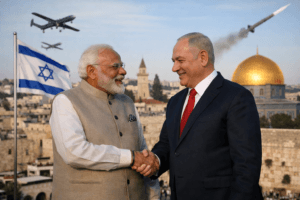
Bromance Under Bombs: Decoding the India-Israel Alliance as Modi Returns to Tel Aviv
The Mediterranean sun glints off the high-rises of Tel Aviv as two giant banners descend from a building in the city center. They show Benjamin Netanyahu and Narendra Modi locked in a handshake, the Hebrew caption above declaring the Israeli prime minister to be “in another league.” It’s July 2019, and the image captures a moment of pure political theater—two strongman leaders celebrating what they’ve already begun calling an “unbreakable” friendship.
Nearly seven years later, Modi is preparing to walk onto that same stage again. But the world around them has transformed catastrophically.
When the Indian prime minister lands in Israel this week, he arrives in a region trembling on the edge of wider war. Gaza lies in ruins, its death toll surpassing 72,000 according to Palestinian officials. The International Court of Justice is weighing charges of genocide against Israel. Iranian missiles have flown both ways across borders. And Netanyahu, fighting for his political survival, needs friends more than ever.
This is the uncomfortable backdrop against which the India-Israel relationship has matured from transactional convenience into something its architects call “special”—a word historically reserved for America’s embrace of the Jewish state. What does that designation actually mean in practice? And what drives Delhi to deepen its embrace of Israel even as much of the Global South recoils?
The Architecture of Affection
Netanyahu, ever the showman, couldn’t resist reaching for poetry when describing his bond with Modi. “We waded together in the waters of the Mediterranean,” he recalled recently, “and much water has flowed since then in the Mediterranean, the Ganges, and the Jordan.”
The imagery is deliberate—rivers as witnesses to friendship, civilizations intertwining. But beneath the lyrical surface lies something more transactional: a relationship built on weapons, water technology, and diplomatic utility.
Modi’s 2017 visit was the watershed moment. It marked the first time an Indian prime minister had traveled to Israel without also visiting Palestinian territories, signaling Delhi’s abandonment of what diplomats call “de-hyphenation”—the decades-old practice of balancing ties to Israel with visible support for Palestinian statehood. That trip produced memoranda on everything from cybersecurity to space cooperation, but its real significance was symbolic: India was no longer apologizing for its friendship with Israel.
This week’s visit extends that logic into darker terrain. According to itineraries circulating in Israeli media, Modi will address the Knesset—an honor reserved for heads of state deemed genuinely important to Israeli interests. He’ll tour Yad Vashem, the Holocaust memorial that serves as the moral foundation of Israel’s diplomatic messaging. He’ll meet with tech CEOs in Jerusalem and pose for photographs that will be beamed back to audiences in both countries.
What he will not do is travel to Ramallah. He will not meet with Palestinian Authority officials. He will not issue statements expressing concern about settlement expansion or the recent Israeli declaration of vast areas of the West Bank as “state property.” The war in Gaza, the ICJ case, the humanitarian catastrophe—these are not on the official agenda.
This silence is itself a policy statement.
The Weaponization of Friendship
To understand what drives this relationship, one need only follow the money—and the missiles.
Between 2015 and 2019, Indian purchases of Israeli weapons increased by 175 percent. For the better part of a decade, India has been the largest customer for Israel’s defense industry, buying drones, missile systems, surveillance technology, and border-control equipment worth billions of dollars. The relationship has evolved beyond simple buyer-seller dynamics into something more intimate: coproduction agreements that see Indian factories manufacturing Israeli-designed weapons under license.
This matters enormously for both countries.
For Israel, whose defense exports represent a critical economic sector and a source of diplomatic leverage, India offers a massive, reliable market and a manufacturing base that circumvents European restrictions on arms sales. For India, Israeli technology provides capabilities—particularly in drone warfare, missile defense, and border surveillance—that address immediate security concerns along the Pakistani and Chinese frontiers.
The numbers tell the story. India’s defense budget has grown steadily alongside its economic ambitions, and Modi has made military modernization a priority. Israeli firms like Israel Aerospace Industries, Rafael Advanced Defense Systems, and Elbit Systems have become indispensable partners in this project. When Indian forces need loitering munitions for counterinsurgency operations or surveillance drones to monitor the Line of Actual Control with China, they increasingly turn to Tel Aviv.
Reports suggest this week’s discussions may explore even deeper integration. Indian media has floated the possibility of joint development of anti-ballistic missile defense systems—a project that could be worth $10 billion over the next several years. Long-range standoff missiles, laser-based defense technology, and quantum computing cooperation are also reportedly on the table.
The timing is striking. All of this is happening while Israeli weapons are being used in operations that human rights organizations, the International Court of Justice, and a growing number of governments have characterized as potential war crimes. When India’s defense secretary met with his Israeli counterpart in mid-2025—at the height of global calls for an arms embargo—the official readout spoke only of “strengthening bilateral defense cooperation with a long-term perspective.”
That long-term perspective appears to include insulating the relationship from international law.
The Political Utility of Friendship
For Netanyahu, Modi’s visit arrives at a moment of maximum personal and political vulnerability.
The Israeli prime minister faces elections within nine months, and his standing remains damaged by the October 7 security failures and the grinding, inconclusive war in Gaza. His coalition depends on far-right parties whose leaders—figures like Bezalel Smotrich and Itamar Ben-Gvir—openly advocate for policies that much of the world considers illegal under international law. The International Criminal Court has issued arrest warrants for Netanyahu and his defense minister. Domestically, protesters continue to fill the streets demanding his resignation.
In this context, a visit from the leader of the world’s most populous country—a man who is himself a master of nationalist politics and carefully cultivated global image—offers multiple benefits.
First, there’s the visual: Modi and Netanyahu walking together, shaking hands, exchanging warm words. These images will blanket Israeli media, reminding voters that their prime minister remains a player on the world stage, capable of attracting major leaders even amid crisis. The banners that hung in Tel Aviv in 2019 captured this dynamic perfectly: “Netanyahu, in another league.” The message is that he operates at a level above domestic politics, moving among global statesmen while rivals squabble.
Second, there’s the substance: India represents a bridge to the Global South, precisely the constituency where Israel’s image has suffered most dramatically during the Gaza war. By showcasing Indian support—diplomatic, economic, military—Netanyahu can argue that Israel is not as isolated as its critics claim. If the world’s largest democracy stands with us, the logic goes, perhaps we’re not the pariah our enemies describe.
Third, there’s the strategic vision. Netanyahu’s office has begun floating the concept of a “hexagon” of alliances linking Israel with India, Arab states, African nations, Mediterranean countries, and unspecified Asian partners. The details remain vague—this is more branding than policy—but the underlying message is clear: Israel is positioning itself as a key node in emerging alignments that transcend the Middle East. India is central to that positioning.
The Indian Domestic Calculus
Modi’s embrace of Israel serves purposes that extend far beyond foreign policy.
At home, the prime minister has spent a decade cultivating an image as India’s voice on the world stage—a leader who commands respect in Washington, Tokyo, Tel Aviv, and the Gulf. Every handshake with a foreign leader, every state visit, every bilateral agreement reinforces this narrative for domestic consumption. Modi with Netanyahu, Modi with Biden, Modi with Mohammed bin Zayed—these images communicate that India matters, that its prime minister belongs in rooms where global decisions are made.
The Israeli dimension carries additional resonance for Modi‘s political base. Sections of his Bharatiya Janata Party have long admired Israel’s approach to security challenges—its willingness to use overwhelming force, its refusal to apologize for defending Jewish interests, its emphasis on military strength as the foundation of national pride. The comparison with India’s own approach to Kashmir, to counterinsurgency operations, to border management is not lost on observers.
There is also, to be blunt about it, the question of political optics at home. The opposition Indian National Congress has struggled to articulate a coherent alternative to Modi’s foreign policy, caught between its historical sympathy for the Palestinian cause and the reality that India-Israel ties enjoy broad support across much of the political spectrum. When Congress spokesperson Jairam Ramesh criticized the visit, his objection focused less on the substance than on the lack of transparency—Indians learning about the trip from Netanyahu’s statements rather than their own government.
Even that mild criticism was unusual. For the most part, Indian political discourse has normalized the relationship with Israel to the point where it barely registers as controversial. The war in Gaza, the ICJ case, the humanitarian catastrophe—these appear in Indian media primarily as foreign news, disconnected from the steady drumbeat of cooperation agreements and high-level visits.
The Dissent That Dares Not Speak Its Name
This is not to say that Indians are universally comfortable with their government’s position.
Across the country, activists and pro-Palestine advocates have organized protests, circulated petitions, and attempted to raise awareness about what they see as their government’s complicity in Israeli actions. Student groups at major universities have held solidarity events with Gaza. Muslim organizations have issued statements condemning the arms trade. Human rights defenders have documented the ways in which Israeli surveillance and crowd-control technologies—exported to India and deployed in Kashmir—mirror tactics used against Palestinians.
The response from authorities has been swift and severe.
Pro-Palestine demonstrations have been broken up, participants detained, social media accounts blocked. When Middle East Eye journalists attempted to cover these developments, they found their access restricted, their platforms suspended. The message is clear: dissent on this issue will not be tolerated.
This crackdown reflects a broader trend in Modi’s India, where space for criticism of government policy—foreign or domestic—has steadily contracted. But it also speaks to the specific sensitivities surrounding the Israel relationship. For a government that has staked considerable political capital on this alliance, visible opposition cannot be allowed to take root.
What the Relationship Means for Palestinians
Perhaps the most significant aspect of Modi’s visit is what it omits.
There will be no trip to the West Bank. No meeting with Palestinian representatives. No public expression of concern about settlement expansion, about the recent appropriation of Palestinian land, about the destruction of Gaza. The two-state solution—formally endorsed by India for decades—will not be mentioned.
This silence is not accidental. It reflects a deliberate policy choice made early in Modi’s tenure: India would no longer allow its relationship with Israel to be held hostage to the Palestinian issue. Diplomatic support for Palestinian statehood would continue in multilateral forums when convenient, but it would no longer constrain bilateral engagement.
For Palestinians, this shift has real consequences. India’s voice in the Non-Aligned Movement, in the United Nations, in the Global South carries weight. When Delhi refrains from criticizing Israeli actions, it creates space for others to do the same. When it continues business as usual—signing investment agreements, deepening defense cooperation, exchanging high-level visits—it signals that the costs of Israel’s conduct are manageable, that the international community’s outrage is performative rather than consequential.
The numbers bear this out. Israeli Finance Minister Bezalel Smotrich—a figure so extreme that even some in Netanyahu’s government have distanced themselves from his statements—welcomed the recent India-Israel investment agreement as a way to “open new doors” and “strengthen Israeli exports.” Human rights activists saw it differently: as an effort to provide material cover for Israel’s war, to assure investors that business could continue as usual despite the destruction.
Both interpretations are probably correct.
The Iran Factor
Any discussion of India-Israel ties must eventually address the elephant in the room: Iran.
Netanyahu’s “hexagon” remarks, vague as they were, hinted at something specific: the consolidation of an anti-Iranian axis that would include Israel, Gulf Arab states, and increasingly India. The India-Middle East-Europe Economic Corridor—announced with great fanfare at the 2023 G20 summit—provides the infrastructure framework for this alignment. Modi’s warm relations with the United Arab Emirates, with Saudi Arabia’s de facto ruler, with the United States all reinforce the same strategic picture.
For India, the calculus is complicated. New Delhi maintains traditionally warm relations with Tehran, views Iran as an important player in Afghanistan and Central Asia, and depends on Iranian energy exports (though these have declined under US sanctions). It has invested in the Chabahar port project as a way to access Afghanistan and Central Asia without passing through Pakistan. It cannot simply abandon this relationship.
But the gravitational pull of the US-Israel-Gulf axis is strong. India’s growing strategic partnership with the United States, its deepening defense ties with Israel, its economic integration with the Gulf—all push in the same direction. When Netanyahu speaks of a “hexagon” that includes “Arab nations” and “nations in Asia,” he is describing a coalition defined primarily by opposition to Iran and its regional proxies.
Modi’s visit will almost certainly include discussions of this emerging architecture. Whether it produces concrete outcomes remains to be seen, but the direction of travel is clear.
The Human Cost
Amid all the strategic calculations, the weapons deals, the investment agreements, the photo opportunities, it’s worth remembering what this relationship enables.
The drones that India purchases from Israel are the same drones that survey Gaza, identifying targets for airstrikes that have killed entire families. The surveillance technology that India deploys in Kashmir is the same technology that tracks Palestinian movements in the West Bank. The missile defense systems that India seeks to co-develop with Israel are the same systems that intercept rockets fired from Gaza—and, critics would argue, enable the offensive operations that kill civilians.
There is no wall between these domains. The weapons trade is not abstract; it has human consequences. When Israeli officials thank India for its support, they mean support for specific policies, specific military operations, specific actions that international courts and human rights organizations have characterized as unlawful.
The 72,000 dead in Gaza are not a statistic. They are people—children killed in their homes, doctors killed in hospitals, journalists killed while reporting on the destruction. Every country that continues business as usual with Israel, that deepens cooperation rather than imposing consequences, that treats the war as background noise rather than a fundamental challenge to the international order, bears some responsibility for this outcome.
The Future of a “Special Relationship”
So what comes next?
Modi’s visit will produce the usual deliverables: memoranda of understanding, joint statements, photo opportunities. The two leaders will praise each other, celebrate their friendship, and announce new areas of cooperation. The Indian media will cover it extensively, framing it as evidence of Modi’s global stature. The Israeli media will do the same, presenting it as validation of Netanyahu’s leadership.
Beneath the surface, the relationship will continue its steady deepening. Defense ties will expand. Investment will flow. Intelligence sharing will intensify. The war in Gaza, the ICJ case, the international criticism—none of this will fundamentally alter the trajectory.
This is the reality that Palestinians and their supporters must confront. The Global South is not a monolith; its largest, most influential member has chosen sides. India’s “special relationship” with Israel is not a temporary arrangement or a tactical convenience. It is a strategic choice, rooted in shared interests, personal chemistry between leaders, and a vision of the world that places military power and technological cooperation above international law and human rights.
The water has flowed in the Mediterranean, the Ganges, and the Jordan. Much more will flow before this story reaches its conclusion.
You must be logged in to post a comment.