
Broken Promises: The “Pay-for-Slay” Controversy Testing UK-Palestinian Relations
The UK’s recognition of a Palestinian state was conditioned on the Palestinian Authority (PA) ending its controversial payments to prisoners and families of militants, a practice widely known as “pay-for-slay.” Despite public decrees by President Mahmoud Abbas to end the Martyrs and Prisoners Funds and replace them with the needs-based PNEEI system, mounting evidence suggests payments continue through back channels, sparking criticism from Israel, the EU, and UK lawmakers.
The controversy tests the credibility of the UK’s conditional recognition, challenges the PA’s willingness to implement reforms, and highlights the tension between domestic Palestinian support for these stipends and international demands for accountability. The situation underscores the delicate balance of diplomacy, governance reform, and trust crucial to advancing the two-state solution and broader Middle East peace efforts.
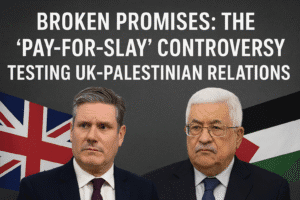
Broken Promises: The “Pay-for-Slay” Controversy Testing UK-Palestinian Relations
The British government’s landmark decision to recognise a Palestinian state was heralded as a historic step toward peace, but it was underpinned by a critical, if less publicised, condition: the Palestinian Authority (PA) must end its longstanding practice of paying stipends to individuals imprisoned for acts of violence against Israelis and their families. Now, mounting evidence suggests these “terror salaries” are continuing, creating a crisis of credibility that threatens to undermine the nascent diplomatic relationship and the very reform agenda upon which recognition was premised .
This emerging contradiction places Prime Minister Keir Starmer in a difficult position. Having personally welcomed PA President Mahmoud Abbas to Downing Street in September, Starmer’s administration must now reconcile the PA’s public commitments to reform with persistent reports that a system widely condemned as “pay-for-slay” remains operational through back channels . The situation presents a stark test of the UK’s diplomatic leverage and the PA’s genuine willingness to transform its governance.
The Reform Promise: A Cornerstone of Recognition
The UK’s recognition of Palestine was not an unconditional endorsement. It was explicitly tied to a “tough reform agenda” for the Palestinian Authority, with the cessation of martyr and prisoner payments being a central pillar . The logic was clear: for a future Palestinian state to be a credible partner for peace, it could not be seen to financially incentivise violence against its neighbour. The PA, led by Mahmoud Abbas, appeared to acquiesce. In February 2025, Abbas signed a decree ending the notorious Martyrs Fund, and in September, he publicly reiterated this commitment to nations like the UK and France, linking it directly to their recognition of statehood .
The Martyrs Fund, and its associated Prisoners Fund, have long been a flashpoint. Critics, including Israel, the United States, and the European Union, argue the payments—which in 2023 amounted to an estimated $30 million per month—reward terrorism and create a perverse incentive for violence . The system provided monthly “salaries” on a sliding scale based on prison sentence length, with additional stipends for families. Reports indicated families of those killed could receive up to £740 monthly, while families of prisoners could get up to £2,220 . For the UK government, demanding an end to this practice was a non-negotiable element of its diplomatic shift, framed as essential for ensuring Israel’s security and the legitimacy of a future Palestinian state .
Mounting Evidence of a Continued Scheme
Despite the decrees and promises, multiple sources now indicate that payments have not ceased; they have merely evolved. According to investigations, the PA has established a new needs-based welfare program, the Palestinian National Economic Empowerment Institution (PNEEI) . However, allegations suggest that “bypass channels” are being used to funnel payments to the same beneficiaries—prisoners and families of “martyrs”—often without them even applying through the new system . Reports indicate a payment was made as recently as October 25, 2025, using mechanisms from the old scheme .
The European Union, a major donor to the PA, has confirmed it is probing these claims. A European Commission spokesperson stated they “profoundly regret” that payments appear to have continued based on the previous scheme, which “seems to go against prior announcements” . Brussels has formally requested clarity from the PA . Israel’s government has been vocal, with Foreign Minister Gideon Sa’ar alleging the PA simply changed the delivery method, channeling funds through the Palestinian postal system . These allegations gain credence from Abbas’s own contradictory rhetoric; shortly after his February decree, he reportedly told an audience, “I will not agree… to reduce any obligation… given to them. They must receive everything, as it was in the past” .
The PA’s internal actions send mixed signals. In November 2025, Abbas fired his finance minister, Omar al-Bitar, with Israeli reports suggesting it was because he allowed payments to security prisoners to continue outside the new PNEEI system . While this could be interpreted as a crackdown on violators, critics like Israeli officials see it as a tacit admission that the practice persists and an attempt to deflect blame .
A Test for UK Diplomacy and Leverage
This controversy strikes at the heart of the UK’s diplomatic strategy. Recognition was intended to be a lever for reform, not merely a symbolic gesture. The Starmer administration has outlined a comprehensive set of demands for the PA, including demilitarisation, educational reform to remove antisemitic content, and the holding of elections, with the end of “pay-for-slay” being fundamental . The UK’s special envoy, Sir Michael Barber, has been deeply involved in pushing this reform agenda .
The emerging evidence of continued payments thus represents a direct challenge to the UK’s authority and the seriousness of its conditional recognition. Backbench pressure is already building. Luke Akehurst, Labour MP and supporter of Labour Friends of Israel, has accused the PA of making promises to Western governments only to “quietly abandon[]” them, warning that this failure “bodes badly for the range of other necessary reforms” . If the PA is seen to renege on this flagship commitment, it will fuel scepticism—prevalent in parts of the British Jewish community and the political opposition—that recognition was premature and granted without sufficient leverage .
The UK’s position is further complicated by its own legal and historical obligations. In a parallel but symbolically significant arena, the High Court recently quashed the Foreign Office’s refusal to help a Palestinian family with UK entry clearance leave Gaza, calling the decision “irrational” . This ruling underscores the UK’s operational responsibilities to individuals amidst the conflict. On a broader historical plane, Palestinian petitioners are simultaneously urging the UK to address colonial-era war crimes committed during the British Mandate, arguing that recognition “alone does not deal with all these historic problems” . This multilayered context means the UK’s relationship with Palestinian rights is scrutinised across both contemporary ethical dilemmas and historical redress.
The Stubborn Reality of Palestinian Politics
Understanding why the PA might risk international condemnation over these payments requires delving into their entrenched role in Palestinian society. As detailed in analyses of the Martyrs Fund, these payments are “exceedingly popular” and have become “sacred in Palestinian politics,” with support among Palestinians as high as 91% . They are not viewed by many Palestinians as rewards for terrorism, but as a necessary social welfare system for families who have lost breadwinners to the conflict, whether they were militants or civilians killed in clashes.
The PA, which faces severe legitimacy challenges and competition from Hamas, risks significant domestic backlash if it is perceived as capitulating to Western and Israeli pressure by cutting off this support. The firing of Qadura Fares, the head of the detainees’ affairs commission who opposed abolishing the fund, and Hamas’s condemnation of that move, highlight the internal political tensions . Replacing the old fund with PNEEI may be a genuine, if flawed, attempt to transition to a needs-based system that complies with international demands while still providing for a vulnerable constituency. However, the alleged use of “bypass channels” suggests a attempt to have it both ways: satisfying international donors with a new legal framework while maintaining the old network of patronage and support.
The Path Forward: Audit, Accountability, and Sustained Pressure
The immediate next step is the audit commissioned by the PA, scheduled to begin in January, which promises “verification to assess that no parallel payment schemes are in place” . The credibility of this audit will be paramount. The European Commission has emphasised that EU funds—which provide vital direct budget support to the PA—are not used for these contested payments and are subject to strict controls . Future financial aid is explicitly conditional on the implementation of reforms, including the full dismantling of the martyr payment system .
For the UK government, the course is delicate but clear. It must use its newly established diplomatic channels to insist on transparent and verifiable compliance. This involves moving beyond accepting declaratory decrees and demanding demonstrable proof that the old system is defunct. The UK’s ability to follow through on its stated framework for peace—which includes the complete removal of Hamas from Gaza and the establishment of a demilitarised Palestinian state—now hinges on its capacity to hold the PA accountable on this first, major test .
The “pay-for-slay” controversy is more than a bilateral dispute; it is a microcosm of the larger challenges facing the two-state solution. It touches on issues of incitement, security, governance, and the profound lack of trust between the parties. The UK has bet its Middle East policy on the premise that recognition can catalyse reform. If the PA allows this promise to unravel over the martyr payments, it will not only damage its relationship with London but will also vindicate those who argue that the foundations for a viable, peaceful Palestinian state are not yet in place. The world is watching to see whether this is a case of bureaucratic inertia and political difficulty or a fundamental breach of faith. The answer will significantly shape the troubled journey toward peace.
You must be logged in to post a comment.