
Broken Dreams and Divided Faiths: The Human Cost Behind a Medical College’s Sudden Closure
In January 2026, the National Medical Commission (NMC) abruptly withdrew permission from the Shri Mata Vaishno Devi Institute of Medical Excellence, forcing its first batch of 50 MBBS students to leave, citing serious infrastructure and faculty deficiencies. However, the closure was engulfed in controversy as it followed protests by right-wing groups over the batch’s demographic composition—42 of the 50 students admitted through national merit were Muslim—leading to allegations that the regulatory action was politically influenced rather than purely administrative. While the Jammu and Kashmir government pledged to accommodate the displaced students in other colleges, the incident highlighted a collision of regulatory standards, merit-based admissions, and identity politics, raising profound concerns about the secular foundations of education and setting a troubling precedent for the politicization of academic institutions in India.
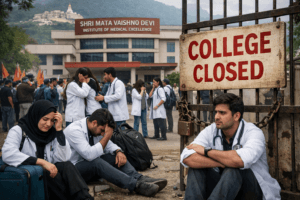
Broken Dreams and Divided Faiths: The Human Cost Behind a Medical College’s Sudden Closure
In January 2026, 50 aspiring doctors at the Shri Mata Vaishno Devi Institute of Medical Excellence (SMVDIME) in Jammu and Kashmir packed their dreams alongside their belongings. Their medical education, which had barely begun, was abruptly terminated by regulatory action, leaving in its wake a complex story of administrative failure, political polarization, and shattered aspirations. This incident transcends a simple college closure; it exposes deep fault lines in how merit, faith, and governance collide in modern India.
The Regulatory Rationale: Deficiencies in Black and White
The National Medical Commission (NMC) formally withdrew the college’s Letter of Permission (LoP) based on a surprise inspection conducted on January 2, 2026. The findings, detailed in the Medical Assessment and Rating Board’s (MARB) report, painted a picture of an institution far below mandated standards.
The inspection revealed systemic failures across critical areas:
| Deficiency Area | Shortfall Found | Regulatory Requirement |
| Teaching Faculty | 39% shortfall | Full complement as per norms |
| Tutors & Senior Residents | 65% deficiency | Full complement as per norms |
| Hospital Bed Occupancy | 45% occupancy | Minimum 80% occupancy |
| Library Books | 744 books available | Minimum 1,500 books |
| Functional Operation Theatres | 2 functional | Requirement of 5 |
| Monthly Deliveries | ~25 per month | Termed “grossly deficient” |
According to the NMC Chairperson, the initial LoP had been granted based on a virtual hearing, but credible complaints later prompted the physical inspection. The regulator stated that allowing the college to continue would “jeopardise the education of the innocent students”. Invoking its powers under the NMC Act, 2019, the commission not only withdrew permission but also decided to encash the performance bank guarantee furnished by the college.
The Political Firestorm: Merit, Faith, and “Unacceptable” Demographics
Parallel to the regulatory process, the college had become the epicenter of a heated political and social controversy. The trigger was the composition of its inaugural MBBS batch. Of the 50 students admitted through the National Eligibility-cum-Entrance Test (NEET), 42 were Muslim.
This outcome, a product of merit-based, centralized counselling with no religious quotas, was perceived as a problem by some groups. Right-wing organisations, including the BJP-supported Shri Mata Vaishno Devi Sangharsh Samiti, protested. They argued it was unjust for a shrine-run institution, funded by offerings from Hindu devotees, to have a predominantly Muslim student cohort. Initial demands to cancel the admissions escalated to calls for the college’s complete closure.
The political reaction was starkly divided. Members of the Sangharsh Samiti distributed sweets and celebrated the NMC’s order as a victory. BJP leaders welcomed the move, framing it as “quality over quantity”. Conversely, Jammu and Kashmir Chief Minister Omar Abdullah defended the admissions, stating, “Those children worked hard to get their seats. No one did them any favour”. He later said that if the atmosphere made the institution unsafe for students, it should be shut down.
The Constitutional Conundrum: Can Hindus Be a Minority?
Beneath the immediate controversy lies a profound constitutional question pertinent to Jammu and Kashmir: Can Hindus claim minority status? As noted by commentators, while Hindus are a majority nationally, they are a demographic minority within the Union Territory of Jammu and Kashmir.
This territorial definition of minority status, upheld by the Supreme Court, opens a potential legal pathway. A Hindu-run institution in J&K could, in principle, seek formal recognition as a minority educational institution under Article 30 of the Constitution. This would allow it to design an admission policy that includes a reserved share for Hindu students, while still adhering to NEET merit and without excluding others entirely. A precedent exists in the Acharya Shri Chander College of Medical Sciences in Jammu, which operates with a notified Hindu minority quota.
However, this status must be established proactively through proper governance, not claimed retroactively after a contentious admission list. As one analysis points out, seeking minority status only after protesting an “unacceptable” merit list risks appearing as a “retrofit” of constitutional principles to satisfy a communal demand.
The Human Cost: Dreams Deferred and Futures in Limbo
Beyond the regulations and politics are the 50 students whose lives have been upended. For many, like Bilkis from Budgam, this was a chance to become the first doctor in their family. Others, like Saqib from Kulgam, spoke of the “unmatched joy” their NEET success brought their households.
Students expressed shock and a sense of betrayal. They questioned the timing and severity of the decision, with some insisting the facilities were excellent. “How can they say that college is closed because it lacks facilities? We have been in distress,” said student Aleena. Another, Ashiya from Srinagar, worried they would never find comparable facilities or camaraderie elsewhere.
Importantly, students from both communities inside the campus reported a united academic environment. “No one within the premises discussed anyone’s religion,” said Manit, a Hindu student from Udhampur. They were bound by the rigors of their medical course, not religious identity.
The government has directed that all 50 students be accommodated in other medical colleges in Jammu and Kashmir as supernumerary seats, ensuring no one loses their MBBS chance. Chief Minister Omar Abdullah confirmed this was feasible. Yet, the disruption is real. The academic session had already started two months late, and further delays threaten to put these students permanently behind.
Broader Implications and a Warning for the Future
The closure of SMVDIME reduces the total number of medical colleges in Jammu and Kashmir to 12, cutting 50 precious MBBS seats from a region in need of more healthcare professionals. This loss of capacity is a significant setback.
The episode has raised alarms about a dangerous precedent. Former Chief Minister Mehbooba Mufti warned that politicizing education on religious lines could encourage similar moves elsewhere in India. She questioned what would happen to Muslim youth in other states if they could be excluded from educational spaces in their own region.
The affair tests the balance between three core principles: regulatory integrity, meritocratic fairness, and minority rights. The ideal path forward, as suggested by analysts, would involve a clear sequence: first, rectifying any genuine deficiencies to meet regulatory standards; second, if desired, the institution transparently defining its character (general or minority) through proper legal channels; and third, conducting future admissions on a clean, constitutionally sound slate that respects both merit and lawful minority protections.
Conclusion: A Crossroads for Educational Ethos
The shuttering of the Vaishno Devi medical college is more than an administrative action. It is a microcosm of contemporary India’s tensions. It highlights the imperative of uncompromising standards in critical fields like medical education. Simultaneously, it reveals how quickly meritocratic achievements can be engulfed by identity-based politics, and how the constitutional machinery can be perceived as a tool for majoritarian or minoritarian agendas, depending on one’s perspective.
The ultimate tragedy, as poignantly noted, is not that a shrine-run college admitted Muslim students on merit, but “that some chose to celebrate the burning of public capacity because merit produced an outcome they disliked”. The futures of 50 students are now in flux, and the region has lost vital educational infrastructure. As Jammu and Kashmir moves forward, this episode serves as a stark reminder that for a diverse society to thrive, faith must be respected in its proper sphere, merit must be protected in education, and constitutional pathways must be preferred over polarization. The healing of this rift, much like the training of a good doctor, will require careful, principled, and compassionate treatment.
You must be logged in to post a comment.