
Bridging Worlds: How Awaneesh Verma’s Multicultural Journey is Shaping the Future of Human Connection
Awaneesh Verma, the Google executive behind Google Meet, channels his childhood experience of navigating between British and Indian cultures into a mission to eliminate global communication barriers. His personal journey from being “the only Indian kid” in his Sheffield classroom to leading products for billions of users fuels a drive to build technology that fosters genuine understanding, not just connection.
Under his direction, innovations like AI-powered meeting notes and real-time voice translation—which clones a speaker’s voice into another language—aim to preserve the nuance of human conversation and combat meeting fatigue. Verma’s work exemplifies a core belief: that the highest purpose of technology is to neutrally bridge divides, allowing ideas and collaboration to flow freely across the cultural and linguistic boundaries that once defined his own world.
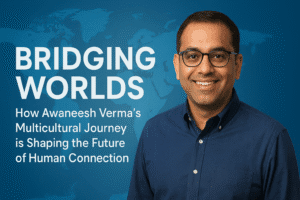
Bridging Worlds: How Awaneesh Verma’s Multicultural Journey is Shaping the Future of Human Connection
In an era defined by global teams and digital nomads, the quest for seamless communication is more than a technical challenge—it’s a deeply human one. At the forefront of this mission is Awaneesh Verma, the Senior Director of Product for Real-Time Communication at Alphabet, who leads Google Meet, Google Voice, and other platforms connecting billions. His drive to eliminate friction and foster true understanding is not just corporate strategy; it’s a philosophy forged in the lived experience of navigating between cultures and languages .
Verma’s story is a powerful testament to how personal identity can shape technological ambition. Born in the UK to Indian immigrant parents and raised in Sheffield where he was often “the only Indian kid in my class,” Verma developed an early, acute awareness of being an insider and an outsider simultaneously . This unique position, rather than being a barrier, became his foundational lens—a perspective that now informs the development of tools used by 3 billion users and 11 million companies worldwide. His childhood fascination with a physical atlas, imagining distant places, has evolved into building the very digital infrastructures that make those places instantly accessible .
The Personal Compass: From Cultural Bridges to Digital Ones
Verma’s professional path is a direct extension of his personal curiosity. As an engineering student at Carnegie Mellon, a talk by Google’s Alan Eustace about projects like Google Translate was a revelation: “I was like, ‘Wow, this is the future of connecting people’” . This moment crystallized a lifelong interest in travel and cultural exchange into a tangible mission. His subsequent roles—working on Google Translate, becoming Duolingo’s first head of product, a leadership stint at Uber, and his return to Google—are not random career moves. They are stepping stones in a consistent pursuit: leveraging technology to dissolve the barriers he once felt personally.
This narrative resonates with broader observations about technology’s role in cultural exchange. The digital revolution has fundamentally transformed communication, shifting it from linear, one-way channels to complex, interactive networks . Platforms like those Verma oversees are central to this shift, enabling the real-time, multi-directional exchange that defines modern work and social life . Yet, as Verma’s childhood experience highlights, connection requires more than just a pipeline; it requires understanding.
Beyond Translation: Engineering Empathy and Fidelity
Under Verma’s leadership, the innovation at Google Meet is moving far beyond simple video conferencing. The goal is to preserve the “high fidelity of human conversation, including tone and emotion” . This is evident in two groundbreaking suites of features: AI-powered collaboration aids and real-time speech translation.
AI as a Collaborative Partner: Verma is a hands-on beta-tester, using tools like “Take Notes with Gemini” in all his meetings . With a click, AI generates live notes and transcripts that become a team’s “decision of record.” This isn’t just about convenience; it’s about building organizational trust and efficiency. He recounts an instance where a third of his team in Stockholm confidently skipped a meeting with Bay Area executives, trusting that the AI-generated record would accurately capture their stance . This transforms meetings from ephemeral events into durable, actionable knowledge. Furthermore, by cross-referencing human debriefs with AI-generated summaries, teams can resolve discussions faster and with greater clarity, as Verma did by distilling a 60-minute engineering chat into a concise 15-point spec .
The “Uncanny” Breakthrough of Real-Time Voice Translation: Perhaps the most vivid example of Verma’s vision comes from Google’s real-time speech translator, demonstrated by colleague Niklas Blum. A journalist hears Blum speaking German, and with a slight delay, hears Blum’s own voice cloned and speaking in English . This is a quantum leap from text translation. It involves multiple layers of AI working in concert: translating meaning, accounting for linguistic structure (like German’s end-of-sentence verbs), and generating a synthetic voice that retains the speaker’s identity .
This technology, developed over two years in collaboration with DeepMind, addresses a core pain point for global businesses. As Blum notes, it was “really hard” to conduct multi-language team conversations while ensuring correct information flow . The ambition, therefore, is for Google Meet to be more than a connection tool—it must “create value in the conversation” itself .
The Deeper Imperative: Solving for Human Fatigue
The driving force behind these innovations is not merely technological prowess but a urgent human need: combating “meeting fatigue” . The post-pandemic proliferation of often-ineffective virtual meetings has left a universal sense of exhaustion and ambiguity. Verma’s team filters every improvement through a simple, user-centric question: “how could we have helped them do this better?” .
This aligns with a wider corporate ethos at Google, which, despite recent shifts in some policies, maintains a mission to “organize the world’s information and make it universally accessible and useful” . It also reflects a growing recognition across the tech industry that removing communication barriers is essential for business success. Studies have shown that language misunderstandings can derail international deals, and inclusive practices that aid communication for people with disabilities correlate with stronger company performance .
The Beauty and the Caution: Technology in a Cultural Tapestry
Verma sees the “beauty of technology” in its potential to neutrally represent what was said, building trust in cross-cultural dialogue . This vision is part of a larger digital transformation where social media and streaming platforms have become arenas for global cultural exchange, from K-pop to social movements . Technology can empower marginalized communities, as seen in Indigenous groups using digital tools to preserve languages, or platforms showcasing minority-owned businesses .
However, the search results also sound important cautions that contextualize Verma’s work. Technology can risk cultural homogenization, where dominant cultures overshadow local traditions . Furthermore, AI systems themselves, including large language models, often harbor a Western and Anglo-centric bias, lacking true “meta-cultural competence”—the ability to adapt to unseen cultural contexts . The real-time translator must navigate not just grammar, but also cultural nuance and context, which remain profound challenges . As Microsoft UK COO Clare Barclay notes, automatic translation doesn’t automatically confer an understanding of cultural implications .
Conclusion: A Human-Centric Future of Connection
Awaneesh Verma’s journey from a child pondering an atlas in Sheffield to a leader shaping global communication mirrors the evolution of the digital age itself: from observing boundaries to actively dissolving them. His work on Google Meet exemplifies the next chapter of this evolution, where AI moves from being a passive tool to an active facilitator of human understanding, aiming to capture not just words, but intent and emotion.
The ultimate insight from his story is that the most powerful technologies are those infused with human experience. The “beauty of technology” that Verma champions is not an end in itself, but a means to fulfill a timeless human desire: to truly understand and be understood, regardless of where we are born or what language we first speak . In building bridges across digital and cultural divides, the goal remains profoundly simple—to ensure that no one has to feel like “the only kid in the class.” The future of connection depends not just on smarter algorithms, but on the wisdom of those, like Verma, who have lived in the spaces between.
You must be logged in to post a comment.