
Border Denial Diplomacy: How Canada-Israel Tensions Erupted at the West Bank Gate
Border Denial Diplomacy: How Canada-Israel Tensions Erupted at the West Bank Gate
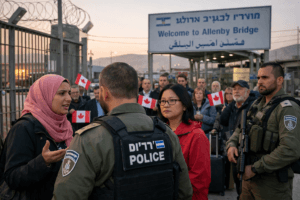
In the early hours of December 16, 2025, a group of 30 Canadians, including six sitting members of Parliament, found themselves in a familiar limbo for many seeking to enter the West Bank: detained for hours at the Israeli-controlled Allenby Bridge crossing from Jordan. Despite holding pre-approved electronic travel authorizations, the entire delegation was turned back, declared a threat to “public security or public safety or public order”. What unfolded was not merely a border refusal but a stark, public collision between diplomatic allies, revealing deep fissures in Canada-Israel relations and the intensifying global struggle over narrative, access, and sovereignty in the occupied Palestinian territories.
The Delegation and the Denial: Conflicting Narratives
The delegation, organized by the non-profit The Canadian-Muslim Vote (TCMV), described its mission as a fact-finding visit. The itinerary included meetings with Palestinian Authority officials, Palestinian refugees, and interfaith advocates—Jewish, Muslim, and Christian—aimed at witnessing the daily realities in the West Bank. For the participating MPs, it was a chance to gather firsthand observations to inform their parliamentary work.
Israel’s justification for the denial has been twofold, articulated primarily through its ambassador to Canada, Iddo Moed:
- An Organizational “Link” to Terrorism: Ambassador Moed stated the denial was due to TCMV’s funding links to Islamic Relief Canada, a subsidiary of Islamic Relief Worldwide (IRW). Israel designated IRW as a terrorist entity in 2014. Moed argued this link “raised red flags” and necessitated further questioning at the border, which he claimed the delegation refused to cooperate with.
- A Procedural Failure: The Israeli military agency COGAT (Coordinator of Government Activities in the Territories) offered a separate, more administrative reason, stating the group arrived “without prior coordination”.
The delegation and its supporters forcefully reject both claims. They counter that all members had valid Israeli-issued electronic travel authorizations (ETA), and the Canadian government had notified Israeli authorities of the trip in advance. They highlighted that a similar TCMV-sponsored delegation with five MPs visited without incident in January 2024, questioning what had genuinely changed.
The Conflicting Official Positions
| Party | Primary Stated Reason for Denial | Counter-Argument from Delegation/Canada |
| Israeli Government | 1. Delegation organizers linked to a terrorist entity (IRW). | Islamic Relief Canada is a legally registered Canadian charity, not listed as a terror entity by Canada, and has received Canadian government grants. |
| 2. Group arrived “without prior coordination”. | Electronic Travel Authorizations were pre-approved, and Canada’s government had provided advance notice. | |
| Canadian Delegation | Denied entry as “public safety threats”. | The claim is rejected as baseless for elected officials and civil society on a peaceful fact-finding mission. |
| Canadian Government | – | Expressed “objections regarding the mistreatment” of its citizens. Noted Israel controls access and sets its own entry rules. |
Allegations of Mistreatment and the Question of “What Are They Trying to Hide?”
The incident escalated from a diplomatic disagreement to a personal confrontation with allegations of physical mistreatment. Liberal MP Iqra Khalid reported being shoved multiple times by an Israeli border officer.
According to Khalid’s account, she stepped closer to observe the questioning of a young female delegate when an officer yelled at her, pushed her into a wall, and, when she said “Don’t touch me,” replied, “I’ll touch you as much as I want” before pushing her again. NDP MP Jenny Kwan witnessed the event and corroborated the account.
This experience led delegates to a pointed and recurring question: “What are they trying to hide?”. They framed the denial not as a security necessity but as a deliberate obstruction to prevent independent witnesses from observing conditions in the West Bank, where reports of settlement expansion and settler violence have surged. “If people cannot witness [what is happening],” said MP Jenny Kwan, “then misinformation and disinformation will continue”.
A Diplomatic Relationship Under Strain
This border incident did not occur in a vacuum. It is a symptom of a significant and ongoing recalibration of Canada’s Middle East policy. For decades, Canada was regarded as one of Israel’s staunchest Western allies. However, in September 2025, the Canadian government announced its recognition of an independent Palestinian state, joining a cohort of European nations.
The Israeli reaction to that move was swift and severe. Prime Minister Benjamin Netanyahu accused Canada of trying to “shove a terror state down our throats”. Against this backdrop, the delegation’s denial is viewed by many analysts as a direct diplomatic signal. Stephen Brown, CEO of the National Council of Canadian Muslims, called it part of a “broader pattern” of restricting access.
The Canadian government’s response has been measured but firm. Foreign Affairs Minister Anita Anand stated her department expressed objections regarding the “mistreatment” of the Canadians. However, Global Affairs Canada also clarified that as the delegation was traveling privately and Israel controls the border, “the Government of Canada cannot intervene in these decisions”. This underscores a core tension: Canada’s objection to the treatment of its citizens versus its recognition of Israel’s de facto control over access to the West Bank—a control that much of the international community, as reflected in a recent multi-nation joint statement, considers part of an illegal occupation.
Broader Implications: Sovereignty, Scrutiny, and Shifting Alliances
The standoff at the Allenby Bridge encapsulates several critical, interconnected issues in contemporary international affairs:
- The Battle Over Access and Narrative: Controlling who sees what in conflict zones is a powerful tool. By barring lawmakers, Israel has sparked a debate about transparency and the right of foreign officials to conduct independent observation. This action risks reinforcing the very narratives the delegation sought to investigate.
- The Weaponization of “Security”: The event highlights how broadly defined “security” concerns can be used to justify sweeping actions, from barring delegations to, as critics argue, justifying settlement expansion. The recent non-UN joint statement condemned new Israeli laws aiming to impose sovereignty over the West Bank as violations of international law.
- The Erosion of Traditional Alliances: The public friction between Ottawa and Tel Aviv marks a notable shift. Israel’s ambassador insisted the country welcomes critics but draws the line at perceived terror links. However, Canada’ recognition of Palestine and its reaction to this incident suggest a partnership that is becoming increasingly conditional and transactional, rather than rooted in unwavering solidarity.
- The Plight of the “Everyday Person”: As MP Iqra Khalid noted, if elected officials are treated this way, “I can only wonder how people crossing that border are being treated at any given time”. The incident serves as a stark, high-profile example of the restrictive and often opaque regime of movement control that Palestinians and their advocates routinely face.
Conclusion: A Crossing Point in More Ways Than One
The denial of entry to the Canadian delegation is more than a logistical footnote. It is a microcosm of a larger geopolitical struggle. It touches on raw questions of sovereignty, occupation, and law; on the tactics used to manage international scrutiny; and on the painful evolution of long-standing diplomatic relationships.
For Canada, the incident presents a dilemma: how forcefully to defend the rights of its parliamentarians without escalating a diplomatic rift. For Israel, it represents a calculated assertion of its border authority and security paradigm, albeit at a significant public relations cost. And for the international community, it is a case study in how the protracted Israeli-Palestinian conflict continues to disrupt global diplomacy, turning a bridge crossing into a flashpoint for much deeper tensions. The gates at Allenby Bridge did not just turn back 30 visitors; they revealed a doorway into the current, contentious state of international relations in the Middle East.
You must be logged in to post a comment.