
Bondi’s Tragedy: A Deadly Attack, a Political Firestorm, and a Nation’s Resolve
The December 14, 2025, mass shooting at a Hanukkah festival on Sydney’s Bondi Beach, which killed 16 people and injured 42, triggered a complex national crisis involving grief, security failures, and international political conflict. In its immediate aftermath, Israeli Prime Minister Benjamin Netanyahu launched a sharp personal attack on Australian Prime Minister Anthony Albanese, accusing his government of fueling antisemitism through its recognition of a Palestinian state and demonstrating weak leadership.
Albanese deflected this geopolitical blame game, focusing instead on domestic unity and condemning the act as one of terror and antisemitism, while simultaneously confronting significant security lapses that failed to prevent the attack despite one assailant being known to intelligence services. The tragedy, marked by both profound loss and the heroic intervention of a Muslim bystander who disarmed a gunman, exposed critical vulnerabilities in Australia’s gun laws and highlighted the intense challenge of maintaining social cohesion when overseas conflicts violently spill onto domestic soil.
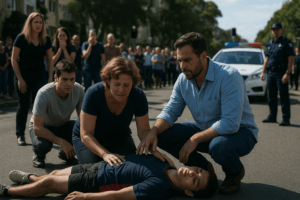
Bondi’s Tragedy: A Deadly Attack, a Political Firestorm, and a Nation’s Resolve
In the shadow of a world-famous beach, a festival of light was shattered by gunfire, exposing deep fractures in a nation’s social fabric and igniting a geopolitical blame game that reached from Sydney to Jerusalem.
The attack at Bondi Beach on December 14, 2025, was a moment of profound national trauma for Australia. What began as a joyful Hanukkah celebration for nearly 1,000 people at Archer Park descended into one of the deadliest acts of violence in the country’s modern history. With 16 lives lost and 42 injured, the shooting instantly became a horrific landmark—the second-deadliest mass shooting in Australian history and its deadliest terror incident. Yet, in the immediate, raw aftermath, as a nation grieved, a parallel narrative erupted on the international stage. Israeli Prime Minister Benjamin Netanyahu launched a stinging personal and political critique at Australian Prime Minister Anthony Albanese, accusing his government of weakness and of fueling the antisemitism that led to the massacre. This confluence of local tragedy and global political conflict reveals a crisis with multiple dimensions: a failure of domestic security, a test of national unity, and a stark illustration of how overseas conflicts are violently imported onto Western soil.
The Victims: Faces Behind the Numbers
The brutality of the attack lies in its deliberate targeting of a community at a moment of celebration. The shooters, a father and son dressed in black, opened fire on the crowd from a pedestrian bridge, firing approximately 50 gunshots into the gathering below. The victims were not anonymous statistics; they were grandparents, children, community pillars, and newcomers embracing Australian life.
The following table details some of the individuals whose lives were tragically cut short:
| Victim | Age | Background | Details |
| Matilda Britvan | 10 | Young student from a family of Ukrainian migrants | Described as a “bright, joyful, and spirited child”; was celebrating Hanukkah with her family. |
| Alex Kleytman | 87 | Holocaust survivor from Ukraine | Reportedly died while shielding his wife, Larissa, from bullets. |
| Eli Schlanger | 41 | British-born assistant rabbi, father of five | A community leader who had traveled to Israel after the October 7 attacks; known for his message of joy and defiance against hate. |
| Dan Elkayam | – | French national and IT analyst | A passionate soccer player for a local club who loved the Australian way of life; had been living in Sydney for several years. |
| Yaakov Levitan | – | Rabbi and secretary of the Sydney Beth Din | Was handing out religious items at the event; remembered as a “bright light” and dedicated helper in the community. |
| Peter “Marzo” Meagher | – | Retired police detective and rugby club volunteer | Working as a freelance photographer at the event; served nearly 40 years in the NSW Police Force. |
The injured, 27 of whom remained hospitalized the following day with six in critical condition, represented a similar cross-section of the community. In response to an urgent call for blood donations, Sydneysiders queued for over six hours, crashing the donation service’s website in an overwhelming display of solidarity. As one donor in line poignantly stated, the attack could not be justified by events overseas: “They cannot justify [it] by saying there are dead children over there, so a… little girl should die here on the beach”.
Netanyahu’s Accusation: Geopolitics in a Time of Grief
While Australia was still in shock, Israeli Prime Minister Benjamin Netanyahu seized the moment to deliver a blistering political rebuke. In an address, he directly laid responsibility at the feet of Anthony Albanese, accusing the Australian leader of pouring “fuel on the antisemitism fire” by recognizing a Palestinian state. He framed the attack as a direct consequence of Australian policy and leadership failure.
“I call upon you to replace weakness with action, appeasement with resolve. Instead, prime minister, you replaced weakness with weakness and appeasement with more appeasement,” Netanyahu declared.
This was not an isolated comment. Israeli Foreign Minister Gideon Sa’ar echoed the sentiment in a call with his Australian counterpart, Penny Wong, criticizing a perceived surge in antisemitic rhetoric in Australia since the Gaza war began in October 2023. This narrative posits a direct, causal link between Western governments criticizing Israeli military actions or advancing Palestinian diplomacy and violent attacks on Jewish citizens in their own countries.
In stark contrast, Prime Minister Albanese’s response was deliberately measured and focused on domestic unity. Facing the media, he avoided engaging with Netanyahu’s provocation. “This is a moment for national unity,” he stated, flanked by state leaders and police. He described the attack as “an act of pure evil, an act of terror and an act of antisemitism,” and urged Australians to light candles in their windows at 6:47 PM—the time the attack began—as a symbol of solidarity. This dichotomy highlights a fundamental clash in crisis response: one leveraging tragedy for geopolitical argument, the other seeking to bind a wounded nation together.
Security Failures and the Path to Reform
The identity of the attackers exposed significant gaps in Australia’s renowned security and gun control frameworks. The assailants were a 50-year-old father and his 24-year-old son. The father, who arrived in Australia on a student visa in 1998, held a recreational hunting license and legally owned six firearms. The son was an Australian-born citizen who had previously come to the attention of the Australian Security Intelligence Organisation (ASIO).
Crucially, ASIO had assessed the younger man and determined “there was no indication of any ongoing threat or threat of him engaging in violence”. This assessment proved catastrophically wrong. Police later found homemade bombs in a car belonging to the attackers, indicating a level of planning that went undetected. The revelation triggered an immediate political and policy reckoning.
Prime Minister Albanese announced he would put tougher gun laws on his cabinet’s agenda, specifically considering limits on the number of firearms an individual can own. This move is profound in a nation whose identity was reshaped by gun control. After the 1996 Port Arthur massacre, Australia enacted some of the world’s strictest firearm regulations, which led to a dramatic and sustained decline in gun violence. However, the number of legally held guns has quietly crept back up to over four million, exceeding pre-Port Arthur levels. The Bondi attack has brutally demonstrated that existing laws, however strict, have evident loopholes—such as the recreational license used by the attacker—that can be exploited with deadly intent.
A Hero’s Intervention and a Community’s Response
Amid the horror, a single act of extraordinary courage emerged as a beacon of hope and a powerful symbol of unity. Ahmed al Ahmed, a 43-year-old father of two and a fruit shop owner from Sydney’s Sutherland Shire, was captured on video tackling one of the gunmen from behind, wrestling away his rifle, and pointing it back at him. During the struggle, he was shot twice by the second gunman but survived after surgery.
His actions were hailed universally. NSW Premier Chris Minns called him a “genuine hero,” stating unequivocally that his bravery saved many lives. In a remarkable and telling moment, Benjamin Netanyahu also praised Ahmed, specifically noting, “We saw an action of a brave man — turns out a Muslim brave man, and I salute him”. Even U.S. President Donald Trump commended the “very, very brave person” from the White House.
Ahmed’s heroism stood in sharp contrast to the divisive political rhetoric. It was a spontaneous, human response that cut across the very religious and political lines the attackers sought to exploit. Furthermore, Australian Muslim communities were quick and unequivocal in their condemnation of the attack. The Australian National Imams Council stated the violence was “an attack on all of us” and urged Muslims to reach out and support their Jewish neighbors. This grassroots solidarity represents the antithesis of the hatred that fueled the attack and the political division that followed.
Healing a Divided Nation: The Road Ahead
The Bondi Beach shooting has left Australia at a crossroads. The immediate tasks are clear: supporting the victims and their families, rigorously investigating the security failures, and tightening gun laws. However, the deeper challenge is navigating the politicization of trauma and healing the social divisions that the attack both revealed and exacerbated.
Prime Minister Albanese’s call for unity and his focus on domestic cohesion is a direct attempt to steer the national conversation away from Netanyahu’s geopolitical framing. The risk for Australia is that the trauma of Bondi becomes a tool in a foreign conflict, further polarizing communities at home. The strength of the response will be measured not only in new legislation but in the nation’s ability to reject imported hatred and uphold the shared civic identity so powerfully embodied by bystanders like Ahmed al Ahmed and the diverse citizens standing in line to donate blood.
The final lesson from Bondi is a grim one for all liberal democracies: in an interconnected world, conflicts abroad can ignite violence at home with terrifying speed. Combating this requires more than intelligence and laws; it demands political leaders who, in times of crisis, choose to build bridges for their own citizens rather than burn them for an overseas audience. Australia’s resilience is now being tested not just by the evil of the attack itself, but by the difficult task of defining its meaning on its own terms.
You must be logged in to post a comment.