
Bondi Beach Attack: How a Tragedy Redefined the Line Between Protest and Incitement
In the aftermath of the Islamic State-inspired Bondi Beach massacre that targeted a Jewish Hanukkah celebration in Sydney, killing 15 people, authorities in Australia and the United Kingdom have enacted swift and controversial restrictions on pro-Palestinian protests, specifically banning chants of “globalize the intifada.” New South Wales introduced expanded police powers to shut down unauthorized protests and proposed new hate speech laws, while UK police began arresting individuals for using the slogan, arguing the terror attack had fundamentally changed the context and that such language now constituted a public order threat.
While major Jewish groups have welcomed the moves as necessary for community safety, civil liberties advocates and some protesters warn the measures dangerously conflate political speech with criminal incitement, collapsing legitimate protest into security threats and setting a precarious precedent for free expression in volatile times.
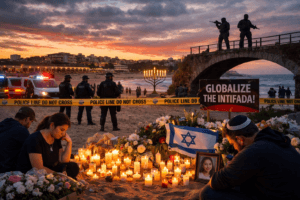
Bondi Beach Attack: How a Tragedy Redefined the Line Between Protest and Incitement
The devastating attack on a Hanukkah celebration at Sydney’s Bondi Beach has done more than shatter a community; it has triggered a fundamental reassessment of political speech and public safety in democracies half a world away. In the wake of the massacre that killed 15 people, authorities in Australia and the United Kingdom are enacting unprecedented restrictions, most notably on the pro-Palestinian chant “globalize the intifada.” This swift legislative and policing shift represents a pivotal moment, forcing societies to grapple with a harrowing question: when does political sloganism cross into dangerous incitement?
The Attack That Changed the Context
On the evening of December 14, 2025, a community event marking the first night of Hanukkah at Sydney’s iconic Bondi Beach turned into Australia’s deadliest mass shooting in nearly 30 years. Two gunmen, identified as 50-year-old Sajid Akram and his 24-year-old son Naveed, opened fire on the crowd of approximately 1,000 people. The attackers, positioned on a small bridge overlooking the celebration, showed a chilling disregard for their victims, who ranged in age from 10 to 87 years old.
The investigation quickly pointed to a terror motive. Australian Federal Police Commissioner Krissy Barrett stated the attack was “inspired by Islamic State,” a finding supported by the discovery of homemade IS flags and improvised explosive devices in the suspects’ vehicle. Authorities also revealed the pair had traveled to Davao in the Philippines for nearly the entire month of November, with investigations ongoing into whether they received militant training there.
The human toll was profound. Among the dead were a British-born rabbi, a Holocaust survivor, a retired police officer, and a young girl named Matilda. In the face of terror, remarkable acts of bravery emerged. Ahmed al-Ahmed, a 43-year-old Syrian-born fruit shop owner, was captured on video disarming one of the gunmen. His heroism, which left him wounded, was hailed by Prime Minister Anthony Albanese, who called him a “true Australian hero.”
The Slogan at the Center of the Storm: “Globalize the Intifada”
In response to the attack, authorities have zeroed in on a specific phrase used in pro-Palestinian protests: “globalize the intifada.” To understand the controversy, one must unpack its layered meanings.
- Linguistic Roots: The Arabic word “intifada” stems from the root n-f-ḍ, relating to “shaking off.” It translates to “uprising” or “shaking off” and entered global political lexicon through the Palestinian resistance against Israeli occupation.
- Historical Context: The term is primarily associated with two periods: the First Intifada (1987-1993), characterized by widespread protests and civil disobedience, and the Second Intifada (2000-2005), a far more violent conflict marked by suicide bombings that killed nearly 1,000 Israelis. This dual history is central to the debate—is “intifada” a call for civil resistance or armed struggle?
- The Call to “Globalize”: The slogan “globalize the intifada” urges the internationalization of this struggle. For supporters, it is a call for worldwide solidarity against oppression. For critics, it is an explicit call to export violence. As the American Jewish Committee argues, because the most prominent expressions of intifada have been violent, the phrase is “often understood by those saying and hearing it as encouraging violence against Israelis, Jews, and institutions supporting Israel.”
The slogan has been a common feature at protests worldwide since the October 2023 Gaza war, heard from New York’s Times Square to central London, and on university campuses including Harvard and Columbia.
A Swift and Sweeping Policy Response
The Bondi attack created what authorities termed a “changed context.” The following table outlines the rapid and decisive measures taken in Australia and the United Kingdom.
| Country | Key Policy Measures | Rationale & Official Statements |
| Australia (NSW) | – New police powers to shut down unauthorized protests for 3 months – Proposed ban on chanting “globalize the intifada” under revised hate speech laws – Pledge to tighten already strict national gun laws | Premier Chris Minns stated protests with violent imagery were “unleashing something… that the organizers can’t contain.” PM Albanese acknowledged a failure to act forcefully enough against hate speech pre-attack. |
| United Kingdom | – Arrests for chanting or displaying “globalize the intifada” (London & Manchester) – Enhanced policing and security funding for Jewish community sites | Police stated: “Violent acts have taken place, the context has changed — words have meaning and consequence. We will act decisively.” |
The policy shift moved from announcement to enforcement with startling speed. Within days of their announcement, London’s Metropolitan Police arrested multiple individuals at a pro-Palestinian protest for allegedly shouting slogans “involving calls for intifada.”
The Deepening Fault Lines: Security vs. Civil Liberties
The new restrictions have not been met with universal approval, exposing a deep societal rift.
- The Security Argument: Jewish community leaders have overwhelmingly welcomed the moves. The UK’s Chief Rabbi Ephraim Mirvis called the police decision “an important step towards challenging the hateful rhetoric we have seen on our streets, which has inspired acts of violence and terror.” David Ossip of the NSW Jewish Board of Deputies interpreted the chant bluntly, stating it means “kill Jews wherever you find them.” This perspective holds that in a climate of elevated threat, where rhetoric has demonstrably inspired violence, the state has a duty to act preemptively.
- The Free Speech Counter-Argument: Civil liberties groups and some progressive Jewish organizations warn of governmental overreach. The U.N. High Commissioner for Human Rights had previously cautioned that some UK protest measures appear “at odds with international human rights law.” The Palestine Solidarity Campaign’s Ben Jamal argued the police crackdown uses the “grotesque racist violence on Bondi beach” to delegitimize all protest against Israel’s actions in Gaza.
- The Practical Dilemma: Legal experts highlight the enforcement challenge. Mark Stephens of the International Bar Association noted that criminalizing a slogan is a “game of Whac-A-Mole,” predicting that if one phrase is banned, “someone will come up with something else which isn’t illegal, and that becomes the new phrase du jour.” This raises the question of whether banning words can ever address the underlying ideologies that produce them.
Looking Ahead: An Unresolved Tension
The aftermath of the Bondi Beach attack has accelerated a confrontation between two fundamental democratic values: the right to security and the right to free expression. The central, unresolved tension is whether restricting specific language is a legitimate, necessary tool for protecting vulnerable communities or a dangerous precedent that criminalizes political dissent.
This is not a theoretical debate. It involves real-world consequences:
- For Jewish communities in Sydney, London, and Manchester, it is about the ability to gather and celebrate without fear.
- For pro-Palestinian activists, it is about the ability to voice what they see as legitimate criticism of a state and solidarity with an occupied people.
- For governments, it is about maintaining public order and social cohesion in an increasingly polarized world.
The tragedy at Bondi Beach has forced these democracies to make a grim calculation. The coming months will reveal whether the new balance they have struck will enhance safety, further inflame divisions, or simply push the line of acceptable speech to a new, contested frontier. The world is watching to see if this represents a sustainable new norm or a reactive moment in a long, unresolved conflict.
You must be logged in to post a comment.