
Bloodbath on Dalal Street: Nifty Cracks Below 24,400, Sensex Plunges 1,600 Points as Iran Fears Ignite a Perfect Storm
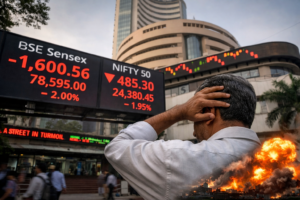
Bloodbath on Dalal Street: Nifty Cracks Below 24,400, Sensex Plunges 1,600 Points as Iran Fears Ignite a Perfect Storm
The celebratory chimes of Dalal Street were replaced by the frantic clatter of selling orders on Wednesday as a geopolitical powder keg in the Middle East detonated directly onto Indian equity markets. In a session that felt more like a controlled detonation of wealth, the benchmark BSE Sensex crashed by over 1,600 points, while the Nifty50 decisively breached the critical 24,400 level in opening trade, sending shivers down the spines of investors from Mumbai to Manhattan.
At 9:16 AM, the Nifty50 was firmly in the red, trading at 24,380.45—a brutal cut of 485 points or 1.95%. Its older counterpart, the BSE Sensex, was not far behind, hemorrhaging 1,644 points to trade at 78,594.94, a staggering drop of 2.05%. This wasn’t just a correction; it was a visceral reaction to a world teetering on the brink of a wider conflagration.
The Geopolitical Spark: From Tehran to Tel Aviv to the Trading Floor
The immediate trigger for the sell-off is a dangerous escalation in the long-simmering conflict between Israel and Iran, with the United States now seemingly drawn into the fray. Overnight reports of a “massive missile” strike by Iran on a US airbase in Bahrain, coupled with renewed Israeli bombing of Beirut, have dismantled any remaining hope of de-escalation. The situation has moved from a shadow war to a potential open confrontation, and financial markets, which abhor uncertainty above all else, are reacting with predictable panic.
The crisis took on an even more ominous tone with reports suggesting a potential succession shift within Iran’s leadership, adding a layer of political instability to an already volatile mix. The question on every trader’s lips is no longer “if” but “how long?”—and the answer to that question holds the key to the market’s near-term destiny.
The Indian Dilemma: Why This Conflict Hits Home Harder
While global markets are reeling, the sell-off in India carries a unique, palpable fear. As Dr. V.K. Vijayakumar, Chief Investment Strategist at Geojit Investments Limited, points out, the anxiety is rooted in a hard economic reality: India’s energy dependency.
“From the perspective of India, which relies on imports for around 85% of her oil requirements, the real concern is the potential inflation and its consequences on economic growth,” Dr. Vijayakumar explains. This single sentence encapsulates the nightmare scenario for the Indian economy.
Here’s why the spike in crude oil prices, triggered by the war, acts as a poison pill for India:
- The Inflationary Spiral: India is a massive importer of crude oil. When global prices surge, it directly increases the cost of everything from transportation to manufacturing. This isn’t just about paying more at the petrol pump; it’s about the price of dal, vegetables, and every consumer good that travels on a truck. This imported inflation could force the Reserve Bank of India (RBI) to reverse its softening stance and keep interest rates higher for longer, choking off credit and consumption.
- The Fiscal Deficit and Trade Deficit: A higher import bill for oil widens the Current Account Deficit (CAD). The government may also have to consider cuts in excise duty to cushion citizens from high fuel prices, straining its fiscal math. A wider deficit is a negative signal for foreign portfolio investors (FPIs), who are already jittery.
- Currency Depreciation: To pay for more expensive oil, India needs more US dollars. This increased demand, coupled with FPI outflows during risk-off events, puts immense pressure on the Indian Rupee. A weaker rupee further exacerbates import costs, creating a vicious cycle.
Dr. Vijayakumar warns, “From the market perspective, the impact of potentially widening trade deficit, depreciating currency, higher inflation and perhaps lower growth is the real issue. If this fear materialises, corporate earnings will be impacted. This is the fear in the market.”
Technical Breakdown: The 24,600 Level Gives Way
For traders who follow the charts, Wednesday’s move was a technical disaster. Analysts had been sounding alarm bells for days, warning that the Nifty50 was sitting on a precarious ledge. The level of 24,600 was identified as a make-or-break support zone. The gap-down opening, which sliced through this level like a hot knife through butter, confirmed a decisive breakdown.
A breach below such a crucial support is not just a number; it’s a psychological trigger. It forces algorithmic trading systems to go into sell mode and prompts stop-losses of leveraged positions to be triggered, adding further fuel to the fire. With the 24,600 level now acting as resistance, the market has technically opened the door for a further slide towards the 24,000 mark in the near term, unless a miracle recovery happens in the coming sessions.
The Global Contagion: A World on Edge
The bloodbath in Mumbai was not an isolated incident. It was part of a global cascade of fear. Wall Street ended lower on Tuesday, with the Cboe Volatility Index (the VIX, or “fear gauge”) spiking as investors rushed to price in geopolitical risk. The selling was widespread, with materials stocks taking the biggest hit, signaling a broad-based concern over global growth and supply chains.
Asian markets extended their losing streak to a third day, a clear sign that this is not a fleeting bout of nerves. The rising crude prices are reigniting the dreaded “I” word—inflation—just as global central bankers were beginning to pat themselves on the back for taming it. This has thrown a wrench into the works for the US Federal Reserve. Traders are now rapidly scaling back bets of aggressive interest rate cuts in 2024. If the Fed is forced to keep rates high to combat oil-driven inflation, it spells trouble for all risk assets, from equities in emerging markets like India to tech stocks in the US.
The fallout was also visible in the currency and commodity markets:
- Dollar Dominance: The US Dollar Index climbed to a three-month high as investors fled the Euro and sought the safety of the greenback.
- Gold Shines: True to its status as a safe haven, gold prices jumped 1%, recovering from recent lows as investors sought a store of value outside of the fiat currency system.
Strategy in the Storm: What Should Investors Do Now?
In the eye of this storm, the cacophony of panic selling can be deafening. However, market history is replete with lessons for those willing to listen. The single worst decision an investor can make is to sell in a state of panic.
Dr. Vijayakumar offers a calming, experience-based perspective: “Experience tells us that panicking and getting out of the market during uncertain times like these is not the right thing to do. Markets have an uncanny ability to surprise and climb all walls of worries.”
This “wall of worry” is undoubtedly high. But for investors with a long-term horizon and a strong stomach for volatility, corrections like these often present the best buying opportunities. The key is to distinguish between a temporary panic and a fundamental, long-term destruction of value.
Opportunities Amidst the Carnage: Where to Look?
For those with a high-risk appetite and the patience to wait out the storm, the expert suggests a selective nibbling strategy. The focus should be on high-quality stocks in sectors that have strong domestic demand and are less susceptible to global shocks, or those that directly benefit from government spending themes.
Here are the sectors identified as offering long-term buying opportunities during this dip:
- Banking: The recent underperformance of banking stocks has brought valuations in many large-cap and select mid-cap private banks to attractive levels. If the economic growth story remains intact (a big “if” contingent on the war’s duration), banks are the primary conduits of that growth.
- Pharmaceuticals: This sector is traditionally a defensive play. Demand for healthcare is non-discretionary and largely insulated from geopolitical swings. A weaker rupee is actually a positive for pharma companies with significant export revenue.
- Automobiles: While the sector is sensitive to interest rates and fuel prices, the long-term story of EV adoption and premiumization in India remains strong. A sharp correction in auto stocks could provide an entry point for investors betting on a consumption rebound once the uncertainty clears.
- Defense: With the government’s continued focus on “Atmanirbhar Bharat” (Self-Reliant India) in defense manufacturing and the ongoing geopolitical tensions, the defense sector is poised for structural growth, irrespective of the quarterly noise.
The Bottom Line: Navigating Uncertainty
This is not a time for heroics, nor is it a time for despair. The market is sending a clear signal: the geopolitical risk premium has been repriced. The next few days and weeks will be dictated by headlines from the Middle East. Will this be a short, sharp shock lasting 3-4 weeks, as Dr. Vijayakumar posits as a benign scenario? Or will it drag on, fundamentally altering the economic landscape?
Until there is clarity, volatility will remain the only constant. For the day trader, this means extreme caution and strict risk management. For the long-term investor, it means reviewing one’s portfolio, ensuring adequate diversification, and keeping a list of high-quality stocks handy to deploy capital if the panic intensifies.
The fall below 24,400 on the Nifty is a stark reminder that in the interconnected world of finance, peace is the most valuable commodity of all. For now, the bulls have been routed, and the market awaits the next dispatch from a troubled world.
You must be logged in to post a comment.