
Blood Red on the Screens: Decoding the India VIX Spike and What the Iran Crisis Means for Your Portfolio
Blood Red on the Screens: Decoding the India VIX Spike and What the Iran Crisis Means for Your Portfolio
The headlines scream in red. The India VIX, the market’s “fear gauge,” has just logged its most terrifying jump in months, soaring nearly 30% to a nine-month peak. The catalyst? A seismic shift in geopolitical tectonics: the reported killing of Iran’s Supreme Leader in a US-Israeli strike, plunging the West Asia region into a conflict of potentially unprecedented scale.
For the Indian investor watching their portfolio turn red on a Monday morning, the instinct is primal: sell first, ask questions later. But in the eye of this geopolitical storm, panic is the enemy of profit. This isn’t just another market correction; it’s a real-world event with complex, multi-layered implications for the Indian economy and your hard-earned money.
Let’s move beyond the screaming tickers and dissect what is really happening. We’ll analyze the spike in the India VIX, understand which sectors are in the line of fire, and most importantly, formulate a strategy to navigate this chaos with a clear head.
Part I: The Fear Gauge Flashes Red – Understanding the India VIX Spike
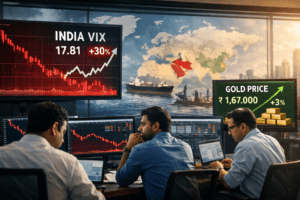
To the uninitiated, a 30% jump in something called the “VIX” might seem like just another statistic. But for market veterans, it’s the equivalent of a smoke alarm blaring in a crowded theater. The India VIX, or Volatility Index, measures the market’s expectation of near-term volatility. Think of it as the “fear meter.” When it’s low, the market is complacent and calm. When it spikes, as it did to 17.81—its highest since May 2025—it signals that traders are willing to pay a hefty premium to protect themselves from wild swings.
Why the sudden fear? The attack on Iran isn’t just another skirmish. By targeting the Supreme Leader, the conflict has moved from a shadow war of proxies to a direct, high-stakes confrontation. This introduces a specific type of risk that markets despise above all else: unquantifiable uncertainty.
- The Certainty of Uncertainty: We can model for earnings reports, for interest rate decisions, even for a moderate oil price fluctuation. But how do you model for a full-scale war in the Strait of Hormuz? You can’t. So, institutional investors, foreign portfolio investors (FPIs), and even domestic mutual funds hit the “risk-off” button. They square off positions, book profits, or simply move to cash. This mass exodus of liquidity amplifies the downward move, which in turn fuels more fear, creating a vicious cycle that the VIX captures perfectly.
- The 82% Year-to-Date Climb: The article notes that the India VIX is up 82% so far in 2026. This is a crucial detail. It tells us that the market’s nerves were already frayed. Perhaps it was due to global interest rate uncertainty, a tepid earnings season, or previous geopolitical rumblings. Today’s 30% spike is the culmination of that underlying anxiety. The market was a pile of dry kindling, and the Iran crisis was the match.
Part II: The Ripple Effect – Who Gets Hurt First (And Worst)
A crisis of this magnitude doesn’t just erase a few percentage points from the Sensex; it re-wires the economic calculus for entire industries. As the benchmark indices tumbled, with the Nifty falling below 24,900 and the Sensex shedding over 1,000 points, the real story was in the brutal sectoral rotation.
- The Crude Awakening: Oil & The Import BillThe most immediate and tangible impact is the spike in crude oil prices. Brent crude surging 13% to above $82 a barrel is a nightmare scenario for India. As the world’s third-largest oil importer, India finances its massive energy needs by purchasing dollars to buy oil. A $10 per barrel sustained increase in oil prices can widen the current account deficit (CAD) by 0.4-0.5% of GDP and stoke inflationary pressures.
- The Victims:
- Oil Marketing Companies (OMCs): Stocks like BPCL, HPCL, and IOC tumbled. The government often asks these companies to absorb price hikes to protect the common citizen, meaning their margins get crushed.
- Airlines: The aviation sector operates on razor-thin margins. For carriers like IndiGo, which saw a 7% slide, fuel is the single biggest cost component. A sustained oil price hike forces them to either raise ticket prices (risking demand destruction) or bleed.
- Tyres & Consumables: Crude oil derivatives are key inputs for tyre manufacturing. Companies like JK Tyres, which fell 16%, are hit by a double whammy of input cost inflation and potential demand slowdown.
- Safe Havens Shine: Gold, Silver, and the Commodity ExchangeWhen stocks burn, capital flees to safety. This was evident in the meteoric rise of gold (up 3% to nearly ₹1.67 lakh per 10 grams) and silver.
- The Beneficiary: MCX The article highlights a fascinating micro-story within the macro chaos: the rally in Multi Commodity Exchange (MCX) shares. This isn’t just a sympathy move. The logic is sound. Higher volatility in commodity prices, especially in sought-after safe havens like gold and silver, drives higher trading volumes on the exchange. More volume means more revenue for MCX. The breakout above ₹2,460, as noted by analysts, signals that the market is pricing in a period of sustained high activity in the commodity markets. This is a classic example of a “play on volatility” rather than a play on the commodity itself.
Part III: The Strategist’s View – History as a Compass
In times like these, the cacophony of noise is deafening. This is when the voice of seasoned market strategists becomes invaluable. The counsel from experts like VK Vijayakumar of Geojit Investments is rooted in a crucial piece of wisdom: the distinction between a crisis and a permanent loss of capital.
He argues, “Experience tells us that panic selling during a crisis is the wrong strategy… an event like the present crisis will not have any impact on the market six months later.”
This is not blind optimism; it’s historical pragmatism. Look back at the last two decades:
- The Kargil War (1999)
- The 9/11 attacks (2001)
- The 2008 Global Financial Crisis (though economic, it felt existential)
- The COVID-19 crash (2020)
In every single instance, the market bottomed and then, over the following months and years, went on to scale new heights. The human ability to adapt, the resilience of corporate earnings, and the long-term growth story of India have always prevailed. The key takeaway? The businesses you own—the banks, the auto companies, the capital goods firms—are fundamentally the same today as they were last week. Their long-term value hasn’t been destroyed by a missile strike 2,000 kilometers away.
Part IV: A Practical Playbook for the Investor
So, what do you do with your money right now? The answer depends on who you are.
For the Short-Term Trader: Rule #1: Don’t catch a falling knife. The sentiment is fragile, and as Ponmudi R of Enrich Money notes, “trading is likely to remain choppy and biased to the downside.” Trying to pick a bottom in a market driven by unpredictable headlines is a fool’s errand. If you must trade, stick to strict stop-losses and consider the elevated VIX as your warning that the market can turn against you in an instant.
For the Long-Term Investor (The “Accumulator”): This is your moment. The weakness, as Vijayakumar suggests, can be used to “slowly accumulate high-quality stocks.”
- Focus on Domestic Consumption: Companies in banking, automobiles, and FMCG that earn their revenue from within India are less exposed to the global trade shock that an oil crisis might bring. A HDFC Bank or a Maruti Suzuki still benefits from India’s internal demand, regardless of what happens in the Persian Gulf.
- Look at Thematic Winners: Sectors like capital goods and defence are structural long-term stories. A temporary geopolitical crisis doesn’t negate the government’s focus on infrastructure or domestic manufacturing. If quality stocks in these spaces are down 5-10%, it’s an opportunity, not a signal to run.
For the Risk-Averse Investor: If you cannot stomach the volatility and are losing sleep over your portfolio, use the VIX spike as a signal to re-evaluate your risk tolerance. Perhaps your equity allocation is too high. Waiting for a “dead cat bounce” to reduce your position to a level where you can sleep peacefully is a perfectly valid strategy. Capital preservation is not a dirty word.
Conclusion: Beyond the Headlines
The image of the India VIX at a nine-month high is frightening. The news of conflict in West Asia is genuinely concerning for global peace and stability. But for the Indian stock market investor, it is crucial to separate the geopolitical event from the economic reality.
Oil is a risk. Inflation is a risk. But the Indian economy is not built on oil alone. It is built on the savings, consumption, and enterprise of 1.4 billion people. A spike in the VIX is a measure of short-term fear, not a prediction of long-term doom.
The red on your screen today is a test—a test of your patience, your strategy, and your belief in the long-term story. The investors who passed similar tests in 1999, 2001, 2008, and 2020 were the ones who stayed calm, avoided the herd mentality, and used the fear of others to their advantage. The question is, will you pass this one?
You must be logged in to post a comment.