
Blood Red in the Morning: How a Strike on Tehran Sent the Indian Stock Market Into a Tailspin
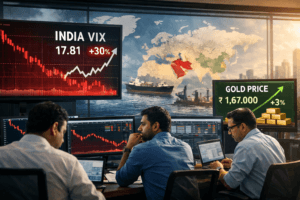
Blood Red in the Morning: How a Strike on Tehran Sent the Indian Stock Market Into a Tailspin
The first hour of trading on the Indian stock market this Monday was not for the faint of heart. As the clock struck 9:15 AM, the Sensex and Nifty didn’t just open lower; they fell off a cliff. The 30-share Sensex plunged a staggering 2,743 points, while the Nifty50 cratered over 2% in what analysts are calling the most volatile session since the seismic budget movements of early 2025.
The immediate culprit wasn’t a domestic scandal or a corporate earnings miss. It was the sound of explosions in Tehran. The escalating conflict between the U.S./Israel and Iran, culminating in a strike on the Iranian capital and the subsequent, drastic closure of the Strait of Hormuz, has lit a fuse under the Indian economy. For millions of Indian investors watching their portfolios bleed, the geopolitical map of West Asia has never felt closer to home.
The Anatomy of a Panic
To understand why Indian markets reacted with such ferocity, one must look beyond the trading screens and into the engine room of the Indian economy: crude oil. India is the world’s third-largest importer of oil, reliant on foreign shores to feed over 85% of its consumption needs. When Tehran announced the closure of the Strait of Hormuz—a narrow choke point through which nearly a fifth of the world’s petroleum passes—New Delhi didn’t just hear a political threat; it heard the sound of its import bill exploding.
The numbers tell a stark story. Brent crude futures surged nearly 6% in early trade, flirting with the $78 per barrel mark. For India, every sustained $10 per barrel increase in oil prices widens the Current Account Deficit (CAD) by approximately 0.4% of GDP and stokes inflationary pressures. This is the “twin shock” that spooks investors: a weakening rupee and rising prices that force the Reserve Bank of India (RBI) to reconsider its interest rate trajectory.
“The market isn’t just reacting to war; it’s reacting to a supply chain strangulation,” explains a senior fund manager at a private life insurance company, speaking on condition of anonymity. “If Hormuz remains closed, insurance premiums for tankers skyrocket, shipping routes double in length, and the cost of every barrel that does make it to India becomes punitive. For a growth story built on manufacturing and consumption, this is kryptonite.”
Beyond the Oil Drum: The Ripple Effect on the Ground
While the macro-economic fears gripped institutional traders, the pain became acutely real for specific sectors almost immediately.
The Turbulence in Aviation If oil is the economy’s blood, it is the aviation industry’s life support—and the tank was just holed. Shares of InterGlobe Aviation (IndiGo) and SpiceJet took a nosedive, dropping over 7% as the market opened. For airlines already grappling with high operational costs and a price-sensitive customer base, a surge in Aviation Turbine Fuel (ATF) prices is a direct hit to profitability.
But the crisis brought a secondary, more logistical nightmare. West Asia is not just a source of oil; it is India’s air corridor to the West. Dubai, Doha, and Abu Dhabi serve as the Grand Central Terminals for millions of Indian passengers heading to the US, Europe, and the UK. With Iranian airspace closed and the conflict spilling over, flights were grounded, routes became labyrinthine, and operational costs ballooned. The sharp sell-off in stocks like Yatra Online and Easy Trip Planners reflected the market’s grim assessment: travel demand, already elastic, is likely to falter if tickets become expensive and itineraries uncertain.
The Human Element: Stranded Dreams and Canceled Holidays Behind the ticker symbols and percentage drops are human stories. In Delhi’s Lajpat Nagar, a travel agent we’ll call Rajeev spent Monday morning on three different phones—one to his distributor in Dubai, one to a frantic family in Karol Bagh, and one to an airline helpline.
“A family was supposed to fly to London via Tehran tomorrow. That flight is gone. Re-routing them via Mumbai and then connecting through Europe costs almost 40% more. They can’t afford it, but they have visas expiring. It’s a nightmare,” he says, the stress evident in his voice.
This is the “human insight” that the aggregate data misses. The Indian Association of Tour Operators (IATO) reported a surge in cancellations and rescheduling requests. It’s not just about wealthy tourists; it’s about the Indian diaspora, about students heading to universities in the UK, about business travelers with contracts to sign. The closure of the Strait and the escalation of conflict have injected a paralyzing uncertainty into the lives of ordinary Indians planning their futures.
A Historical Echo with a Modern Twist
This isn’t India’s first rodeo with a Gulf crisis. The 1990 Gulf War saw oil prices double, pushing India to the brink of a balance of payments crisis that eventually catalyzed the 1991 economic reforms. In 2022, the Russia-Ukraine war sent commodities soaring.
However, veteran market strategist V.K. Vijayakumar of Geojit Financial Services offers a crucial distinction. “If Brent crude remains around $76-$78, equity markets may remain weak but are unlikely to witness a big crash,” he noted in his early assessment. The difference today lies in India’s economic structure. Unlike 1991, India has nearly $700 billion in foreign exchange reserves. Unlike the 1970s oil shocks, the Indian corporate sector today is far more resilient and diversified.
Yet, there is a modern vulnerability: relentless FPI (Foreign Portfolio Investor) flow. Foreign investors have been net buyers of Indian equities in recent months, attracted by the country’s stable growth premium. But geopolitical risk is the fastest way to reverse that tide. If foreign funds perceive India as a high-beta play on a West Asian conflict, they will sell first and ask questions later, exacerbating the domestic sell-off.
The Gold Rush and the Rupee Woes
As equities bled, the classic safe havens glittered. Gold prices pierced through the $5,300 per ounce mark internationally, with domestic prices following suit. In the bylanes of Zaveri Bazaar in Mumbai, the footfall was noticeably higher than usual. “People are converting their depreciating currency fears into something they can hold,” said a jeweler polishing a gold coin for a middle-aged customer. “When the Sensex falls this hard, gold is the only thing that looks like it isn’t lying.”
The Indian rupee, meanwhile, took a beating, sliding past the 91 mark against the US dollar. The logic is straightforward: India must buy more expensive oil with the same amount of dollars. To get those dollars, importers rush to buy USD, weakening the rupee further. This creates a vicious cycle—a weaker rupee makes oil even more expensive, widening the trade deficit and fueling inflation (imported inflation), which in turn hurts the stock market.
What Happens Next? Scenarios for the Investor
As the morning panic subsided and the market found some footing (with the Nifty recovering to trade 0.8% down by mid-session), the question on every investor’s mind shifted from “what happened?” to “what now?”
Scenario A: The Diplomatic Fizzle If global diplomacy, perhaps through the UN or back-channel communications, manages to reopen the Strait of Hormuz quickly and de-escalate the kinetic conflict, oil prices could retreat just as fast as they rose. In this scenario, Monday’s crash could be viewed as a massive “buy the dip” opportunity. Sectors like banking and auto, which were punished on rate-hike fears, would see a swift recovery.
Scenario B: The Protracted Grind If the closure persists for weeks, India will be forced to tap into its strategic petroleum reserves (stored in caverns in Mangalore and Padur) and accelerate talks with alternative suppliers. The government may consider a temporary cut in excise duty on fuel to cushion the blow to the common man, sacrificing revenue to maintain political stability. Markets would remain volatile, grinding lower, with stock selection becoming paramount. Defensive sectors like IT (which benefits from a weak rupee) and pharma would likely outperform cyclicals.
Scenario C: The Escalation The worst-case scenario—a wider war involving Iran directly against US assets in the region—would send oil prices towards triple digits. For India, this would mean a perfect storm: runaway inflation, a plunging rupee, a massive fiscal deficit, and a potential downgrade in sovereign outlook by rating agencies. In such a world, the 2,700-point drop seen today would merely be a preview.
A Morning That Changed the Narrative
As the closing bell approaches, the initial panic has cooled to a simmering anxiety. The Sensex and Nifty are off their intraday lows, but the damage is done—not just to portfolios, but to the narrative of “decoupling.” For years, Indian markets have enjoyed a “premium” valuation, partly based on the belief that the country is a “rule of law” oasis, insulated from the geopolitical chaos of its neighbors and the West.
Monday, March 2, 2026, served as a brutal reality check. In a globalized world, a missile launched at Tehran travels at the speed of light to the trading terminals of Dalal Street. The closure of a strait 2,000 kilometers away translates directly into a canceled vacation for a family in Gurugram, a delayed salary for a SpiceJet employee, and a sleepless night for a retired couple watching their life savings flicker red on a screen.
For the Indian investor, the takeaway is sobering. In the weeks to come, tracking the Nifty might be less about analyzing corporate balance sheets and more about understanding the movement of naval fleets in the Gulf of Oman. The war has come home, not with tanks and troops, but with tankers and ticker tape.
You must be logged in to post a comment.