
Blood on the Branches: As West Bank Settler Attacks Spike, the Olive Harvest Becomes a Battlefield
A recent violent attack by masked Israeli settlers on a group of Palestinian villagers, activists, and journalists during the olive harvest near the West Bank village of Beita underscores a severe and escalating crisis. This assault, which injured two clearly identified Reuters staff, is part of a record-breaking surge in settler violence since the Gaza war began, with the UN documenting over 260 attacks in October alone.
The olive harvest, a crucial economic and cultural tradition for Palestinians, has become a specific flashpoint, and the targeting of the press signifies a dangerous attempt to suppress documentation of these events. Ultimately, the incident epitomizes a broader pattern of intimidation and economic warfare faced by Palestinian communities, exacerbated by a pervasive sense of impunity as such attacks are rarely investigated or prosecuted by Israeli authorities.’
Blood on the Branches: As West Bank Settler Attacks Spike, the Olive Harvest Becomes a Battlefield
The ancient olive groves of the West Bank have long been a symbol of peace, resilience, and deep-rooted connection to the land. For thousands of years, the autumn harvest has been a sacred, communal ritual, passed down through generations of Palestinian families. But today, in the hills south of Nablus, that ritual has been transformed into a flashpoint of violence, where the simple act of gathering a crop becomes an act of defiance and a target for assault.
A recent, brutal attack near the village of Beita, which injured Palestinian villagers, international activists, and two Reuters journalists, is not an isolated incident. Instead, it is a microcosm of a escalating crisis in the occupied West Bank, where a record-breaking surge in settler violence is systematically undermining livelihoods, silencing the press, and entrenching a climate of impunity.
The Attack: A Witnessed Assault on the Press and Peaceful Gatherers
On a Saturday morning in early November, a group of about 50 people—a mix of Palestinian farmers from Beita, Israeli human rights activists, and journalists—gathered with a simple goal: to harvest the olives from their groves. These groves lie in the shadow of an unauthorized Israeli settler outpost, a location that has become a perennial hotspot for tension.
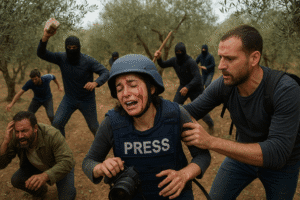
According to multiple witness accounts, the peaceful gathering was swiftly shattered. Dozens of masked men descended from the outpost, armed with sticks, clubs, and large rocks. They did not discriminate in their targets.
Among them was Reuters photographer Raneen Sawafta, a professional journalist clearly marked with a “Press” insignia on her protective vest and a helmet. Witnesses describe the assailants singling her out, beating her relentlessly with sticks as she tried to protect herself. The violence did not stop when she fell. Jonathan Pollak, an Israeli rights activist present at the scene, stated the settlers “beat her up without mercy, continuing to stone her while she was on the ground.”
Her colleague, Reuters security adviser Grant Bowden, was beaten as he attempted to shield her. Sawafta’s camera equipment, her tool for bearing witness, was deliberately smashed. The dent left in her helmet served as a chilling, physical testament to the force of the blows intended for her head. This was not a random clash; it was a targeted assault on the very principle of a free press.
The Bigger Picture: A Record-Breaking Surge in Violence
To view this attack as a singular event is to misunderstand the reality on the ground. The United Nations Office for the Coordination of Humanitarian Affairs (OCHA) released a report just one day before this incident that provides the crucial, damning context. In October alone, Israeli settlers carried out at least 264 attacks against Palestinians in the West Bank.
This is the highest monthly total since the UN began systematically tracking such incidents in 2006. This number is not an abstract statistic; it represents hundreds of lives upended—farmers threatened, homes vandalized, livestock killed, and children traumatized.
This dramatic escalation is directly linked to the ongoing war in Gaza, which began two years ago. In the West Bank, the conflict has acted as a catalyst, emboldening extremist settlers and fueling a cycle of retaliation and intimidation. The olive harvest, a period of economic and cultural significance, has become a particularly intense focal point. For many Palestinian families, olive oil is a primary source of income. Destroying or preventing the harvest is not just an act of violence; it is a form of economic warfare designed to strangle communities and force them from their land.
The Olive Tree: More Than a Crop, A Cultural Lifeline
To understand the ferocity of the response, one must understand the profound significance of the olive tree in Palestinian society.
- Economic Survival: The olive sector is a cornerstone of the Palestinian economy, supporting the livelihoods of nearly 100,000 families. A successful harvest can mean the difference between financial stability and destitution for a farming household.
- Cultural Heritage: Many olive groves are centuries old, cared for by the same families for generations. The trees are living heirlooms, their gnarled trunks embodying a history that predates the modern conflict. The harvest is a time for family reunion, storytelling, and the passing of traditions.
- Symbol of Steadfastness: The olive tree’s deep roots and ability to thrive in arid, rocky soil have made it a powerful symbol of Palestinian resilience and attachment to the land—sumud in Arabic. To attack the tree is to attack this very identity.
This is why the presence of Israeli activists and international journalists is so critical. They act as both a protective shield and a vital channel for documentation. Their presence is a conscious strategy of non-violent resistance, an attempt to ensure that the world sees what happens when the harvest begins.
The Architecture of Impunity: Why Does the Violence Continue?
A recurring and deeply troubling theme in the pattern of settler violence is the pervasive sense of impunity. As the Reuters report notes, Israeli rights groups consistently point out that such incidents are “rarely investigated by the Israeli authorities and perpetrators are rarely held to account.”
The response to the Beita attack is telling. The Israel Defense Forces (IDF) stated they dispatched soldiers to the scene after reports of a “confrontation”—a term that implies a two-sided fight, contradicting witness accounts of a one-sided assault. Notably, those witnesses said they saw no Israeli soldiers arrive to intervene. The IDF’s subsequent statement, which “condemns any act of violence,” rings hollow when divorced from concrete action on the ground.
This dynamic creates a self-perpetuating cycle: settlers attack, the military is often slow to respond or absent, the police rarely make arrests, and the violence is therefore normalized. This lack of accountability signals to perpetrators that their actions carry no consequence, effectively green-lighting further aggression.
The Targeting of Journalism: A Threat to Truth Itself
The severe beating of clearly identified Reuters journalists marks a dangerous escalation. When the press is attacked, the first casualty is the truth. These assaults are designed to create information blackouts, to ensure that stories like the one from Beita remain untold. If journalists cannot report safely from flashpoints, the world is left in the dark, and powerful actors can operate without scrutiny.
Reuters’ call for Israeli authorities to “investigate this incident and hold those responsible accountable—and to ensure that journalists can work freely and without harm” is a fundamental plea for the principles of a free society. The dent in Raneen Sawafta’s helmet is a stark monument to the price of seeking that truth.
A Path Forward Demands Accountability and Protection
The violence in the olive groves near Beita is a symptom of a much deeper sickness. It reflects a conflict over land, resources, and narrative that is becoming increasingly brutalized. The international community’s focus often rests on Gaza or high-level diplomacy, but the daily reality for West Bank Palestinians is one of creeping annexation and targeted violence.
Addressing this crisis requires more than statements of condemnation. It demands:
- Concrete Accountability: Israeli authorities must fulfill their legal obligation, as the occupying power, to protect Palestinian civilians. This requires rigorous investigation and prosecution of settler violence.
- International Pressure: The record-breaking UN data must serve as a catalyst for stronger international mechanisms to document violence and hold perpetrators accountable, potentially through sanctions on violent actors.
- Protection for Journalists: Ensuring the safety of the press is non-negotiable. Without it, the conflict becomes shrouded in misinformation and unverified claims.
The olive harvest should be a time of abundance and community. That it has become a season of fear and violence is a profound tragedy. The story from Beita is a warning that the roots of peace are being systematically poisoned, and without urgent, decisive action, the consequences will be felt for generations to come.
You must be logged in to post a comment.