
Blood and Olive Trees: A Day of Reckoning in the Occupied West Bank
On February 28, 2026, a wave of coordinated violence by Israeli settlers swept across the occupied West Bank, leaving multiple Palestinians injured in a series of attacks that underscore the escalating impunity under which such groups operate. The assaults, which occurred under the protection of the Israeli army, ranged from live fire that wounded a young man near Hebron, to pepper-spraying shepherds near Tubas and physically assaulting farmers near Nablus, while settlers also ransacked homes and stole livestock. These incidents, consistently enabled by the military’s presence and the absence of any arrests, reveal a strategic campaign aimed at terrorizing Palestinian communities and forcing them from their land, highlighting a system where the state acts as a shield for violent land grabs rather than a protector of all citizens under its control.
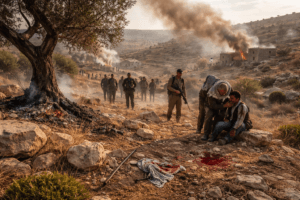
Blood and Olive Trees: A Day of Reckoning in the Occupied West Bank
The hills of the occupied West Bank, scarred by rock and ancient olive terraces, are supposed to be a place of quiet resilience. But for the Palestinians who call them home, February 28, 2026, was a day that underscored a terrifying and escalating reality: the law of the jungle, backed by the guns of the state.
What unfolded across the territory on Saturday was not a series of isolated incidents, but a coordinated symphony of violence. From the arid hills of Masafer Yatta in the south to the pastoral lands near Tubas in the northeast, waves of Israeli settlers—referred to as “colonizers” in the initial report—launched attacks on Palestinian communities, leaving a trail of blood, bruises, and terror. This was not spontaneous friction; it was a systematic display of force, carried out, as witnesses repeatedly stated, under the protective arm of the Israeli military.
This article delves beyond the headlines, exploring the human cost and the chilling mechanics of a day that exemplifies the ongoing, low-intensity war over land and life in the West Bank.
South Hebron Hills: Where Every Day is a Battle for Survival
The most severe violence erupted in the South Hebron Hills, a region that has become a flashpoint for settler aggression. Osama Makhamra, a local anti-settlement activist, painted a grim picture for WAFA News Agency. In Masafer Yatta, a cluster of villages and herding communities living under the constant threat of displacement, armed settlers—often described as paramilitary in their organization and weaponry—opened fire.
One young man now lies in a hospital bed with a live gunshot wound to his hand, his injury listed as moderate. But the physical wound is only the most visible scar. In communities like Khirbet Asfi and Mughayir al-Abeed, the attack was multifaceted. Settlers didn’t just shoot; they targeted the very livelihood of the people. They assaulted shepherds from the Makhamra and Awad families, attempting to steal their livestock. In a society where a family’s flock represents generations of work and survival, this is an act of economic warfare.
The assault wasn’t limited to the open fields. In the village of Al-Halawa, the home of Ahmed Ismail Abu Aram was invaded and ransacked. To have your home—the one place of sanctity—violated by armed strangers is a trauma that echoes for a lifetime. Nearby, in Khirbet Aqwawis, the air was filled with the sound of live fire, a message of terror sent to every family huddled in their homes.
Throughout these attacks, the Israeli army was not a neutral party. According to reports, they stormed homes in Khirbet Asfi, detaining residents. While no arrests were officially reported, the act of detention serves a dual purpose: it paralyzes the community’s ability to resist or even document the settler violence unfolding around them, and it reinforces the settlers’ impunity. The message is clear: the shepherds are the trespassers, and the settlers are the ones being protected.
The Northern Front: From Nablus to Tubas, A Pattern of Impunity
As the sun rose over the northern West Bank, the violence continued. Near the town of Qusra, south of Nablus, a young man was doing what generations of Palestinians have done before him: working his land. This simple, profound act of connection to the soil was interrupted by a group of settlers. He was assaulted so brutally that he required hospitalization. For farmers in areas like Qusra, which lies in a region dotted with illegal outposts, working the land is an act of defiance, and the price of that defiance is increasingly physical danger.
Further east, near Tubas, the assault took on a particularly insidious form. In the Ras al-Ahmar area, shepherds were approached by settlers who then sprayed them directly in the eyes with pepper spray. Abdullah Bisharat, the head of the local village council, reported that five citizens suffered eye injuries, three requiring hospital treatment. This is not the act of someone seeking to steal land or livestock; it is the act of someone seeking to cause pain and terrorize. It is a weapon of mass disruption, temporarily blinding people in a rugged landscape where sight is essential for survival.
The Spoils of War: Stealing a Future in Ramallah
Even as people were being shot and pepper-sprayed, another form of predation was taking place in the central West Bank. In the town of Taybeh, east of Ramallah, a group of settlers did something that, on the surface, seems petty: they stole a horse and a foal. But this act is deeply symbolic.
To a farmer, a horse is not just an animal; it is a partner, a piece of the family, and a crucial asset. Stealing it is a targeted blow to a family’s dignity and livelihood. The incident also perfectly illustrates the symbiotic relationship between the settlers and the state. Soon after the settlers arrived to steal the animals, the army stormed the town—not to stop the theft, but, as the report states, “to provide protection for the illegal settlers.”
The day’s violence concluded with another assault on a road between Abu Falah and al-Mughayyer. Here, settlers stoned a commercial vehicle, smashing its windows and attacking the driver. This is the reality of movement for Palestinians: a simple drive from one village to the next can become a gauntlet of violence, with no protection in sight.
The Deeper Reality: More Than “Attacks”
To read these reports as mere news items is to miss the forest for the trees. What happened on February 28, 2026, is a microcosm of a larger, strategic campaign.
- The Goal is Displacement: The ultimate aim of this violence is to force Palestinians from their land. By making life unbearable—through physical assault, economic sabotage (stealing livestock), and psychological terror (home invasions)—the settlers hope to trigger a slow-motion ethnic cleansing. The focus on shepherds in Masafer Yatta and farmers near Nablus is no accident. These are the people whose presence on the land is the biggest obstacle to settlement expansion.
- The Army as an Enabler: The report repeatedly mentions that these attacks happened “under army protection” or were followed by the army “storming” towns. This is the core of the issue. The Israeli military acts as a shield, allowing the settlers to commit their crimes with impunity. When the army does intervene, it is often to protect the settlers from the consequences of their own actions or to detain the victims. This transforms the state from a neutral arbiter into an active participant in the land grab.
- A System of Impunity: The lack of arrests for the settlers is deafening. When a Palestinian throws a stone, the response is often immediate arrest, home demolition, or even live fire. When armed settlers shoot a young man, ransack a home, or pepper-spray five shepherds, the official response is, at best, silence. This double standard is the fuel that keeps the fire of settler violence burning.
For the people of Khirbet Asfi, their world is now a little smaller, a little more frightening. For the shepherds recovering from pepper spray in Tubas, their eyes will heal, but the lesson of their vulnerability will not. For the young man with a bullet in his hand near Hebron, his injury is a permanent reminder of the price of simply existing on his own land.
The international community often speaks of the two-state solution, but on the ground, a very different reality is being built. It is a reality built on the ruins of Palestinian homes, the theft of their livestock, and the blood of their young men and women. February 28th was just one day in this long, grinding conflict. But it was a day that laid bare the brutal mechanics of an occupation that continues to tighten its grip, one attack at a time.
You must be logged in to post a comment.