
BIRSA 101: How India’s Homegrown CRISPR Therapy Is a Monumental Leap in Medicine
India’s launch of BIRSA 101 in November 2025 marks a monumental achievement in medicine, as the nation’s first entirely indigenous CRISPR-based gene therapy designed to cure Sickle Cell Disease (SCD)—a genetic disorder that disproportionately and severely affects its tribal population. Named in honor of tribal freedom fighter Bhagwan Birsa Munda, the therapy symbolizes a fight for genetic liberation and represents a strategic fusion of cutting-edge science and socio-economic justice.
Developed by the CSIR-Institute of Genomics and Integrative Biology using its proprietary, high-precision enFnCas9 platform, and partnered with the Serum Institute of India for scalable manufacturing, BIRSA aims to rewrite the defective gene responsible for SCD, moving beyond symptom management to offer a potential functional cure. This breakthrough not only heralds a new era of affordable, accessible advanced therapy for a neglected community but also positions India as a global leader in democratizing groundbreaking genetic medicine.
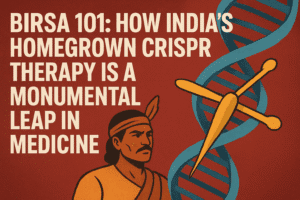
BIRSA 101: How India’s Homegrown CRISPR Therapy Is a Monumental Leap in Medicine
The words “sickle cell disease” have, for generations, echoed with a particular resonance in India’s tribal heartlands. It’s a genetic shadow, a sentence of chronic pain and shortened lives, passed down through families with a cruel, Mendelian inevitability. But on November 20, 2025, a new echo was heard—one not of resignation, but of revolutionary hope. India announced the launch of BIRSA 101, its first entirely indigenous CRISPR-based gene therapy for Sickle Cell Disease (SCD).
This isn’t just another medical advance. It’s a watershed moment that intertwines cutting-edge science, socio-economic justice, and national ambition. By naming the therapy after Bhagwan Birsa Munda, the revered tribal freedom fighter, India is sending a powerful message: the fight for freedom is now a fight for genetic liberation.
More Than a Treatment: The Burden of Sickle Cell Disease in India
To understand the magnitude of BIRSA 101, one must first grasp the enemy it seeks to vanquish.
Sickle Cell Disease is a monogenic disorder—meaning it’s caused by a single error in a single gene. This error lies in the HBB gene, which provides the instructions for making beta-globin, a crucial component of haemoglobin. A single typo in this genetic code—a switch from an ‘A’ to a ‘T’—results in the production of a defective haemoglobin. Under certain conditions, this faulty haemoglobin causes normally flexible, doughnut-shaped red blood cells to crumple into rigid, sickle-shaped crescents.
These sickled cells are the agents of chaos. They are sticky and fragile, clogging tiny blood vessels and causing ischemic attacks—sudden cuts in blood supply. This manifests as:
- Excruciating Pain Crises: Often described as worse than childbirth or amputation, these episodes of vaso-occlusion can last for hours or weeks.
- Organ Damage: Repeated blockages starve vital organs like the spleen, kidneys, and brain of oxygen, leading to progressive, irreversible damage.
- Severe Anaemia: The fragile sickle cells die early, leaving the body in a constant state of haemoglobin deficit, causing fatigue, jaundice, and shortness of breath.
The statistics are stark. India is home to the second-largest SCD population in the world, with a devastating concentration among its Scheduled Tribes (STs). One in every 86 births within these communities is affected by SCD. For decades, management has been the only option—painkillers, blood transfusions, and hydroxyurea to manage symptoms. A curative bone marrow transplant exists but is prohibitively expensive, risky, and dependent on finding a perfectly matched donor—a near-impossible task for many.
The Science of Precision: Deconstructing the CRISPR Miracle
So, how does BIRSA 101 propose to rewrite this tragic genetic script? The answer lies in CRISPR, a tool that has democratized genetic engineering.
Think of the CRISPR-Cas9 system as a pair of molecular scissors and a GPS guide.
- The GPS (Guide RNA): This is a custom-designed snippet of RNA programmed to find one specific sequence in the vast 3-billion-letter library of the human genome. In the case of SCD, it is programmed to hunt down the exact location of the mutated HBB gene.
- The Scissors (Cas9 Protein): This enzyme is the cutting tool. It follows the Guide RNA to the target site and makes a precise cut in both strands of the DNA double helix.
Once the cut is made, the cell’s own natural repair mechanisms kick in. BIRSA 101 likely leverages this to introduce a healthy version of the gene or edit the existing one to correct the mutation. The goal is simple: instruct the patient’s own stem cells, harvested from their bone marrow, to start producing healthy, round red blood cells. Once these edited cells are reintroduced into the patient, they can, in theory, produce a lifelong supply of healthy blood cells—a functional cure.
The Indian Ingenuity: Why BIRSA 101 and enFnCas9 Are a Game-Changer
The core technology here isn’t just any CRISPR; it’s built on a platform called enFnCas9, developed by the CSIR-Institute of Genomics and Integrative Biology (IGIB). This is where the “indigenous” label carries profound significance.
Most CRISPR systems use the Cas9 protein from the bacterium Streptococcus pyogenes (SpCas9). While powerful, it can sometimes have “off-target effects”—making accidental cuts in parts of the genome that look similar to the target. enFnCas9, derived from Francisella novicida, is an engineered high-fidelity system. It’s designed to be far more accurate, significantly reducing the risk of off-target edits. This is a critical safety advantage.
Furthermore, the partnership with the Serum Institute of India (SII) is a masterstroke. SII is a global behemoth in vaccine manufacturing, renowned for scaling up production to achieve unprecedented affordability and volume. By bringing SII into the fold, India is pre-emptively solving the biggest problem plaguing gene therapies in the West: cost.
Current gene therapies for other diseases in the US and Europe can cost over $2 million per dose. BIRSA 101 aims to shatter this paradigm. The vision is to create a therapy that is not only made in India but is also accessible and affordable for Indians—a “Made in India” solution for a “Bane of India” problem.
Beyond the Lab: The Socio-Economic Liberation of a Name
Naming the therapy BIRSA 101 is a act of profound symbolism. Bhagwan Birsa Munda led an uprising against colonial oppression to secure the land and identity of tribal communities. BIRSA 101 wages a war against an internal, biological oppression that has burdened these same communities for centuries.
This move reframes a public health initiative as an act of restorative justice. It acknowledges the disproportionate burden borne by tribal populations and positions scientific advancement as a tool for social equity. It’s a powerful narrative that can help build trust and awareness within communities that have often been marginalized and mistrustful of external medical interventions.
The Road Ahead: Cautious Optimism and Future Horizons
While the launch is cause for celebration, it’s important to temper excitement with scientific realism. The journey from announcement to widespread availability involves crucial steps:
- Robust Clinical Trials: The therapy must now undergo rigorous Phase III and IV trials to confirm its long-term efficacy and safety in a larger Indian population.
- Manufacturing & Logistics: Scaling up a gene therapy is complex. It involves creating a seamless cold chain and a network of specialised treatment centres.
- Regulatory Approval & Cost: The Drug Controller General of India (DCGI) will need to give final approval, and a sustainable pricing model must be established, potentially involving government subsidies.
The success of BIRSA 101 will not just rewrite the future for SCD patients. It will establish India as a global leader in affordable, cutting-edge genetic medicine. It proves that the nation can not only consume advanced technology but also innovate, indigenize, and democratize it.
This is more than a medical breakthrough. It is the dawn of a new era where the chains of inherited disease are being broken, not by a foreign miracle, but by homegrown genius—a fitting tribute to the spirit of a freedom fighter, now empowering a new generation to fight for and win the most personal freedom of all: the freedom of health.
You must be logged in to post a comment.