
Bihar’s Ballot Battle: Why a Single State Election Could Unravel Modi’s National Ambitions
The ongoing state election in Bihar, with results expected on November 14, serves as a crucial referendum on Prime Minister Narendra Modi’s popularity and a critical test for his BJP-led National Democratic Alliance (NDA), which relies on key allies from the state to maintain its fragile coalition government at the national level.
The vote unfolds amid significant public discontent over unemployment and a controversial revision of electoral rolls, with the opposition alleging the disenfranchisement of millions of poor and minority voters. The outcome will not only determine leadership in the politically influential and impoverished state but could also potentially destabilize Modi’s central government by triggering defections, thereby shaping the political landscape ahead of the 2029 national elections.
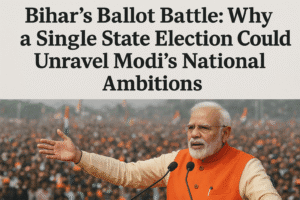
Bihar’s Ballot Battle: Why a Single State Election Could Unravel Modi’s National Ambitions
In the dense, pre-dawn fog of a North Indian November, the political destiny of the world’s largest democracy is being quietly, yet fiercely, contested. As millions of voters in Bihar line up outside polling stations, they are doing more than just choosing a government for their state. They are participating in a high-stakes referendum that will measure the temperature of the nation, testing the resilience of Prime Minister Narendra Modi’s political hegemony and potentially reshaping India’s trajectory for years to come.
This election for Bihar’s 243-seat legislature, with results due November 14, is the most significant political event since Modi’s Bharatiya Janata Party (BJP) was forced into a coalition government in last year’s surprise national election results. The outcome will answer a critical question: Was the 2024 national verdict a temporary setback for Modi, or the beginning of a fundamental political realignment?
The Bellwether State: Why Bihar is India’s Political Compass
To understand why all eyes are on Bihar, one must look beyond its economic statistics. With a population of around 130 million, if Bihar were a country, it would be the eighth most populous in the world. More importantly, it has earned a reputation as India’s political bellwether. The state’s complex social fabric—a mosaic of castes, classes, and communities—often mirrors the broader political sentiments of the Hindi heartland, the crucial belt that decides who rules in New Delhi.
“Bihar’s election is not just about alliances but arithmetic,” observes New Delhi-based analyst Sidharth Mishra. This arithmetic is national in its consequence. Bihar sends 40 lawmakers to the Lok Sabha, the lower house of Parliament. A strong performance by Modi’s National Democratic Alliance (NDA) here would signal that the coalition’s foundations are solid, providing crucial momentum ahead of major state elections in Uttar Pradesh, West Bengal, and Assam over the next two years. A setback, however, could expose cracks in the edifice, energizing a fragmented opposition and unsettling Modi’s already-dependent coalition at the center.
The Precarious Alliance: Modi’s Coalition Conundrum
The 2024 general election marked a paradigm shift. For the first time in a decade, Modi’s BJP failed to secure a majority on its own. The government’s survival hinges on two key allies from Bihar: Nitish Kumar’s Janata Dal (United) [JD(U)] and the Lok Janshakti Party (Ramvilas). This dependency transforms the Bihar election from a regional contest into a battle for the stability of the federal government.
The central figure in this delicate dance is Chief Minister Nitish Kumar. At 74, Kumar has been the dominant force in Bihar politics for nearly two decades, a wily strategist known for his frequent political flip-flops. Having once been a staunch opponent of Modi, he is now back in the NDA fold, serving as the alliance’s chief ministerial face. Analysts warn that a poor showing for the NDA could trigger a crisis of confidence in Kumar’s leadership.
“This election could affect not just Bihar’s leadership but the stability of Modi’s government,” cautions Ravi Ranjan, a political science professor in New Delhi. The JD(U) contributes 12 critical MPs to the central coalition. If the party fractures or if Kumar feels his position is untenable, his return to the opposition camp is not an unthinkable scenario—a move that could plunge the national government into chaos.
The Opposition’s Gambit: Caste, Congress, and a Wildcard
Facing the NDA is a coalition led by the Rashtriya Janata Dal (RJD), in partnership with the Congress party. Their campaign has hammered the government on its most vulnerable fronts: rampant unemployment, a perceived decline in law and order, and a controversial revision of the state’s electoral rolls.
The issue of the voter lists has become a major flashpoint. Rahul Gandhi, leader of the Congress Party, has denounced the process as politically motivated, alleging it deliberately disenfranchises poor and minority voters. The Election Commission of India reports that nearly 10% of the state’s 74 million voters—a staggering 7.4 million people—were removed from the lists since June. While the Commission justifies this as a necessary cleanup due to labor migration and demographic changes, the opposition sees a sinister plot to tilt the scales.
Adding an intriguing wildcard to the mix is Jan Suraaj (People’s Good Governance), a new political group floated by Prashant Kishor. A master strategist who once managed Modi’s own campaign, Kishor understands the mechanics of Indian elections better than most. His entry into the fray, campaigning on a platform of development and governance beyond traditional caste lines, could siphon off votes from both the ruling alliance and the opposition, disrupting the established political calculus.
The Paradox of Progress: Bihar’s Saddled Economy and the Battle for Hearts
Beneath the political maneuvering lies a stark socioeconomic reality. Bihar remains one of India’s poorest states, an agrarian economy saddled with landlessness, low wages, and limited industrial employment. Both the NDA and the opposition have made extravagant promises, pledging to create millions of government jobs—a vow economists view with deep skepticism given the state’s fragile fiscal health.
This creates a powerful paradox. The ruling alliance points to improved infrastructure, better roads, and restored law and order as signs of development. Yet, as Pushpendra Kumar, a former professor at the Tata Institute of Social Sciences, notes, “The majority of the people continue to live in poverty while the ruling alliance claims to have put the state on a path to development. The state government has initiated welfare measures but has rarely attempted to address underlying causes of poverty.”
Recognizing this discontent, Modi made a strategic intervention in September, directly transferring 10,000 Indian rupees (approximately $113) each to 7.5 million women as part of a welfare program. This move underscores the critical importance of the women’s vote. With men often migrating to metropolitan areas for work, women form a decisive voting bloc, and such direct cash transfers are a potent tool for cutting through complex political narratives with tangible, immediate benefit.
A Verdict With National Reverberations
As the dust settles on the campaign trail, the people of Bihar hold a unique power in their hands. Their verdict on November 14 will be dissected not just as a regional outcome, but as a national prognosis.
A decisive NDA victory would be hailed by the BJP as a triumphant return to form, proving that Modi’s appeal and his welfare politics remain potent. It would solidify the current alliances and send a clear message to the opposition that the road to 2029 will be arduous.
However, a setback for the NDA, or even a slim victory that exposes the coalition’s internal strains, would be catastrophic for Modi’s political project. It would be interpreted as a validation of the opposition’s critique and a sign of growing public impatience over jobs and the economy. More dangerously, it could tempt key allies like Nitish Kumar to reconsider their loyalties, threatening the very stability of the central government.
In the end, the Bihar election is a story of two parallel Indias: one of high-octane national politics, fragile alliances, and prime ministerial authority, and the other of ground-level realities—of migration, poverty, and the search for dignity. The result will be the moment these two Indias collide, and the reverberations will be felt all the way to the capital.
You must be logged in to post a comment.