
Beyond Windmills & Solar Farms: How Dutch Ingenuity and Indian Ambition are Forging a New Green Hydrogen World Order
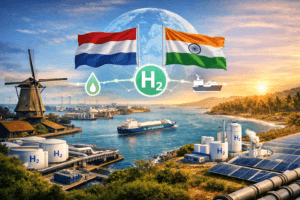
Beyond Windmills & Solar Farms: How Dutch Ingenuity and Indian Ambition are Forging a New Green Hydrogen World Order
The sun beats down on Goa’s coastline, a stark contrast to the cool, North Sea winds that shape the Dutch horizon. Yet, in January 2026, these two distinct geographies and energy narratives converge with a shared, urgent purpose. The Netherlands’ delegation at India Energy Week is more than a diplomatic courtesy or a trade mission; it is a deliberate and tactical alignment of two nations whose complementary strengths could fundamentally accelerate the world’s most critical energy transition. This partnership isn’t just about selling technology; it’s about co-creating a replicable blueprint for a hydrogen-based future, moving from theoretical potential to tangible pipelines, from certification debates to cargoes of green fuel.
The historical synergy between India and the Netherlands is profound. For centuries, Dutch traders navigated routes to India’s shores. Today, the navigation is through the complex currents of climate policy and energy economics. The Netherlands, a nation that literally reclaimed its land from the sea, excels in a specific form of orchestration: systemic integration. Its approach to hydrogen is not merely about production, but about building the entire ecosystem—the ports, the pipelines, the legal frameworks, the financial instruments. India, on the other hand, possesses the unparalleled scale, the monumental renewable energy potential, and a dynamic, problem-solving entrepreneurial spirit. Where the Netherlands is the master architect of intricate systems, India is the powerhouse capable of building them at a breathtaking pace and scale.
The Core Logic: Complementary Strengths in Action
The partnership’s genius lies in its non-competitive synergy. The Netherlands is not arriving with a promise to build India’s solar parks; India is already a global leader in that arena. Instead, the Dutch focus on hydrogen infrastructure, certification, and system integration speaks to the next, more complex set of challenges.
- Infrastructure as a Catalyst: India’s renewable energy potential, particularly in sun-rich states like Rajasthan and Gujarat, is staggering. However, green hydrogen—produced by splitting water using renewable electricity—needs more than generation. It requires a spine of infrastructure to transport it from production sites to ports and industrial hubs. The Netherlands, with its world-leading gas pipeline network (which it is actively converting to carry hydrogen) and Europe’s largest port in Rotterdam, brings centuries of logistics and hydraulic engineering expertise. Their knowledge in designing safe, efficient hydrogen transport and storage is precisely what India needs to avoid bottlenecks and ensure its green hydrogen can reach both domestic industries and international markets.
- Certification: The Currency of Trust: In a nascent global market, trust is paramount. How can a German manufacturer or a Dutch utility be certain that the hydrogen molecules they purchase from India are truly “green”? This is where certification—a verifiable guarantee of origin and carbon footprint—becomes the essential currency. The Netherlands is at the forefront of developing robust, blockchain-backed certification systems that are gaining EU acceptance. By partnering on this, the two nations can help establish a globally accepted standard, lifting a major barrier to trade. It turns green hydrogen from a vague promise into a tradable, bankable commodity.
- System Integration: The Art of the Possible: Perhaps the most valuable Dutch export is its holistic mindset. The Netherlands views energy systems as interconnected webs—linking wind farms to electrolyzers, pipelines to industrial clusters, port operations to international shipping lanes. This is crucial for India’s ambitions to develop hydrogen hubs. These are not just production facilities; they are integrated economic zones where industries like steel, cement, and fertilizers can directly offtake clean hydrogen, decarbonizing sectors that are otherwise hard to abate. Dutch planners and engineers can collaborate with Indian counterparts to design these hubs for maximum efficiency and circularity, embedding principles of waste-heat recovery and resource optimization from day one.
The Vision: Corridors, Clusters, and Climate Impact
The tangible outcomes this partnership seeks are monumental:
- International Green Hydrogen Corridors: This is the grand vision. Imagine a reliable maritime route for green hydrogen and its derivatives (like green ammonia) from India’s west coast to Rotterdam, the “Gateway to Europe.” This corridor would do more than connect two countries; it would weave India into the EU’s strategic energy tapestry, providing Europe with a diversified, clean energy source while giving India a massive, long-term export market. It’s a geopolitical bridge built on climate action.
- Industrial Decarbonization Projects: Pilot projects at Indian refineries, fertilizer plants, or steel mills using Dutch integration technology can serve as global lighthouse projects. They prove the technological and economic feasibility of deep industrial decarbonization in an emerging economy context—a template for Southeast Asia, Africa, and beyond.
- A Learning Symbiosis: The Dutch are shrewdly focused on “learning from India’s scale and innovation.” India’s ability to drive down costs in renewables and digital solutions (like smart grid management) is legendary. This partnership is a two-way street of knowledge. The Netherlands gains insights into scalable, cost-effective models, while India accelerates its mastery of complex system integration.
The Human Insight: Beyond Governments, a Mosaic of Collaboration
The real engine here is the delegation of “more than twenty companies and knowledge partners.” This mosaic—comprising multinationals like Shell and Vopak, innovative SMEs specializing in electrolyzer components or membrane technology, and world-class institutes like TNO and Delft University of Technology—represents the entire value chain. It’s the research scientist from Delft collaborating with an IIT counterpart on new catalyst materials. It’s the project finance specialist from Amsterdam structuring a viable investment model for a Gujarat hydrogen hub with local banks. It’s the Dutch startup offering smart valve technology to an Indian engineering giant.
This multi-stakeholder model, guided by policy but driven by enterprise and academia, is what transforms lofty memorandums of understanding into on-the-ground jobs, technologies, and emissions reductions. It builds a network so interdependent that it can withstand political shifts, focused on the long-term horizon of 2040 and 2050.
Conclusion: A Partnership for a Planet
The Netherlands-India energy partnership showcased at India Energy Week 2026 transcends bilateral trade. It is a case study in strategic, solution-oriented internationalism. In a world often divided by zero-sum energy geopolitics, this alliance demonstrates how nations can leverage unique national competencies to solve a common, existential crisis.
It acknowledges that the energy transition will be won or lost not just in the labs of Silicon Valley or the policy halls of Brussels, but in the industrial clusters of Gujarat and the port logistics of Rotterdam. By combining Dutch orchestration with Indian execution, they are not merely partnering for clean energy; they are actively constructing the physical and contractual architecture of the post-carbon world—one pipeline, one certificate, one green corridor at a time. The winds of the North Sea and the sun of the Indian subcontinent are, finally, powering the same vital mission.
You must be logged in to post a comment.