
Beyond Time: The $1.5 Million Watch and the New Gilded Age of Bespoke Billionaire Tributes
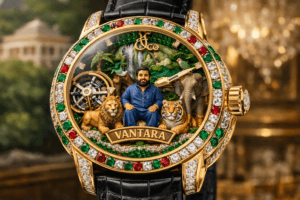
Jacob & Co.’s unveiling of a $1.5 million watch featuring a hand-painted statue of billionaire heir Anant Ambani, encircled by sculpted animals, transcends horology to become a defining artifact of a modern Gilded Age. This bejeweled timepiece, framed as a tribute to Ambani’s private Vantara animal sanctuary, encapsulates the new language of ultra-luxury, where bespoke goods function as wearable legacies for the global elite. It highlights the intricate fusion of monumental wealth, personal philanthropy, and curated narrative, celebrating a private conservation project while inevitably inviting scrutiny about opacity, perception, and the commodification of legacy in an era of extreme inequality. Ultimately, the watch is less a timekeeping device and more a symbolic mirror reflecting the power of contemporary aristocracy to transform personal passion into a permanent, jewel-encrusted spectacle.
Beyond Time: The $1.5 Million Watch and the New Gilded Age of Bespoke Billionaire Tributes
In the rarefied world of haute horology, where mechanics meet myth-making, a new timepiece has emerged that tells a story far beyond hours and minutes. It narrates a tale of monumental wealth, personal legacy, and the audacious blurring of lines between philanthropy, personal passion, and unparalleled luxury. Jacob & Co.’s latest creation—a wristwatch featuring a hand-painted statue of Anant Ambani, the son of Asia’s richest man, surrounded by a miniature menagerie—isn’t just a watch. Priced at an estimated $1.5 million, it is a crystallized moment in our modern Gilded Age, where personal branding reaches a zenith of jewel-encrusted literalness.
The Artifact: Deconstructing a Portable Pantheon
At first glance, the watch is a feat of micro-sculpture and jeweler’s art. Its openworked green and gold dial, a landscape under glass, hosts a tiny, detailed figurine of Anant Ambani seated centrally, flanked by sculpted lions and Bengal tigers. The word “Vantara”—the name of his expansive private animal rescue and rehabilitation centre—is inscribed with prominence. Adorned with 397 precious stones, including diamonds, green sapphires, and garnets, the object is undeniably a technical masterpiece.
Jacob & Co., a brand born from the flamboyant world of high jewelry, has a history of creating “conversation pieces” themed around astronomy, automotive engineering, and pop culture. Yet, this model marks a significant pivot: it is a commissioned tribute to a living individual’s specific philanthropic project, effectively making the wearer’s wrist a showcase for another man’s legacy. The watch’s value lies not in revolutionary movement complexity (though craftsmanship is extreme), but in its narrative. It transforms timekeeping into a form of wearable storytelling, where the central character is the benefactor himself.
The Subject: Anant Ambani and the Vantara Narrative
To understand the watch, one must understand the story it seeks to immortalize. Anant Ambani, youngest scion of Mukesh Ambani’s $100+ billion empire, has positioned Vantara as his life’s central project. Spanning 3,500 acres in Gujarat, it’s described as a “sanctuary” for over 2,000 rescued animals. Its inauguration by Prime Minister Narendra Modi lent it national significance, while its role as a venue for Anant’s pre-wedding festivities showcased its dual identity—a private conservation project and a breathtaking backdrop for unparalleled luxury.
However, this narrative has layers. Last year, Vantara faced allegations of unlawfully acquiring and mistreating animals. Although a Supreme Court-appointed committee found no evidence of wrongdoing, the episode highlighted the opacity and immense power inherent in such large-scale private ventures. The watch, in its unambiguously celebratory design, chooses to engage only with the redemptive, philanthropic chapter of this story. It freezes Anant as the benevolent steward, a modern-day ruler in harmony with his realm—a powerful piece of visual rhetoric crafted in gold and gemstones.
The Context: The New Language of Ultra-Luxury
This creation is a seminal example of a broader trend in ultra-luxury: bespoke legacy-building. For centuries, the extremely wealthy commissioned portraits, statues, and buildings. Today, the medium has shifted to include wearable, hyper-exclusive consumer goods. A watch like this is less a product for sale and more a totem. It’s unlikely to be “stocked” in any traditional sense; it exists as a symbolic object, affirming a relationship between a brand and a powerful family, and broadcasting a specific curated identity to the handful of people who will ever see it in person.
It also reflects the “experience economy” scaled to billionaire levels. The watch commemorates not just a person, but an experience—the Vantara project, the lavish pre-wedding events attended by global elites from Zuckerberg to Rihanna. Owning or gifting such a piece becomes a way to tangibly connect to that sphere of influence and spectacle. It’s a souvenir from the pinnacle of global privilege.
The Tension: Philanthropy, Privacy, and Perception
Herein lies the core human insight and the tension this object embodies. Philanthropy, when conducted at this scale, is inherently a public act meant for societal good. Yet, Vantara remains resolutely private, not open to the public. The watch takes this private endeavor and makes it the subject of a wildly exclusive commercial artifact. It raises questions: Is this a genuine tribute to conservation, or an exercise in legacy-building through luxury goods? Can a $1.5 million miniature statue further a cause more effectively than a $1.5 million direct donation to wildlife NGOs?
The watch becomes a Rorschach test. To some, it is a beautiful celebration of conservationist passion. To others, it’s a stark symbol of inequality—a jeweled depiction of a man in a nation where millions still grapple with poverty. It encapsulates the modern reality where billionaire actions, whether in business, charity, or matrimony, are performed on a global stage and instantly commodified into cultural talking points.
The Craftsmanship Paradox: Human Hands Making a God-King’s Likeness
There’s a profound irony in the craftsmanship. Dozens of master artisans—engravers, painters, jewel-setters—likely spent thousands of collective hours perfecting this tribute to one man’s vision. Their names are unknown; their genius is channeled into immortalizing another. This dynamic is as old as art itself, from the sculptors of Roman emperors to the painters of royal portraits. The watch continues this tradition, reminding us that behind every god-king’s image is a workshop of devoted human skill.
Conclusion: A Timepiece for an Age of Extremes
Jacob & Co.’s Vantara watch is more than a news item about a luxury brand and a billionaire. It is a cultural artifact rich with meaning. It speaks of a world where personal passion projects can be as vast as kingdoms, where weddings are geopolitical events, and where legacy is not just written in history books but worn on the wrist.
It challenges our definitions of value, taste, and philanthropy. It is, in its essence, a perfect mirror for our era: breathtaking in its artistry, unsettling in its implications, and undeniable in its statement. The watch doesn’t just tell time; it tells us about the time we live in—an age of extreme wealth, personal narrative as power, and the endless, glittering commodification of both. As it ticks, it measures not seconds, but the contours of a new aristocracy and the dazzling, controversial tools it uses to write its own story.
You must be logged in to post a comment.