
Beyond the Yellow Alert: How Mumbai’s “Moderate” Air Quality Became a Civic Emergency and What It Means for You
The India Meteorological Department’s yellow alert for unseasonal rain in Mumbai, accompanied by light showers and mild temperatures, belied a more severe civic emergency revealed in the city’s hyperlocal Air Quality Index data—which showed several suburbs nearing “poor” and “very poor” levels—and in a landmark Bombay High Court ruling that explicitly rejected “moderate” air quality as an acceptable standard for residents. The court, frustrated by years of inadequate progress, warned of stringent measures like freezing officials’ salaries, reframing the city’s pollution not as a seasonal weather footnote but as a critical public health failure that demands immediate, accountable action beyond bureaucratic complacency. This conjunction of a routine weather alert and judicial intervention underscores that Mumbai’s real challenge is not just navigating passing rains but fundamentally securing the right to breathe clean air.
Beyond the Yellow Alert: How Mumbai’s “Moderate” Air Quality Became a Civic Emergency and What It Means for You
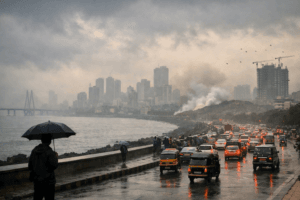
While Mumbaikars awoke on Tuesday to a familiar sight of grey skies and light drizzle, the India Meteorological Department’s (IMD) yellow alert for unseasonal rain was merely the surface-level story. The real, more insidious headline was written not in the clouds, but in the city’s air. With an Air Quality Index (AQI) hovering at 121—firmly in the “moderate” category—the city collectively inhaled a cocktail of pollutants. But in a landmark stance, the Bombay High Court has now declared that “moderate” is simply not good enough, turning a routine weather update into a critical conversation about public health, civic accountability, and the very air we breathe.
Decoding the Yellow Alert: More Than Just a Passing Shower
The IMD’s yellow alert, issued for Mumbai and Thane, predicted light rainfall over a three-hour window. True to forecast, light rain was recorded around 9:00 AM, offering a brief respite from the typical urban grind. Minimum temperatures at Colaba (22.4°C) and Santacruz (22.6°C) were unremarkable, painting a picture of a mild, slightly damp winter day. For most residents, this meant little more than carrying an umbrella and facing minor traffic delays.
However, the alert extended beyond the metropolis. It signalled a broader pattern of unseasonal weather across Maharashtra, with districts like Dhule, Jalna, Parbhani, and Nandurbar also on notice for thunderstorms and gusty winds. This pattern disruption, while not severe, hints at the larger, unpredictable climate rhythms the region is increasingly experiencing.
The “Moderate” Mirage: AQI Reveals a City Gasping for Breath
The heart of this story lies in the detailed, neighborhood-by-neighborhood breakdown of Mumbai’s air quality. The “moderate” city-wide average of 121 is a dangerously misleading mean. Drill down, and a stark disparity emerges:
- Andheri East (178) and Malad West (146) were teetering on the brink of the “poor” and “very poor” categories.
- Mazgaon (147) and Deonar (135) told tales of localized pollution hotspots, likely influenced by construction, traffic, and in Deonar’s case, the landfill site.
- Conversely, Mulund West (77) and parts of Navi Mumbai (94) breathed relatively easier.
This hyperlocal variance is critical. It means a resident in Andheri East is inhaling air more than twice as polluted as someone in Mulund West. The “moderate” label, as the High Court astutely pointed out, becomes a bureaucratic blanket that smothers urgent, localized action. An AQI between 100-200 can indeed cause breathing discomfort for people with lung, heart disease, or asthma, and prolonged exposure impacts even healthy individuals.
The Court’s Clarion Call: Mediocre Air is Not Acceptable
The most significant development embedded in this weather report is the judicial intervention. The Bombay High Court’s bench, led by Chief Justice Shree Chandrashekhar, dismantled the complacency of the “moderate” benchmark. Their message was unambiguous: Mumbai deserves better than mediocrity.
The court’s frustration is palpable. Having initiated a suo motu case three years ago to combat degrading air quality, the judges see insufficient progress. Their warning to potentially freeze the salaries of top civic officials in Mumbai and Navi Mumbai is a radical but telling indicator of their seriousness. This moves the issue from environmental discussion to one of direct administrative accountability. The court recognizes that “moderate” pollution still carries significant health hazards—increased respiratory infections, aggravated asthma, accelerated lung aging, and heightened cardiovascular stress. They are demanding sincerity over excuses, action over reports.
Connecting the Dots: Weather, Pollution, and Urban Life
The day’s conditions—high humidity, light winds, and cloudy skies—acted as a lid, trapping pollutants closer to the ground. The light rain, while washing away some larger particles, did little to scrub the air of finer, more dangerous PM2.5 and PM10 particulates. This is a classic Mumbai winter phenomenon, where cooler, calmer air allows pollution to pool.
The related AQI data from Maharashtra cities further contextualizes Mumbai’s struggle. Amravati (179) and Nagpur (172) were worse off, while Sangli (65) fared better. It shows that air pollution is a pervasive state-wide challenge, influenced by industrial activity, vehicular density, and geographical basins that trap air.
The Human Insight: What This Means for You
For the average Mumbaikar, this news transcends a simple weather advisory. It is a public health bulletin.
- Rethink “Moderate”: Internalize the court’s view. An AQI of 121-150 is not “safe”; it’s a warning, especially for vulnerable groups—children, the elderly, outdoor workers, and those with pre-existing conditions.
- Hyperlocal Awareness: Check real-time AQI for your specific suburb, not just Mumbai overall. A walk in Bandra might be different from a walk in Chembur.
- Personal Precautions: On days with high AQI and unstable weather:
- Sensitive groups should reduce prolonged or heavy exertion outdoors.
- Consider wearing N95 masks during peak traffic hours, a habit we shouldn’t have discarded post-pandemic.
- Keep indoor spaces well-ventilated but use air purifiers if possible, especially during early mornings and late evenings when pollution peaks.
- Civic Duty: The court’s stance empowers citizens to demand more. It validates concerns about relentless construction dust, inadequate waste management, and traffic congestion. Citizen pressure on local wards for better enforcement of dust mitigation norms, green covers, and waste processing is now backed by judicial precedent.
Looking Ahead: From Alert to Action
The yellow alert will pass. The rain will stop. But the question posed by the High Court will remain: will Mumbai settle for mediocre air? The update is a microcosm of the city’s larger battle—to balance explosive development with sustainable living. The true “forecast” needed isn’t just for rain, but for clear, accountable pathways to cleaner air.
The fusion of a routine weather alert with a groundbreaking judicial order creates a pivotal moment. It’s no longer just about whether you need an umbrella today. It’s about whether the city will provide its residents the fundamental right to breathe air that doesn’t just avoid being “severe,” but actively strives to be “good.” The skies may have issued a yellow alert, but for Mumbai’s administration and its citizens, the signal is now flashing red.
You must be logged in to post a comment.