
Beyond the Wickets: How Jammu and Kashmir’s Cricket Fairytale is Redefining a Region’s Identity
The article explores how Jammu and Kashmir’s emergence as a cricketing force, spearheaded by fast bowler Aquib Nabi’s record-breaking 60-wicket season and endorsement for the national team by Sourav Ganguly, transcends the sport to carry profound socio-political significance for India. Drawing a parallel to Afghanistan’s rise through adversity, the piece argues that this surge serves two crucial purposes: it deepens India’s cricketing talent pool, reinforcing the country’s global dominance by tapping into previously overlooked regions, and more importantly, it offers the people of the beleaguered territory a meaningful and unifying stake in the national mainstream through shared pride and sporting excellence, transforming the narrative from one of political strife to one of collective achievement and hope.
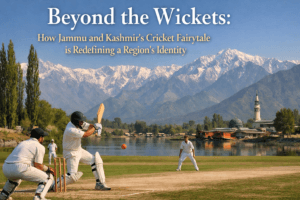
Beyond the Wickets: How Jammu and Kashmir’s Cricket Fairytale is Redefining a Region’s Identity
The dusty, sun-baked grounds of Srinagar and Jammu are not usually where the power brokers of Indian cricket look for the next big thing. The talent pipelines have historically flowed from the metropolises—Mumbai’s maidans, Delhi’s leafy surrounds, Bangalore’s corporate leagues. But if you listen closely during the domestic cricket season, the sound of leather on willow echoes differently in the Himalayas. It carries the weight of aspiration, the crackle of hope, and the whispers of a region finding its voice through sport.
At the heart of this sonic shift is the menacing figure of Aquib Nabi, sprinting towards the crease with the fury of a man on a mission. With 60 wickets in the season, he has been the blunt-force instrument of his team’s success. But to frame this story solely around statistics would be to miss the forest for the trees. This is not just a story about cricket; it is a story about India, about identity, and about the improbable power of a ball striking a willow to heal wounds that politics cannot reach.
The Spearhead and the Dream
To watch Aquib Nabi bowl is to witness a paradox. He combines the raw, skiddy pace of a street cricketer with the disciplined line of a seasoned professional. His 60-wicket haul wasn’t just a number; it was a statement. It was a significant leap from the 44 he claimed the previous year, a jump that signals a man who is not just performing but evolving.
There is a specific kind of hunger that defines cricketers from conflict zones. It is the same hunger that fueled the rise of the Afghanistan cricket team—a relentless drive to prove that they are more than the headlines that define their homeland. Nabi carries that aura. His celebrations are not just releases of joy; they are affirmations of existence.
His breakout season earned him an IPL contract with the Delhi Daredevils (now Capitals), a portal into the glitzy heart of Indian cricket. But the true validation came from a man who knows a thing or two about pressure and pedigree. When Sourav Ganguly—the man who once bared his chest at the Lord’s balcony—publicly endorses you for Test cricket, the world listens.
“Nabi has the tools to play Test cricket for India,” Ganguly stated. It was a line that sent ripples through the Kashmir Valley. In a place where every conversation about “mainstream” is laden with political subtext, here was a former Indian captain inviting a Kashmiri lad into the country’s most elite sporting club. It was an acceptance letter, written in the language of cricket.
The Afghanistan Parallel: Forged in Fire
The comparison between Jammu and Kashmir’s rise and Afghanistan’s ascent in world cricket is not just poetic; it is deeply sociological.
Afghanistan’s journey was forged in the crucible of displacement and war. A generation of Afghans learned cricket in the refugee camps of Pakistan, using the sport as a tether to normalcy. When they returned, they built a team that reflected their struggle: gritty, fearless, and unyielding. They gave a fractured nation a unifying flag to rally behind.
Kashmir’s story, while distinct in its political context, shares that emotional DNA. For years, cricketing talent in the valley was a hidden gem. Young men played on the banks of the Jhelum, on concrete strips in remote villages, with tape-ball tennis balls, dreaming of a stage that felt a world away. The infrastructure was lacking, the pathways unclear, and the socio-political environment often volatile.
The current surge is the culmination of those latent dreams finally finding an outlet. It is a classic underdog narrative, but with higher stakes. For a region beleaguered by decades of uncertainty, having a team that can punch above its weight on the national stage provides a psychological victory that transcends sport. It says: We are here. We can compete. We can win.
The First Consequence: Deepening India’s Cricketing Moat
For the Board of Control for Cricket in India (BCCI) and the national team’s think tank, the emergence of Jammu and Kashmir as a talent factory is a strategic goldmine.
India’s dominance in world cricket rests on one non-negotiable pillar: depth. While Australia relies on a handful of states and England on a handful of counties, India draws from a population of 1.4 billion and a geographical expanse that covers every climate, every culture, and every type of cricketing condition.
The rise of J&K means that the talent net is cast wider than ever before. It means that a fast bowler from the cold climes of the valley develops a natural skid and bounce that is invaluable on Australian pitches. It means a batsman from Jammu, batting on slow, low turners, learns the art of patience and shot-making against spin that is perfect for the subcontinent.
Aquib Nabi is the prototype. His raw pace is a natural resource, honed by the thin air and the grit of his environment. When he enters the Indian dressing room, he brings not just his 60 wickets, but a different kind of resilience—a mental fortitude forged in circumstances far tougher than a simple game of cricket.
This expansion ensures that the Indian team remains a living, breathing organism, constantly refreshed by new blood from unexpected corners. It keeps the system honest and the competition fierce. Every time a player from the periphery succeeds, it sends a message to the millions playing in the margins: the road to the top is long, but it exists.
The Second Consequence: A Stake in the National Mainstream
This is where the story transcends sport and enters the realm of nation-building.
Jammu and Kashmir has often been discussed in the language of security, administration, and geopolitics. The people, the insani (human) element, can sometimes get lost in the abstract discussions of hukumath (governance). Cricket is changing the conversation.
Sporting excellence offers something that legislation cannot always provide: a sense of belonging that is earned, not granted. When Nabi runs in to bowl for his Ranji Trophy side, he is not just representing a team; he is carrying the hopes of a million Kashmiris. When his name is chanted in the stands, it is not a political slogan; it is a cheer for shared excellence.
This is the “meaningful stake in the national mainstream” that the original report alludes to. It is the realization that the path to integration does not have to be exclusively political. It can be cultural. It can be through cinema, music, and most potently in India, through cricket.
For a young kid in Srinagar, seeing Aquib Nabi share a dressing room with a player from Tamil Nadu, or bowl to a batsman from Punjab, normalizes the idea of a unified India. It breaks down the “us vs. them” barrier and replaces it with a “we.” The team becomes a microcosm of the nation—diverse, competitive, and united by a common goal.
In a region where narratives of alienation have often taken root, the cricket team offers a powerful counternarrative: a narrative of inclusion, of opportunity, and of pride. The tricolor that flies over the stadium when J&K plays is not just a flag; in that context, it becomes a symbol of a shared victory.
The Road Ahead: Uncertainty and Hope
Yet, for all the fairytale elements, the path forward is fraught with uncertainty. The leap from domestic star to international cricketer is the widest chasm in sport.
For Nabi, the challenge is mental as much as physical. The IPL will expose him to the glitz and pressure of the world’s biggest T20 league. The question is whether he can retain the raw edge that made him special while refining his craft. Can he handle the analysis, the fame, the expectations? Sourav Ganguly believes he has the “tools,” but tools must be wielded with a calm mind.
For the region, the challenge is sustainability. Is this a golden generation, or the start of a consistent pipeline? It requires investment in infrastructure, coaching, and mental health support for players who carry immense burdens. The J&K Cricket Association must build on this momentum, ensuring that Nabi is not a shooting star but the first of many constellations.
Conclusion: A Win for the Whole Country
As the season ends and the records are filed away, the legacy of this moment for Jammu and Kashmir cricket will linger. Aquib Nabi’s 60 wickets are a statistic, but the hope they have generated is immeasurable.
This rise matters because it reminds India of its own diversity. It proves that cricketing excellence is not the preserve of the traditional hubs. It can bloom in the shadows of the Himalayas, on the banks of the Jhelum, and in the bustling city of Jammu.
Most importantly, it offers a glimpse of a different future. A future where the headlines about the region are not about cross-border firings or stone-pelting, but about a yorker that shattered the stumps of a Mumbai batting legend. A future where the “mainstream” is not a political destination, but a shared space where a fast bowler from the valley can be celebrated as the next big hope for the Indian cricket team.
In that sense, the surge of Jammu and Kashmir cricket is not just their victory. It is a win for the entire country—a testament to the idea that when you give people a platform to excel, the boundaries they break are not just on the cricket field, but in the mind.
You must be logged in to post a comment.