
Beyond the White Cube: How Wall Art India 2026 is Scripting a New Visual Language on the Nation’s Walls
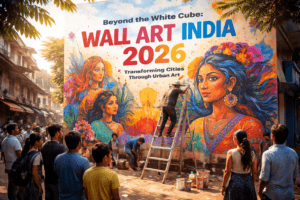
Beyond the White Cube: How Wall Art India 2026 is Scripting a New Visual Language on the Nation’s Walls
Forget everything you know about gallery previews and vernissage canapés. This March, the most compelling contemporary art exhibition in India isn’t behind a velvet rope—it’s on a bustling street corner in Nagpur, a quiet lane in Puducherry, or a busy flyover in Bengaluru. Wall Art India returns for its fifth edition, and it’s inviting the entire country to look up, engage, and reclaim the public realm as a space for shared dreams.
There is a specific kind of magic that happens when an artist’s ladder touches a rough, sun-warmed wall in a dense urban neighbourhood. It’s a quiet act of defiance against the grey monotony of concrete, a splash of colour that interrupts the daily commute and sparks a conversation between a stranger and a surface.
From 10 February to 9 March 2026, that magic is spreading across 15 Indian cities as Wall Art India, the ambitious urban art initiative led by the Alliance Française network in collaboration with the Embassy of France and the Institut Français, returns for its milestone fifth edition. What began in 2021 as a bridge between French and Indian artistic expression has evolved into one of the subcontinent’s most significant cultural movements—one that fundamentally asks: Whose city is this, and who gets to write its story?
The Canvas of the Everyday
The genius of Wall Art India lies not just in the scale of its murals, but in its philosophy. In an era where art is often commodified, digitised, and confined to the air-conditioned silence of the “white cube,” this festival shatters the fourth wall—literally. It places art back into the flow of life.
For the residents of the 15 host cities, the festival isn’t a distant event to be read about in a newspaper; it is a visceral, month-long experience. They wake up to the sound of compressors and the scent of spray paint. They watch as blank, often neglected walls—those forgotten spaces between buildings—transform into vibrant portals of imagination.
This year’s iteration is particularly poignant. Under the theme “Women, Horizons & New Voices in Urban Art,” the 2026 edition is a deliberate and powerful curation that places feminine energy, resilience, and emerging perspectives at the forefront of the urban landscape. It’s a statement that the walls of our cities should reflect the diversity of the people who inhabit them.
The Architects of Dialogue: Meet the Artists
A festival is only as strong as its creators, and this year, Wall Art India has assembled a quartet of artistic voices that represent a dynamic spectrum of styles, philosophies, and cultural backgrounds. The selection of three artists from France (including one from the vibrant island of Réunion) and one from India ensures a cross-pollination of ideas that goes far beyond aesthetic tourism.
1. Khatra (India): The Poetics of the Painted Word
Based in Baroda, a city renowned for its artistic pedigree, Khatra is an artist who understands that a wall has a voice even before the paint touches it. His work is a meditative dialogue with urban decay and renewal. By blending expressive typography with bold abstraction, he doesn’t just cover a surface; he excavates its hidden stories. His murals often feel like ancient inscriptions rediscovered in a modern metropolis—a raw, textured calligraphy that speaks of the city’s soul, its struggles, and its rhythms. For Khatra, the imperfections of a wall—the stains, the cracks, the peeling plaster—are not obstacles; they are collaborators.
2. Kashink (France): The Triumph of Colour and Identity
You cannot walk past a Kashink mural without stopping. A giant of the international street art scene, her work is an explosion of unapologetic vibrancy. Her signature style—bold, multi-faced characters with thick black lines and a palette that seems to vibrate with energy—is a joyful rebellion against the mundane. But beneath the playful, cartoonish surface lies a profound political and social commentary. Kashink’s art is a manifesto for freedom of identity, a celebration of queerness, body positivity, and the dismantling of patriarchal norms. In a country like India, where gender roles are deeply entrenched, her murals become powerful, silent advocates for a more inclusive and fluid understanding of self.
3. Kesadi (France): Finding the Extraordinary in the Ordinary
There is a quiet, documentary quality to the work of Kesadi. Growing from a foundation in traditional graffiti, his art has evolved into a poetic realism that captures the fleeting moments of urban life. He finds beauty in the banal—a group of kids playing cricket in a dusty gully, a chai wallah lost in thought, the intricate geometry of drying laundry on a balcony. By elevating these everyday scenes onto a monumental scale, Kesadi validates the lives of the common citizen. His murals act as mirrors, reflecting the community back to itself and reminding them that their stories are worthy of being immortalised.
4. Dey MKO (France / Réunion): The Resonance of Ancestral Strength
Hailing from the multicultural crucible of Réunion Island, Dey MKO brings a visual language steeped in symbolism and the raw power of the natural world. Her large-scale murals are characterised by an intense, almost volcanic palette and a focus on the female form as a vessel of collective memory. She explores the narratives of women—their pain, their joy, their unbreakable resilience—and connects them to broader themes of ancestry, earth, and community. In a festival celebrating “Women, Horizons & New Voices,” Dey MKO’s presence is vital. Her work feels like a bridge between the personal and the mythological, a visual incantation that honours the strength passed down through generations of women.
Beyond the Wall: The Participatory Process
What transforms a mural painted by a foreign or visiting artist from a mere spectacle into a genuine community asset is the process. Wall Art India places immense emphasis on participation. Throughout the month, these four artists aren’t just working in isolation. They are engaging in a series of workshops, conversations, and collaborative sessions with local students, NGOs, and neighbourhood youth.
Imagine a teenager in a small town, who has never visited a museum, holding a spray can for the first time, guided by an artist from halfway across the world. In that moment, the wall becomes a classroom, a studio, and a bridge. The final artwork, therefore, is not just the vision of the artist; it is imbued with the energy, stories, and even the inadvertent marks of the community. It becomes their mural, a source of local pride and a landmark that holds shared memories.
The Grand Finale: A Symphony in Bengaluru
The crescendo of this month-long artistic journey will occur on 8 March 2026—International Women’s Day—in the garden city of Bengaluru. The Grand Finale will see Kashink, Dey MKO, and Khatra come together for a monumental collaborative project. This is a logistical and artistic challenge of the highest order. Three distinct voices, three unique styles, must find harmony on a single, massive canvas. The result will be a living metaphor for the festival itself: a testament to how dialogue, mutual respect, and a shared vision can create something more beautiful and complex than any single artist could achieve alone. It is a fitting tribute to the theme, symbolising the collective power of women and new voices shaping the future.
A Lasting Legacy on the Urban Canvas
Since its inception, Wall Art India has not been in the business of temporary spectacles. The proof of its impact is scattered across the urban fabric of India and Sri Lanka, where over 40 of its murals remain standing—vibrant, weathered, and integrated into the daily lives of the cities that host them. They have become photo spots, meeting points, and landmarks.
These murals do more than beautify. They contribute to the cultural economy, drawing visitors and generating media coverage that puts host cities on a global map. They challenge the notion that art is an elite pursuit, proving instead that it is a fundamental human need—a tool for inclusion, a catalyst for conversation, and a powerful agent of urban transformation.
As cities in India grapple with breakneck growth, the question of public space becomes increasingly urgent. Wall Art India offers a beautiful answer. It posits that our streets can be more than just arteries for traffic; they can be living galleries, forums for dialogue, and repositories of shared imagination. In a world that often feels fragmented, a splash of colour on a wall, created by a community and an artist in unison, is a small but profound act of reclaiming not just the streets, but our connection to one another.
So, as the festival unfolds over the coming weeks, take a detour from your usual route. Walk through the neighbourhoods you thought you knew. You might just discover a new horizon, painted right on the walls of home.
You must be logged in to post a comment.