
Beyond the Visual Clutter: How Kolkata’s ‘Less is More’ Exhibition Redefines India’s Artistic Soul
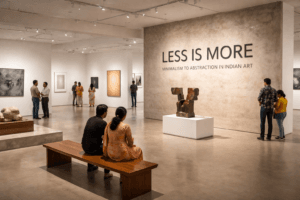
The ongoing “Less Is More: Minimalism to Abstraction in Indian Art” exhibition at Kolkata’s CIMA Gallery, running until February 2026, presents a transformative narrative that reclaims abstraction as an indigenous language rather than a Western import. By curating over 100 works from artists like Ganesh Haloi, Bimal Kundu, and modern masters including S.H. Raza and V.S. Gaitonde, the show traces a direct lineage from contemporary minimalist practices to ancient spiritual and philosophical traditions—such as Jain geometry, Vedic concepts of shunya, and tribal art forms like Warli and Gond. It argues compellingly that the drive to reduce form to its essence is deeply embedded in India’s artistic psyche, a fact historically mediated through channels like the Theosophical Society. More than an art display, the exhibition acts as a vital “visual detox” for the digital age, inviting viewers to engage with silence, space, and the profound metaphysical resonance found in deliberate restraint, thereby challenging entrenched art historical narratives and highlighting the enduring power of simplicity.
Beyond the Visual Clutter: How Kolkata’s ‘Less is More’ Exhibition Redefines India’s Artistic Soul
In the heart of Kolkata, a city synonymous with vibrant chaos, intellectual fervor, and a rich tapestry of sensory experiences, a profound quiet is unfolding. At the Centre of International Modern Art (CIMA), the exhibition “Less is More: Minimalism to Abstraction in Indian Art” offers not just a display of art, but a sanctuary. Running until February 2026, this free-to-enter showcase is more than an aesthetic collection; it is a bold, scholarly, and deeply felt argument that challenges the very foundations of how we write modern art history. It posits that the language of abstraction is not a foreign import to India but a mother tongue, spoken for millennia in spiritual, philosophical, and tribal vernaculars.
Recalibrating the Artistic Compass: From Periphery to Centre
For too long, minimalism and abstraction in Indian art have been viewed through a borrowed lens—often relegated to the status of interesting derivatives of Western movements like Abstract Expressionism or Minimalism. The curation by Rakhi Sarkar, anchored by a powerful introductory essay, acts as a necessary corrective. It meticulously dismantles the Eurocentric narrative that crowns the 20th-century West as the sole birthplace of non-representational art. Instead, the exhibition plants its flag firmly on indigenous ground, tracing a lineage that stretches back to the precise, cosmic geometry of Jain manuscripts, the contemplative emptiness (shunya) of Vedic thought, and the ritual diagrams (yantras) of Tantra.
This is not mere art historical revisionism; it is a reclamation of intellectual and spiritual sovereignty. By presenting over 100 works, the exhibition constructs a visual continuum. It asks the viewer to see the connection between a ancient mandala and a contemporary canvas by V.S. Gaitonde, not as a vague inspiration, but as a shared exploration of cosmos, consciousness, and form.
The Philosophy of Absence: A “Visual Detox” for the Digital Age
In an era of relentless digital noise and informational overload, the exhibition’s timing is prescient. It frames minimalism not as a stylistic choice, but as a form of “visual detox” and heightened attentiveness. When faced with a nearly monochromatic work by Seema Ghurayya or the etched, wounded textures of Somnath Hore’s “Wounds” series, the viewer is stripped of the easy crutch of narrative. There is no story to “read,” no figure to identify. We are left alone with scale, texture, rhythm, and the weight of presence—or the profound power of absence.
This is where the exhibition reveals its true human insight. It understands that in forcing this encounter with the elemental, it creates space for introspection. The “less” of the title does not mean deprivation; it signifies distillation. It is the process of removing the extraneous to arrive at an essence—be it an emotion, a memory, or a metaphysical truth.
Artists as Philosophers: Translating the Intangible
The selected artists serve as masterful translators of this intangible philosophy. Ganesh Haloi’s works are a standout meditation on memory. His landscapes, stripped of specific detail, become not topographical records but emotional maps—a “landscape of memory” where earth, water, and sky are reduced to their essential hues and forms, evoking a deep, nostalgic peace.
In the three-dimensional realm, Bimal Kundu’s sculptures perform a magical contradiction. Using industrial materials like aluminum, he crafts forms that capture the weightless dynamism of a bird in flight. His work proves that minimalism is not cold or sterile; it can be as emotive and lyrical as any figurative piece, achieving its impact through refined form and implied movement rather than explicit depiction.
The inclusion of modern masters like S.H. Raza (with his seminal Bindu and geometric explorations), M.F. Husain, and J. Swaminathan is crucial. It grounds the exhibition’s radical thesis in the canon of Indian modernism, showing how these pioneers were not merely aping Western trends but were often engaged in a conscious dialogue with their own cultural substrata.
The Theosophical Bridge and a Two-Way Dialogue
One of the exhibition’s most compelling historical arguments involves the Theosophical Society, founded in 1875. The show posits this society as a crucial, often-overlooked conduit. It was through Theosophy that core Indian philosophical concepts of the transcendental, the invisible, and the geometric nature of the cosmos traveled to the West, influencing early pioneers of abstraction like Wassily Kandinsky and Piet Mondrian. This reframes the global story of abstraction from one of Western invention and Eastern adoption to a more complex, earlier dialogue. When we view a grid-based painting, we are thus witnessing a potential conversation—a idea that may have journeyed from India, was metabolized in Europe, and has now returned home, transformed yet familiar.
A Tapestry of Media: Beyond the Canvas
True to its expansive vision, “Less is More” transcends the painted canvas. It features hand-stitched textiles that carry the rhythm of needle and thread, bronze sculptures that play with volume and void, and paper collages that explore fragility and layering. This diversity reinforces the idea that the drive towards essential form is not medium-specific but is a pervasive artistic impulse. It is found in the symbolic reduction of Warli and Gond art, where human and animal forms become elegant pictograms tied to cosmological stories, just as it is in the polished metal of a contemporary sculpture.
Why This Exhibition Matters Now
Beyond the art world, this exhibition offers a resonant metaphor for contemporary life. In a culture that equates success with accumulation—more goods, more data, more noise—“Less is More” is a clarion call to consider the value of subtraction, silence, and space. It argues that profundity often lies in what is suggested, not stated; in the pause, not the note.
For students of art, it is an invaluable resource that recalibrates the textbook narrative. For the public, it is an immersive experience that educates not through placards, but through feeling. It teaches us to look differently, to appreciate the emotional resonance of a single, confident line or a carefully balanced block of color.
Final Takeaway: A Legacy of Form and Thought
“Less is More: Minimalism to Abstraction in Indian Art” is more than an exhibition; it is a landmark statement. It successfully stakes the claim that abstraction is an enduring, indigenous visual language within the Indian subcontinent. It liberates these artists from the restrictive narrative of Western derivative and places them within a majestic, timeless continuum—from the cave walls of Bhimbetka to the serene galleries of CIMA.
By the time you leave, the quiet of the gallery lingers. It leaves you with a renewed understanding that India’s abstract and minimal art is not a silent partner in global modernism, but a voice with its own ancient grammar, speaking eloquently of the seen and the unseen, the form and the formless. In doing so, it offers not just a history lesson, but a timeless wisdom: that in the pursuit of meaning, sometimes, the most powerful statement is made by what remains unspoken.
You must be logged in to post a comment.