
Beyond the Verdict: Why the Supreme Court’s Rejection of the ‘Covid Attempt’ Plea Marks the End of a Long Road for UPSC Aspirants
The Supreme Court on March 12, 2026, dismissed a plea by UPSC aspirant Jaimin Patel seeking a one-time additional attempt and age relaxation for the 2026 Civil Services Examination, a demand rooted in the disruption caused by the COVID-19 pandemic to candidates’ final permissible attempts in 2020 and 2021. While the petition highlighted unheeded parliamentary recommendations and the need for a consultative process, the bench of Justices Vikram Nath and Sandeep Mehta refused to intervene, citing the principle of laches (delay), as the petitioner approached the court nearly five years after the fact. The ruling effectively closes the door on judicial remedies for that cohort of aspirants, underscoring the courts’ reluctance to unsettle established exam eligibility criteria years after the event, even in light of past pandemic-related hardships.
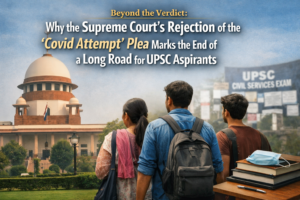
Beyond the Verdict: Why the Supreme Court’s Rejection of the ‘Covid Attempt’ Plea Marks the End of a Long Road for UPSC Aspirants
In a significant ruling on March 12, 2026, the Supreme Court dismissed a plea that sought one last opportunity for a group of Civil Services aspirants—those whose final permissible attempt at the prestigious examination was “lost” to the COVID-19 pandemic . The bench, comprising Justices Vikram Nath and Sandeep Mehta, refused to entertain the petition filed by Jaimin Patel, a self-described “Covid warrior,” who argued that the disruption of the 2020 and 2021 exam cycles robbed him and many others of their fair shot at securing a future in the Indian bureaucracy .
While the headline delivers the legal outcome, the story beneath it is a complex tapestry of dashed hopes, parliamentary recommendations, administrative delays, and the unforgiving nature of the law. This article delves into the nuances of the verdict, the eligibility structure of the UPSC exam, and what this means for the thousands of aspirants who still carry the scars of the pandemic years.
The Case: A Final Appeal for a Lost Year
The petition before the Supreme Court was more than just a personal grievance; it was a symbolic last stand for a generation of aspirants whose preparation timelines were shattered by the global health crisis. The petitioner, Jaimin Patel, found himself in a particularly cruel bind. Statedly denied leave to appear for the exam in 2021, he watched his final attempt slip away—not due to a lack of preparation, but due to circumstances entirely beyond his control .
His legal challenge was not just about his own fate. The plea sought the constitution of an inter-ministerial committee, invoking the mandatory consultative framework under Article 77(3) of the Constitution. Patel argued that despite clear judicial directions in the past (notably the case of Arijit Shukla v. Union of India), and specific recommendations from a Parliamentary Standing Committee, the government had failed to engage in a proper consultative process with cadre-controlling authorities and the UPSC to revisit the eligibility rules .
The core demand was simple yet profound: grant a one-time additional attempt for the 2026 Civil Services Examination (scheduled for May 24, 2026) along with corresponding age relaxation for those whose last chance fell in the pandemic years of 2020 and 2021. Until such a decision was made, the petitioner even prayed for a stay on the issuance of the CSE 2026 advertisement concerning age and attempt limits .
The Court’s Reasoning: The ‘Laches’ Doctrine
However, the Supreme Court was unmoved. The bench’s primary reason for dismissing the plea was the principle of laches, or “delay and latches”—a legal doctrine that bars claimants from seeking relief if they wait too long to assert their rights. The Court noted that the petitioner had approached it after a gap of nearly five years .
“The pandemic years were 2020 and 2021. To challenge the eligibility rules or seek relaxation now, on the brink of the 2026 examination, is simply too late,” the bench reportedly observed .
This reasoning underscores a critical aspect of judicial review in matters of public examinations. Courts are generally reluctant to disturb the timetable and settled policies of exams like the UPSC CSE, which involves lakhs of candidates and immense logistical coordination. By waiting nearly half a decade, the petitioners allowed the government and the UPSC to proceed with multiple examination cycles based on existing rules, thereby creating a scenario where last-minute changes would cause administrative chaos and potential injustice to other candidates who planned their strategies according to the current framework.
The Unforgiving Math of UPSC Eligibility
To understand the desperation fueling such pleas, one must grasp the rigid arithmetic of the UPSC Civil Services Examination. It is often said that clearing the CSE requires not just knowledge, but a meticulous life plan centered around age and attempt limits.
As per the standard eligibility for the 2026 exam, a General category candidate must be between 21 and 32 years old as of August 1, 2026, and is permitted a maximum of six attempts . An “attempt” is officially counted the moment a candidate sits for the Preliminary examination . For Other Backward Classes (OBC), the upper age limit is relaxed to 35 years with nine attempts, while Scheduled Caste (SC) and Scheduled Tribe (ST) candidates enjoy an upper age limit of 37 years with unlimited attempts .
For a General or OBC candidate on their last permissible attempt, the stakes are impossibly high. The pandemic struck at the worst possible time. In 2020 and 2021, libraries were shut, coaching centers went offline, and access to study material was restricted. While the UPSC did postpone some exams, it did not alter the fundamental eligibility criteria. For those who “appeared” and failed during those years, it meant an attempt was consumed under duress. For those who couldn’t appear at all—like the petitioner who couldn’t get leave from work—it meant the loss of their final chance forever.
A History of Unheeded Recommendations
What adds a layer of poignancy to the Supreme Court’s dismissal is the fact that the grievance was not without political or parliamentary backing. In March 2022, the Department-related Parliamentary Standing Committee on Personnel, Public Grievances, Law, and Justice presented its 112th Report to Parliament .
The committee was unequivocal in its empathy. It noted that the COVID-19 pandemic caused “untold agony and insurmountable sufferings,” disrupting the lives of the student community. In a direct appeal to the government, the committee recommended a change of mind, urging them to “sympathetically consider the demand of CSE aspirants and grant an extra attempt with corresponding age relaxation to all candidates” .
For aspirants like Jaimin Patel, this was a beacon of hope. It suggested that the highest levels of parliamentary democracy recognized their hardship. Yet, a parliamentary recommendation is not a binding order. It serves as advice to the government, which in this case, appears to have not translated into a formal policy change. The Supreme Court’s dismissal now effectively shuts the door on any judicial remedy, emphasizing that the executive’s failure to act on a recommendation cannot be eternally challenged in court.
The Human Toll: More Than Just a Number
Behind the legal jargon of “Article 77(3)” and “latches” lie thousands of human stories. The UPSC journey is not a casual endeavor; it is an all-consuming passion. Aspirants often spend years—and significant family savings—building their knowledge base. They move to Delhi’s Mukherjee Nagar or Allahabad, leaving behind their homes, to immerse themselves in an ecosystem of preparation.
For the “COVID batch,” the tragedy was twofold. First, the immediate disruption of the lockdowns. Second, and perhaps more damaging, was the long tail of uncertainty. The pandemic created a “lost year” academically, but the clock for age and attempts never stopped ticking. A 28-year-old General category candidate in 2020 who had used four attempts knew they had two left. After the pandemic-induced disruptions, they had to attempt the exam in a high-stakes environment with diminished preparation quality. If they failed in 2021, they were left with just one final attempt—a pressure cooker situation that the pre-pandemic batch never had to face.
The petitioner’s claim of being a “Covid warrior” adds another layer. Many aspirants, trapped in their hometowns or serving in essential services, were unable to study or even apply. The law, however, does not easily distinguish between a candidate who failed to prepare due to general pandemic stress and one who was physically guarding the nation’s health on the front lines.
Precedent and the Path of Litigation
The Supreme Court’s decision also aligns with a growing judicial trend of refusing to reopen the eligibility criteria for competitive exams years after the fact. In a similar instance just a year prior, in April 2025, the Himachal Pradesh High Court dismissed a plea by one Raja Ram Sahu . Sahu, who had been attempting the exam since 2013, argued that his final attempt in 2020 was ineffective due to COVID.
The High Court firmly held that “unsuccessful participation” cannot be equated with an “inability to appear.” The court emphasized that the petitioner had actually taken the exam in 2020, and while the pandemic was a challenge, it was a challenge faced uniformly by all aspirants. The fact that others succeeded despite the circumstances proved that the examination field was level .
This distinction is crucial. The courts have signaled that they are willing to protect the right to appear for an exam if someone is wrongly denied a hall ticket. However, they are not willing to guarantee the right to succeed under favorable conditions. The pandemic was a force majeure event, but the judiciary appears to view its impact on the quality of preparation as an equal-opportunity disadvantage, not a ground for special privilege.
The Road Ahead for Affected Aspirants
With the Supreme Court dismissing the plea, the possibility of a one-time additional attempt for the 2026 exam is now legally dead. The UPSC CSE 2026 notification is expected to proceed with the standard eligibility criteria published in its brochure .
For the candidates this petition sought to represent, the future is stark. Most are likely now age-barred, having crossed the 32-year or 35-year threshold. The dream of donning the coveted “Lal Bahadur Shastri” or “Sardar Patel” uniform may remain forever unfulfilled.
However, the end of this legal battle does not mean the end of the discourse. The pandemic exposed the fragility of rigid administrative frameworks in the face of black swan events. While the courts cannot rewrite rules years later, the executive branch might still, in the future, consider a one-time policy measure for a specific examination cycle, independent of judicial prodding. The parliamentary recommendation remains on record, a testament to the fact that the argument for compassion had merit, even if it arrived too late in the judicial timeline.
Conclusion: A Harsh Lesson in Timeliness
The Supreme Court’s rejection of the plea serves as a harsh but definitive lesson in the importance of timely legal action. While the quest for an extra attempt was rooted in genuine hardship and backed by parliamentary sympathy, the five-year delay proved insurmountable. The Court rightly pointed out that the stability of public examination systems cannot be held hostage to challenges brought on the eve of a new exam cycle.
As the UPSC CSE 2026 advertisement is set to be released, aspirants must look forward. The judgment reinforces that the rules of the game, however harsh they may seem, are announced at the start. For those still within their attempt limits, the moral of the story is clear: every attempt counts, and the clock never stops.
For Jaimin Patel and his cohort, the Supreme Court may have dismissed their plea, but their struggle will likely remain a poignant chapter in the post-pandemic history of India’s toughest examination—a reminder of the fine line between a lost year and a lost dream.
You must be logged in to post a comment.