
Beyond the Verdict: Conscience, Conflict, and the Crackdown on Direct Action
In a case that underscores the volatile intersection of conscientious protest, legal boundaries, and international conflict, five of six Palestine Action activists were released on bail pending a potential retrial after a jury delivered mixed verdicts over a 2024 break-in at an Elbit Systems UK factory near Bristol. While all were cleared of the most serious charge of aggravated burglary, the jury failed to reach unanimous decisions on counts of criminal damage and violent disorder, amid a highly charged atmosphere that saw anonymous posters advocating for “jury equity”—the principle that jurors can acquit on moral grounds—appear near the courthouse. The defendants, who claimed their action was a non-violent direct intervention to disrupt arms supplies they link to the war in Gaza, now face a retrial in a significantly altered landscape, as Palestine Action has since been proscribed by the government as a terrorist organization, fundamentally recasting such acts of dissent within a stricter legal and political framework.
Beyond the Verdict: Conscience, Conflict, and the Crackdown on Direct Action
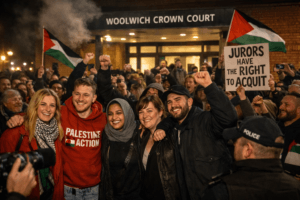
The air outside Woolwich Crown Court was cold and thick with tension late on a Wednesday evening. After a marathon trial spanning months and a gruelling 36 hours of jury deliberation, five of the six defendants emerged, not to prison vans, but to the cheers of roughly a hundred supporters. Their release on bail was not an exoneration, but a reprieve—a pause in a legal saga that cuts to the heart of modern protest, the limits of dissent, and the fiercely contested line between criminal damage and conscientious action.
The case of the six Palestine Action activists—Charlotte Head, Samuel Corner, Leona Kamio, Fatema Rajwani, Zoe Rogers, and Jordan Devlin—is more than a story of a break-in. It is a prism through which Britain’s relationship with activism, international conflict, and judicial independence is being tested. Their target in the pre-dawn hours of August 6, 2024, was a factory in Bristol operated by Elbit Systems UK, a subsidiary of Israel’s largest defence company. Their mission, as they saw it, was to disrupt and dismantle machinery they believed was being used to manufacture components for weapons used by the Israeli military in Gaza—a claim Elbit strenuously denies.
The Anatomy of an Action
What the prosecution framed as a premeditated, violent aggravated burglary, the defendants described as a desperate act of intervention. The imagery was stark: a repurposed prison van, driven by charity worker Charlotte Head, ramming through a perimeter fence before being used as a “battering ram” to access the factory interior. Inside, the scene descended into what Head called “the craziest 20 minutes” of her life—a chaos of sledgehammers, spray paint, and the disorienting blast of a foam fire extinguisher.
The prosecution’s narrative was one of orchestrated violence. They alleged security guards were sworn at, threatened, and attacked; that sledgehammers were swung; that one officer, Police Sergeant Kate Evans, was struck in the back with such a tool, leading to a charge of grievous bodily harm with intent against Samuel Corner (on which the jury could not reach a verdict). The defendants, their barrister Rajiv Menon KC argued, were “completely out of their depth,” insisting they had only intended a property occupation and had reacted in self-defence to an unexpectedly forceful security response. Notably, none of the security staff face criminal investigation.
This clash of narratives played out in a courtroom, but its roots are global. The trial heard that the defendants “genuinely believed” their actions would aid the Palestinian cause. Their motivation was not personal gain but a profound, politically-charged conviction, placing their direct action within a long, contentious tradition of civil disobedience where the law is broken to serve a higher moral purpose, as perceived by the actor.
The Elephant in the Jury Room: Conscience Versus Law
Perhaps the most extraordinary dimension of this trial emerged not from the evidence, but from the streets surrounding the courthouse. While the jury was in retirement, posters appeared on bus stops and lampposts. They bore simple, potent messages: “The jury decide not the judge,” “Jury equity is when a jury acquits someone on moral grounds,” and “Jurors can give a not guilty verdict even when they believe a defendant has broken the law.”
These posters pointed directly to the ancient, powerful, and double-edged principle of “jury equity” or “jury nullification.” This is the de facto power of a jury to acquit a defendant, even if the evidence proves they technically committed the offence, because the jury believes the law itself is unjust, misapplied, or that a conviction would be morally wrong. It is the legacy of historic cases where juries refused to convict under repressive laws, a silent check on state power embedded in the common law system.
The prosecution was aware of the posters; police removed them, only for them to reappear. The judge, in a careful instruction, advised jurors to avoid external influence and return verdicts based solely on the evidence. Crucially, he absolved the defendants of any involvement, but the seed had been planted. The partial verdicts—clear acquittals on aggravated burglary for all, mixed outcomes on violent disorder and criminal damage—suggest a jury deeply conflicted, perhaps wrestling with the very conscience-versus-law dilemma the posters highlighted. Did they accept the defendants broke the law, but struggle to condemn their reasons?
A Shifting Legal Landscape: Proscription and the Terrorism Frame
The context of this potential retrial has seismically shifted since the action itself. On July 5, 2025—nearly a year after the Bristol break-in—the UK government proscribed Palestine Action as a “terrorist” organisation. Supporting the group is now a criminal offence under the Terrorism Act 2000.
This move fundamentally alters the stakes. While the defendants were not tried under terrorism legislation (their actions predating the proscription), the shadow of that designation now hangs over any future activity and public support. It recasts their narrative of conscientious protest into a state-defined framework of extremism. For the government, it is a necessary step to counter what it views as a violent, extremist single-issue campaign targeting British businesses. For the movement’s supporters, it is a profound chilling of dissent, a political manoeuvre to criminalise solidarity and shield arms manufacturers from scrutiny.
The proscription raises a critical question for future cases: when does property destruction in service of a political cause cross from criminal damage into terrorism? The answer, increasingly, may depend less on the nature of the act and more on the political alignment of the cause.
The Human Cost and the Unyielding Conviction
Behind the legal jargon and political framing are six individuals whose lives have been on hold. A charity worker, students, young professionals—now facing the prospect of a retrial and a future defined by this case. Their time in the dock has been a different kind of battering ram, one wielded by the state’s prosecutorial machinery.
Yet, their resilience, mirrored by the crowd waiting outside the court, speaks to a deeper current in British society. It reflects a segment of the public, particularly among younger generations, that is deeply disillusioned with traditional political channels and foreign policy, and which sees direct action as a legitimate, last-resort tool. Their action was not merely about damaging a factory; it was a performative attempt to rip open the façade of a global supply chain they connect directly to civilian suffering.
The looming retrial on the outstanding charges is not just about establishing guilt on criminal damage or violent disorder. It will be a second act in a national conversation about the boundaries of protest in an age of globalised conflict and information. It will test how the judiciary navigates the space where deeply held moral conviction crashes into the letter of the law. And it will determine whether the “craziest 20 minutes” of these activists’ lives will define their futures, or become a catalyst for a wider debate on conscience, complicity, and the right to resist in modern Britain.
The final verdict, when it comes, will be delivered in a courtroom. But the judgement on the tensions this case exposes—between security and liberty, between property rights and moral imperative, between lawful protest and unlawful resistance—will be rendered by society itself, long after the gavel falls.
You must be logged in to post a comment.