
Beyond the Vault: How 3D Scanners and a Sacred Vow Unlocked Puri’s 48-Year-Old Secret
After a 48-year hiatus, the Ratna Bhandar (treasure trove) of Puri’s 12th-century Jagannath Temple was opened on Wednesday for a historic inventory, with a 15-member team spending six hours tallying centuries-old gold, diamonds, and gemstones against the last record from 1978. In a blend of ancient tradition and modern technology, officials entered at an auspicious 12:09 pm, using 3D mapping and computerised records to meticulously document the sacred ornaments from the inner chamber, while ensuring transparency by involving temple servitors, RBI representatives, gemologists, and government officials—a process that will continue with the outer chamber in the second phase.
Beyond the Vault: How 3D Scanners and a Sacred Vow Unlocked Puri’s 48-Year-Old Secret
For nearly half a century, the inner sanctum of the Shri Jagannath Temple in Puri held its breath. Behind the ancient stone walls, in a chamber known as the Ratna Bhandar (Treasure Trove), lay a collection so sacred it was considered the earthly wealth of the Lord of the Universe. To touch it was to invoke the divine; to count it was to challenge the passage of time.
On Wednesday, at precisely 12:09 PM, the silence was broken. For the first time since 1978, a team of 15 individuals—a mix of modern technocrats, hereditary servitors, and government officials—descended into the inner chamber. Their mission was not merely an audit, but a historic reconciliation: to tally the legendary gold, diamonds, and gemstones of the 12th-century temple against a 48-year-old inventory, using the most advanced tools of the 21st century.
It was a scene that perfectly encapsulated India’s eternal dance between tradition and modernity. As a team of gemologists calibrated handheld 3D scanners and computer servers whirred to life outside the temple complex, inside the dimly lit vault, a priest whispered an oath as old as the temple itself.
The Auspicious Hour
The timing was no coincidence. In the Hindu calendar, the opening of the Ratna Bhandar is not a bureaucratic exercise; it is a ritual. The Odisha government, in consultation with temple astronomers and priests, had fixed the muhurta (auspicious time) for 12:09 PM. As the sun reached its zenith, the heavy iron locks—each held by different key holders, including the temple’s chief administrator and the King of Puri’s representative—were turned in unison.
For the servitors, or Sevayats, who have spent their lives in service of Lord Jagannath, Lord Balabhadra, and Devi Subhadra, this was a moment of nervous anticipation. “This isn’t just a locker in a bank,” said one senior servitor, who requested anonymity, as he watched the team prepare outside the Bhitar Bhandar (inner chamber). “This is the Lord’s treasury. Every ornament has a story. Every gold piece has been offered by kings, queens, and devotees who believed they were adorning the living gods. You don’t just ‘count’ it. You pay homage to it.”
The 1978 inventory was the last time such a homage was paid. For 48 years, the vault remained sealed, its contents a subject of myth, folklore, and occasional controversy. Legends spoke of underground tunnels leading to the sea, of emeralds the size of fists, and of gold so pure it was said to glow in the dark. The lack of a modern inventory often fueled speculation, making the reopening one of the most anticipated events in the temple’s recent history.
Old-Fashioned Oath, Cutting-Edge Tools
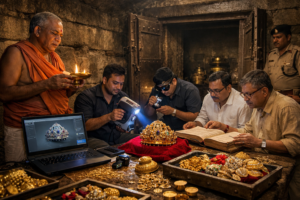
The team that entered the chamber was a microcosm of this duality. Leading the technical charge was a squad of specialists equipped with 3D laser scanners. Their task was unprecedented: to create a digital, three-dimensional map of every piece of jewelry.
“Imagine trying to describe a piece of jewelry that is 500 years old, made with techniques that don’t exist anymore,” explained a gemologist who was part of the team. “A written description in 1978 says ‘a gold necklace with rubies.’ But what is the cut of the ruby? What is the specific gravity of the gold? What is the wear and tear? With 3D mapping, we are creating a digital twin. If a jewel is ever damaged or, God forbid, stolen, we can recreate it with micron-level precision. It’s about preservation for eternity.”
As the scanners hummed, capturing millions of data points on the intricate filigree work and ancient gem-setting techniques, officials meticulously cross-referenced the items with the brittle, yellowed pages of the 1978 ledger. The process was painstakingly slow. Each item was lifted, examined under specialized light, weighed, and photographed from dozens of angles before its digital profile was matched against the handwritten entry from the Nixon era.
“This isn’t about catching discrepancies,” said Arvind Padhee, the temple’s chief administrator, who oversaw the process. “It’s about accountability and transparency. For decades, there has been a veil of mystery. By using modern technology like 3D mapping and computerized records, we are not just making a list for the government; we are creating a public, transparent record for the devotees.”
The Two Chambers of Mystery
The operation was divided into phases, acknowledging the layered complexity of the treasury. The first phase, completed over six grueling hours on Wednesday, focused on the Bhitar Bhandar (inner chamber). This is the most sacred part of the treasury, where the jewels used for the daily adornment of the deities—the Tahia (the gem-studded crowns), the Chita (the hair-pin jewels), and the Hara (the necklaces)—are stored.
The second phase, scheduled to begin soon, will tackle the Bahar Bhandar (outer chamber). This chamber is historically significant as it is believed to hold the accumulated offerings of centuries—gifts from Gajapati kings, tributes from Maratha chieftains, and offerings from British-era zamindars. The outer chamber is considered a historical archive in its own right, its contents a timeline of Odisha’s political and cultural evolution.
The use of 3D mapping in the Bahar Bhandar is expected to yield fascinating insights. Historians hope the digital records will help identify the provenance of items that have long been shrouded in mystery. Was a particular diamond a gift from a Mughal emperor? Was a specific gold carving a tribute from a Southeast Asian king? The digital scans will allow experts from around the world to study the iconography and craftsmanship without ever needing to touch the sacred objects.
A Transparent Process
The 2026 inventory stands in stark contrast to the secretive nature of past operations. The Odisha government ensured the presence of multiple stakeholders: the temple’s high-power committee, representatives from the Reserve Bank of India (for their expertise in handling high-value assets), independent gemologists, and even representatives from a nationalized bank to ensure the locking and unlocking procedures met modern security standards.
For the millions of Jagannath devotees worldwide, this transparency is a significant spiritual comfort. “The wealth of the Lord belongs to the people,” said a devotee who had traveled from Kolkata to Puri upon hearing the news. “For years, we heard rumors that things were missing, or that the vault was empty. Now, knowing that modern technology is being used to protect and document the Lord’s ornaments, it brings manasik shanti (mental peace).”
The data collected will serve multiple purposes. Beyond security, it will allow the temple administration to better care for the jewelry. Ancient gems set in soft gold often suffer from environmental degradation. With a detailed digital inventory, conservators can plan restoration projects. Furthermore, the 3D models can be used to create virtual exhibitions, allowing devotees who cannot visit Puri to witness the grandeur of the Lord’s adornments for the first time.
The Weight of History
As the six-hour tally concluded, the mood outside the Ratna Bhandar was one of solemn relief. The team emerged, their faces a mix of exhaustion and reverence. They had done more than just count gold; they had bridged a gap of nearly five decades.
The reopening of the Ratna Bhandar is a reminder that India’s ancient traditions are not static. They are living entities that must adapt to survive. The use of 3D mapping and computerized records does not diminish the sanctity of the 12th-century temple; rather, it secures it for the next century.
By choosing an auspicious time, honoring the hereditary rights of the servitors, and employing the most advanced tools available, the Odisha government struck a delicate balance. They showed that you can be guided by the stars and grounded in data.
The locks on the Ratna Bhandar were sealed again by Wednesday evening. The inner chamber fell silent once more, its mysteries now safely stored in the digital cloud. But for the first time in 48 years, the treasure of the Lord of the Universe is no longer just a matter of faith or folklore. It is a matter of record—preserved, protected, and ready to be shared with the world, one 3D model at a time.
You must be logged in to post a comment.