
Beyond the Umbrella: Decoding Tamil Nadu’s November Deluge and Its Urban Echoes in Chennai
The India Meteorological Department has issued a multi-day rainfall alert for Tamil Nadu, including Chennai, as the Northeast Monsoon activates across the region, bringing forecasts of light to heavy rain from November 13th-19th that will test urban infrastructure with potential waterlogging and traffic disruptions. While the weather poses significant challenges for daily commuters and has compelled fishermen to stay ashore due to dangerous sea conditions, these showers are also the crucial lifeblood for the state, essential for replenishing water reservoirs and securing the region’s water security for the coming year, highlighting the dual nature of the monsoon as both a disruptive force and a vital resource.
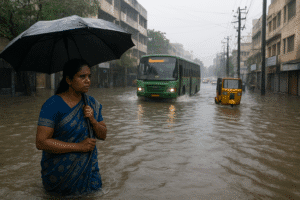
Beyond the Umbrella: Decoding Tamil Nadu’s November Deluge and Its Urban Echoes in Chennai
Meta Description: Tamil Nadu braces for a multi-day rainfall event. We go beyond the weather alert to explore the science of the Northeast Monsoon, its impact on Chennai’s infrastructure, and what this means for daily life in the coastal metropolis.
The familiar scent of wet earth, the rhythmic patter on concrete, and the hurried unfurling of umbrellas mark the return of a powerful, albeit sometimes disruptive, old friend to Tamil Nadu. The India Meteorological Department’s (IMD) recent yellow alert is more than just a bulletin; it’s a prelude to the state’s primary rainy season—the Northeast Monsoon. For the residents of Chennai and the coastal districts, this isn’t just a weather event; it’s a seasonal shift that dictates the rhythm of life, tests the city’s resilience, and fills the vital Veeranam lake.
While the headline “Rain alert for Tamil Nadu” might seem routine, a deeper look reveals a complex interplay of meteorology, urban planning, and human adaptation. This isn’t just about a day of inconvenience; it’s a story written in rain clouds.
The Science Behind the Showers: Why Now?
To understand the current forecast, one must first understand the Northeast Monsoon, or Thalavari Veyyil as it’s known locally. While the rest of India celebrates the retreat of the Southwest Monsoon, for Tamil Nadu, Puducherry, and parts of Kerala, the real water story begins around mid-October.
The mechanism is a fascinating shift in wind patterns. As the sun moves south of the equator after September, a low-pressure area forms over the Indian Ocean, south of the Bay of Bengal. This draws in winds from the northeast, which, after picking up immense moisture from the warm ocean waters, collide with the eastern coast of India. When these moisture-laden winds encounter the coastal terrain, they are forced to rise, cool, and condense, resulting in the widespread rainfall that Tamil Nadu is so dependent upon.
The current alert, specifically predicting heavier spells on November 17th and 18th, suggests the formation of a weather system—perhaps a trough of low pressure or a low-pressure area itself—over the Bay of Bengal. This system acts like a turbocharger for the monsoon, pulling in even more moisture and concentrating the rainfall, leading to the forecast of light to moderate showers now, building up to potentially heavier spells.
Chennai’s Seven-Day Dance with the Clouds: A Micro-Analysis
The IMD’s day-by-day forecast for Chennai is a narrative in itself, moving from tentative drizzle to confident downpour. Let’s read between the lines of this meteorological story:
- November 13-14 (The Overture): “Partly cloudy with brief showers” and “cool and overcast.” This is the monsoon finding its footing. The humidity is palpable, a sticky reminder of the moisture in the air. These initial, sporadic showers are crucial—they settle the dust, lower temperatures, and prime the ground for what’s to come.
- November 15-16 (The Buildup): “Mostly cloudy skies” with “occasional light rain” evolving into “one or two spells of rain or thunder.” The atmosphere is now fully charged. The cloud cover is persistent, and the sun becomes a fleeting visitor. This is when the city starts to slow its pace; spontaneous outdoor plans are postponed, and the first cautions about waterlogging begin to surface.
- November 17-19 (The Crescendo): This is the heart of the alert. The language shifts decisively to “periods of heavy rainfall” and “moderate rain throughout.” These are the days that will test Chennai’s reclaimed resilience. This is not the gentle drizzle of the previous days but a determined, sustained rain that quickly fills stormwater drains and transforms low-lying areas into temporary lakes. The city’s coolness will be undeniable, a direct result of the persistent cloud cover and precipitation.
The Ripple Effect: More Than Just a Commuter’s Headache
The IMD’s caution about traffic disruptions and waterlogging is a masterclass in understatement. For a city that has witnessed catastrophic floods in the recent past, every heavy rain forecast triggers a collective, albeit subdued, anxiety.
The Urban Challenge: The true test lies in the city’s infrastructure. Chennai has invested significantly in its stormwater drain network post-2015. Each rain event is a live audit of this system. Do the drains clear quickly? Are the pumps operational? The answers play out in real-time on social media, with citizens becoming active reporters of waterlogged streets and traffic snarls. The “affected traffic” the IMD warns of isn’t just a delay; it’s a chain reaction of missed appointments, stressed commuters, and a strain on the city’s economic pulse.
The Human Element: Life Interrupted: For the street vendor, persistent rain means no customers and a day without income. For the office-goer, it means navigating a gauntlet of unpredictable transportation and the dreaded prospect of arriving drenched. For children, it might be a welcome holiday from school, but for parents, it’s a logistical puzzle. The rain dictates the city’s mood, from the initial joy of relief from the heat to the grinding frustration of sustained disruption.
The Fisherman’s Advisory: A Necessary Pause: The warning for fishermen to “stay ashore” is not a mere suggestion; it is a critical safety directive. Wind speeds of up to 55 km/h, as predicted near Thoothukudi and Ramanathapuram, can whip the sea into a fury, making it perilous for small boats. This advisory, while essential for preserving lives, has a direct economic impact. It means a mandatory, unpaid holiday for thousands of fishing families whose livelihoods are harvested daily from the sea. It highlights the vulnerability of communities whose lives are intrinsically tied to the mood of the elements.
A Silver Lining in the Rain Clouds
Despite the disruptions, the Northeast Monsoon is the lifeblood of Tamil Nadu. It is the season that replenishes the state’s crucial water reservoirs, which in turn feed the agricultural heartlands and quench the thirst of urban centers like Chennai. The Chembarambakkam, Poondi, and Red Hills lakes, which were hauntingly dry in the past, rely heavily on this annual bounty.
This rainfall is not an adversary to be battled, but a resource to be managed. It underscores the ongoing need for:
- Robust Water Management: Beyond just drainage, the focus must be on capturing and storing this precious rainwater through sustainable urban design and the rejuvenation of traditional water bodies.
- Adaptive Urban Planning: Cities must evolve to become more permeable, with green spaces that act as sponges and infrastructure that can withstand these seasonal stresses.
- Informed Citizenry: Accurate, timely forecasts empower citizens to make better decisions, from choosing a work-from-home day to avoiding waterlogged underpasses.
Conclusion: Listening to the Rain
The current weather alert for Tamil Nadu is a multifaceted story. It is a meteorological phenomenon, a test of urban resilience, an economic disruptor, and ultimately, a bringer of life. As Chennai dons its raincoats and navigates the wet streets, there is a collective understanding that this is the price and the prize of living on this coast.
The rain will fall, as it always has. The true measure of progress will be how the city—its planners, its infrastructure, and its people—learns to listen, adapt, and harness the rhythm of the Northeast Monsoon, transforming annual anxiety into a managed, and even welcomed, seasonal dance.
You must be logged in to post a comment.