
Beyond the Trophy: How Jammu and Kashmir’s Ranji Triumph Rewrote a Story of Strife
Beyond the Trophy: How Jammu and Kashmir’s Ranji Triumph Rewrote a Story of Strife
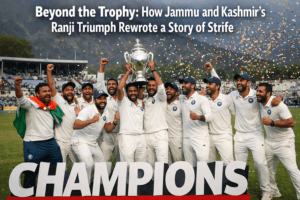
The image is now indelible: a group of cricketers, their faces etched with a mixture of exhaustion and euphoria, hoisting the gleaming Ranji Trophy aloft. For the Jammu and Kashmir team, the moment wasn’t just a victory; it was an exorcism. It was the culmination of a 67-year journey through a landscape far more treacherous than any cricket pitch—a journey marked by political turmoil, geographic isolation, and the heavy weight of a identity often questioned.
When they defeated the star-studded Karnataka by five wickets in the final, it wasn’t an upset. It was a declaration. It was the sound of a region, long defined by conflict and alienation, finally forcing the world to see it through a different lens: one of resilience, skill, and an unyielding passion for a game that, for decades, seemed to have forgotten them.
This is not just a story about cricket. It’s a story about how a team from a “cricketing outpost” built a fortress of belief, brick by brick, defying odds that extended far beyond the boundary rope.
The Echo of an Empty Stadium
To understand the magnitude of this triumph, one must first understand the silence. In 1983, the Sher-i-Kashmir Stadium in Srinagar hosted a match against the mighty West Indies. But instead of cheers for the home team, the air was thick with hostility. Indian players were booed, a stark symbol of the widening chasm between the Kashmir Valley and the rest of the country. The political fault lines, which would later erupt into a full-blown insurgency, were on public display.
Four decades later, top-flight international cricket has not returned to the valley. The stadium, with its breathtaking view of the Zabarwan hills, stands as a silent witness to a complex past. For generations of cricketers from the region, this was the harsh reality. They were not just competing against opponents from Mumbai or Delhi; they were competing against a narrative of distrust and neglect.
The game’s real power centres—Mumbai’s Wankhede, Delhi’s Feroz Shah Kotla, Chennai’s Chepauk—were worlds away, not just in distance but in opportunity. For a young, talented cricketer in Srinagar or Jammu, the path to the national stage was often obscured by a lack of basic infrastructure, indifferent administration, and the lingering shadows of political instability. The team’s first Ranji Trophy victory, a full two decades after the association was formed, was a painful reminder of how far they had to travel.
The First Sparks: From Bedi to Pathan
The change didn’t happen overnight. It was a slow burn, ignited by individuals who saw potential where others saw only problems.
The first significant spark came in the form of a turbaned Sikh from Delhi, a legendary spinner with a direct tongue and an unshakeable belief in the power of self-respect. When Bishan Singh Bedi took over as coach in 2011, he didn’t just work on bowling actions or footwork. He worked on the players’ minds.
“He told us we had every right to be on that field,” Parvez Rasool, the first cricketer from J&K to play for India, would later recall. Before Bedi, the team often carried an air of diffidence, a subconscious acceptance of their underdog status. Bedi dismantled that. He instilled a sense of pride and belonging, hammering home the message that the name on the back of their jersey mattered less than the heart beating beneath it. Rasool, a talented all-rounder, became the embodiment of this newfound belief, his journey to the Indian team a testament to Bedi’s foundational work.
Years later, another outsider arrived with a similar mission. Irfan Pathan, the Baroda all-rounder who had once swung the ball for India, came to J&K as a player-mentor in 2018. His message was even more pointed. In a region often fractured by internal divisions, Pathan’s simple, powerful directive was to “play as one team.”
He wasn’t just a coach; he was a role model who had lived the dream. His presence in the dressing room was a daily reminder of what was possible. It was during this period that raw, explosive talents like Umran Malik, with his 150 km/h thunderbolts, and the elegant batsman Abdul Samad were unearthed. Pathan didn’t create their talent; he simply gave them the belief that it belonged on a bigger stage. Umran would go on to become the second cricketer from the region to wear the India blue, a milestone that sent a powerful signal back home: the pathway was real.
A Blueprint for Belief: The Manhas Era
The third, and perhaps most crucial, inflection point came not from a celebrated former India player, but from a quiet, meticulous administrator with deep roots in the region. Mithun Manhas, a solid domestic cricketer born in Jammu who had led Delhi and played a season for J&K, was handed the reins of the newly formed Apex Council.
Manhas understood the local psyche and the administrative machinery in equal measure. His vision was to professionalise the set-up, bringing it in line with the country’s best. He appointed his former Delhi teammate Ajay Sharma as coach and made a shrewd move to bring in Paras Dogra as captain.
Dogra, a 41-year-old batting veteran from Himachal Pradesh with over 10,000 first-class runs, was the perfect on-field general. He was a run-machine, but more importantly, he was a leader who had seen it all. His job was to create a culture of accountability and excellence. The young players in the squad, like the prodigious fast bowler Aquib Nabi, no longer saw themselves as promising talents from a far-flung region. They were part of a professional unit with a singular, audacious goal.
Under Manhas, the infrastructure caught up with the ambition. Modern coaching methods, scientific fitness regimens, and mental conditioning—tools that were once the exclusive preserve of the cricketing elite—became the norm. The talent that had always existed was now being honed with precision.
The Spearhead and the Soul
If Dogra was the captain and the soul of the team, 23-year-old Aquib Nabi was its speeding heart. In a season where J&K stunned former champions Delhi, Madhya Pradesh, and Bengal, Nabi was the constant, destructive force. He finished with a staggering 60 wickets, his fast, swinging deliveries proving unplayable on numerous occasions.
His story is the story of a thousand boys in the region. Coming from a modest background in north Kashmir’s Sopore town—an area once notorious as a hub of militancy—Nabi’s journey was fraught with challenges far removed from the game. He bowled on concrete pitches with a tennis ball, his action raw and unrefined. But the talent was unmistakable.
Watching him bowl in the Ranji final against a Karnataka line-up boasting international stars like KL Rahul and Mayank Agarwal was to watch a young man unburdened by history. He wasn’t overawed. He was relentless. His 44 wickets the previous year had earned him an IPL contract, and his performance this season prompted former India captain Sourav Ganguly to publicly declare him “ready for Test cricket.”
Nabi is the most potent symbol of J&K’s cricketing rise. He represents the shift from being a talent spotter’s curiosity to a national asset. He is proof that the region is no longer just a supplier of Kashmir willow for bats, but a producer of the talent to wield them.
A Victory Larger Than Cricket
The final against Karnataka was a microcosm of the entire journey. They were the underdogs against a team with four current internationals and a rich history. The pundits predicted a straightforward win for the southern giants. But J&K, through Dogra’s composed leadership, Nabi’s fire, and crucial contributions from the entire batting line-up, played with a composure that belied their inexperience.
When the winning runs were hit, the celebration wasn’t just about a trophy. It was a release of decades of frustration, a roar of defiance against the odds. For a region often in the news for curfews and conflict, here was a headline that spoke of achievement and glory.
Prime Minister Narendra Modi’s congratulatory tweet was more than a formality; it was an acknowledgment of the victory’s profound national significance. For the people of Jammu and Kashmir—both in the Jammu region and the Kashmir Valley—this win provided something invaluable: a shared, positive identity. In a place where politics often divides, cricket had united.
For a young boy or girl growing up in Srinagar today, Aquib Nabi is not just a fast bowler; he is a possibility. The Ranji Trophy win has democratised the dream. It has shown that the path to the top, however arduous, exists. It has woven the region’s story into the broader tapestry of Indian cricket, not as a footnote of strife, but as a chapter of triumph.
In the pantheon of great Ranji Trophy victories, this one will be remembered not just for the quality of cricket, but for the weight of the journey. Jammu and Kashmir didn’t just win a title; they reclaimed their narrative, one delivered delivery at a time. They proved that even in the most contested of lands, the human spirit, when channeled through the love of a game, can build something enduring and beautiful. And in doing so, they gave their people a stake in a mainstream defined not by politics, but by pride.
You must be logged in to post a comment.