
Beyond the Tread: The Unseen Safety Revolution Inside India’s First Tire Buffing Machine
JK Tyre’s inauguration of India’s first precision tire buffing and grinding machine at the NATRAX facility marks a critical advancement in automotive safety by directly addressing the long-overlooked performance gap between new and worn tires. This machine, compliant with global ECE R117 standards, enables rigorous Wet Grip on Worn Tyre testing by scientifically wearing tires down to the legal tread limit of 1.6mm, thereby generating essential data on how tires perform in real-world, worn conditions.
This development promises to elevate safety standards across the entire automotive ecosystem—empowering consumers with informed purchasing choices, accelerating domestic tire innovation by eliminating the need for overseas testing, providing car manufacturers with reliable data for factory-fitted tires, and laying the groundwork for more robust, data-driven safety regulations in India.
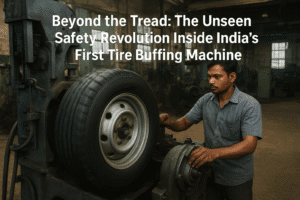
Beyond the Tread: The Unseen Safety Revolution Inside India’s First Tire Buffing Machine
When we think of tire safety, our eyes instinctively drop to the tread. Is there enough depth? Are the grooves visible? For decades, this simple visual check has been the primary gauge for most Indian drivers. But what happens before that tire wears down to the legal limit of 1.6mm? The performance of a brand-new tire and one on the brink of replacement can be worlds apart.
This critical safety gap is precisely why the recent inauguration of India’s first precision tire buffing and grinding machine by JK Tyre at the NATRAX facility in Pithampur is more than just an industry milestone—it’s a quiet revolution for every vehicle owner on Indian roads.
While the headline “JK Tyre unveils machine” might sound like a niche industrial update, the reality is that this technology is a foundational step towards a new era of transparency, accountability, and ultimately, safety in the Indian automotive landscape.
The Performance Chasm: New Tire vs. Worn Tire
Imagine buying a raincoat that works perfectly for the first few monsoons but becomes increasingly porous with each use, failing you just when you need it most. This is the analogue for tire performance, particularly in wet conditions.
A new tire has deep grooves and sipes (tiny slits in the tread) designed to channel water away, maintaining a firm grip on the road—a property known as “wet grip.” As the tire wears, this complex drainage system becomes shallower and less effective. The result? Significantly longer braking distances in the rain and a higher risk of aquaplaning.
Until now, tire safety and performance standards in India have primarily focused on testing tires in their new condition. This leaves a vast, unregulated performance void. A tire might boast excellent wet-braking scores when new, but how does it perform when it’s 80% worn? This was a question Indian regulators and consumers lacked the data to answer.
Decoding the Machine: More Than Just a “Tire Grinder”
JK Tyre’s new installation is far from a simple sander. It’s a high-precision instrument calibrated to adhere to the stringent ECE R117.03 regulation, a global benchmark for tire safety.
Its core function is deceptively simple yet technologically profound: to meticulously and consistently wear down test tires to exactly 1.6mm of remaining tread depth. But why is this so crucial?
- Creating the Perfect Test Subject: For accurate Wet Grip on Worn Tyre (WGWT) testing, you cannot simply use tires that have been driven on a road. Road wear is inconsistent, affected by alignment, driving style, and road surfaces. This machine buffs a tire with absolute uniformity, creating a perfectly worn, scientifically valid sample for testing.
- Enabling True Comparative Analysis: By testing tires from different manufacturers in an identically worn state, NATRAX can generate objective, comparable data on which tires truly maintain their safety integrity throughout their lifespan. This moves the conversation beyond marketing claims to hard, performance-based evidence.
As Dr. Raghupati Singhania, Chairman of JK Tyre, stated, this reflects a commitment to “enhancing vehicular safety through modern engineering.” It’s an investment in infrastructure that benefits the entire industry, not just one company.
The Ripple Effect: How This Machine Elevates the Entire Automotive Ecosystem
The impact of this single machine extends far beyond the walls of the NATRAX testing center. It sets in motion a chain of positive developments:
- For the Indian Consumer: The Dawn of Informed PurchasingSoon, tire buying in India will no longer be a gamble based on brand reputation or price alone. The data generated from WGWT testing will empower consumers to make choices based on a tire’sentire lifecycle performance. A tire that offers superior safety when worn is a tire that provides better long-term value and protection for a family. This fosters a market where safety innovation is directly rewarded.
- For Indian Tire Manufacturers: A Catalyst for R&D and Global CompetitivenessWith this testing capability now domestic, Indian tire companies like JKTyre, CEAT, Apollo, and MRF no longer need to ship samples abroad for this critical certification. This slashes development time and cost, accelerating the pace of innovation. More importantly, it forces R&D departments to design tires that perform well not just out of the box, but for thousands of kilometers. This elevates the global standing of “Made in India” tires, proving they meet the world’s toughest safety protocols.
- For Automotive OEMs (Car Makers): A Partner in Delivering Safer VehiclesCar manufacturers havea vested interest in the safety credentials of the components fitted to their vehicles. Reliable, local WGWT data allows them to make more informed decisions when choosing factory-fitted tires. They can now select partners whose products align with their brand’s safety promise over the long haul, enhancing the overall value proposition of their cars, trucks, and buses.
- For Indian Regulation: Building a Data-Driven Safety FrameworkThe presence of this machine provides Indian regulatory bodies with the robust, local data needed to consider adopting even stricter safety norms.It’s a critical piece of infrastructure that brings India in line with Europe’s advanced vehicle safety standards, paving the way for a future where WGWT scores could become a mandatory part of tire labeling.
The Bigger Picture: JK Tyre’s Strategic Foresight
JK Tyre’s move is a masterclass in strategic leadership. By funding and inaugurating this machine at a national facility like NATRAX, they are not just investing in their own R&D; they are positioning themselves as the de facto leaders in Indian tire safety and testing infrastructure.
Their existing arsenal at NATRAX—skid trailers, steering robots, noise measurement systems—combined with this new buffing machine, creates an unrivalled domestic testing ecosystem. This allows them to iterate faster, validate more thoroughly, and bring superior, safer products to market ahead of the competition. It’s a long-term play that builds immense brand equity as a safety-first innovator.
Conclusion: A Worn Tire is No Longer an Unknown
The unveiling of India’s first tire buffing machine marks the end of an era where a worn tire’s performance was a mystery. It is a definitive step from evaluating tires as static products to understanding them as dynamic safety systems that evolve over time.
For the average Indian driver, this might seem like an invisible change. You won’t feel the machine working, and you might not see the test data immediately. But the next time you brake hard on a rain-slicked highway, the confidence you feel will be backed by a new layer of scientific rigor—a testament to an industry finally beginning to test for real-world conditions, and a company leading the charge to make every kilometer, from the first to the last, a safer one.
You must be logged in to post a comment.