
Beyond the Thermometer: Why 2025’s Unprecedented Heat Demands a Radical Rethink
In 2025, climate change fueled by human activity made it one of the three hottest years on record, with the global three-year average temperature exceeding the critical 1.5°C Paris Agreement threshold for the first time. Scientists from the World Weather Attribution group analyzed 157 severe extreme weather events—including deadly heatwaves, floods, wildfires, and rapidly intensifying storms—finding that many would have been nearly impossible without human-induced warming. These increasingly frequent and severe disasters, from India to Jamaica, are overwhelming the ability of millions to adapt, exposing hard limits in disaster response and forecasting. Despite the clear scientific evidence, global political action stalled in 2025, with UN climate talks failing to secure a fossil fuel phase-out and geopolitical shifts in several major economies delaying the urgent transition needed to prevent catastrophic environmental and human impacts.
Beyond the Thermometer: Why 2025’s Unprecedented Heat Demands a Radical Rethink
The headline is stark, but it risks becoming a numbing refrain: “2025 ranks among the three hottest years ever recorded.” We’ve grown accustomed to the annual ritual of broken records, of “hottest since” and “warmest on record.” Yet, to dismiss 2025 as just another incremental step on a grim chart is to miss the profound and alarming story it tells—a story not merely of rising temperatures, but of a planet and its people hitting hard, tangible limits.
The data, as synthesized by the World Weather Attribution (WWA) group, is unequivocal. For the first time, the three-year average temperature has nudged above the 1.5°C limit set by the Paris Agreement, a threshold scientists identified as a critical guardrail against the worst impacts of climate change. This isn’t a single-year anomaly fueled by a strong El Niño; this is a sustained shift, occurring even during a La Niña phase that should have brought cooling. The cause, as climate scientist Friederike Otto starkly puts it, is our continued burning of fossil fuels. The heatwaves scorching continents in 2025 weren’t just bad luck; they were events made “almost impossible to occur without human-induced climate change.”
But the true narrative of 2025 lies not in the global average, but in the 157 severe extreme weather events researchers identified—the ones that crossed a grim rubric of over 100 deaths, impacted half a region, or forced emergency declarations. This is where abstract warming becomes concrete suffering, and where we encounter the concept of “limits of adaptation.”
The Human Face of a Fracturing Climate
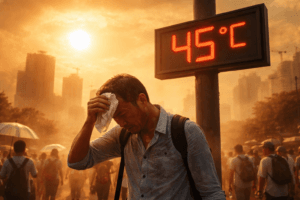
Imagine the heatwave in India, where seeking a drink of water becomes a front-page image of endurance. Or consider the wildfires in Greece and Turkey, fueled not by a passing dry spell but by a prolonged, climate-amplified drought that turns forests into tinderboxes and lives into ashes. Recall the deadly flooding in Mexico, where streets became rivers, or Super Typhoon Fung-wong in the Philippines, where wind and water erased livelihoods in hours.
Each event is a local tragedy. Together, they form a global pattern of systems under siege. Hurricane Melissa, which devastated Jamaica, Cuba, and Haiti, exemplified a terrifying trend: rapid intensification. Storms now explode in strength so quickly that forecasting models scramble and disaster agencies, no matter how prepared, are overwhelmed. There is no adaptation manual for a catastrophe that evolves faster than your evacuation orders can be printed.
This is the core insight from 2025. For years, the climate conversation had a built-in assumption: we can adapt. We can build higher seawalls, design better irrigation, and improve weather forecasting. But 2025 shows us that adaptation has a ceiling. As Andrew Kruczkiewicz of Columbia University notes, disasters are increasingly striking places “that aren’t used to extreme events.” Communities from California to Istanbul are facing threats for which they have no cultural or infrastructural memory. How does a city built for a temperate climate adapt to 45°C heat? How does a region with seasonal rains cope with a year’s worth falling in a day? The resources, time, and warning needed to adapt are being outstripped by the speed and novelty of the extremes.
The Geopolitical Chasm: When Politics Trumps Physics
While the physical world reacted with violent clarity, the geopolitical response in 2025 was mired in opacity. The UN climate talks in Brazil ended without a clear mandate to phase out fossil fuels—the very driver of the crisis. This failure wasn’t born of scientific uncertainty, but of what Otto describes as “cloudy geopolitical weather,” where policymakers too often serve the interests of the fossil fuel industry over their populations.
The global landscape is a patchwork of contradictions. China leads the world in renewable energy deployment yet continues to approve new coal plants, a hedge against energy insecurity. Europe, battered by relentless extremes, pushes ambitious climate laws, but not without internal debates pitting economic concerns against existential ones. In the United States, a shift in administration has led to a policy U-turn, actively promoting coal, oil, and gas over clean energy, betting on short-term economic gains against long-term planetary stability.
This dissonance creates a dangerous lag. Even as new adaptation funds are pledged, implementation is slow. Meanwhile, the disinformation machine that Otto references sows doubt and paralysis precisely when decisive action is needed. The result is that our political and economic systems are now the primary bottleneck, not our technology or knowledge.
A Path Forward: Beyond Fatalism and Toward Action
To concede the breaching of 1.5°C is not to embrace fatalism. It is a call for ruthless realism and redoubled effort. Every fraction of a degree beyond this point extracts a exponentially higher cost in lives, ecosystems, and economic stability. The goal must shift from purely “preventing” 1.5°C to “limiting the overshoot and pulling temperatures back down” within this century.
This demands a two-track approach that 2025 makes non-negotiable:
- Emergency Response for the New Normal: We must invest in truly resilient early-warning systems that account for non-linear, fast-moving disasters. Building codes, agricultural practices, and urban planning must be radically overhauled for a climate that no longer resembles the past. As Kruczkiewicz urges, we need new approaches to response and recovery, treating climate disasters with the same urgency and innovation as a global health pandemic.
- An Accelerated Engine of Transition: The clean energy transition must move from a linear progression to an exponential curve. The economics are already in favor; now policy must catch up and accelerate. This means overcoming the diplomatic inertia seen in Brazil, calling out and countering disinformation, and creating just transition plans that leave no communities behind. It means recognizing, as the year’s events show, that every new fossil fuel investment directly fuels the extremes that are breaking our adaptive capacity.
The story of 2025 is a final warning written in heat, fire, and flood. It tells us that the climate crisis is no longer a future tense problem; it is a present tense, pervasive reality. The years labeled “among the hottest” will soon be remembered as the coolest of the rest of our lives if we do not change course. The record-breaking heat of 2025 is not just a metric; it is a mirror, showing us a species at a crossroads. One path leads to a destabilized planet where adaptation fails. The other requires a collective, courageous pivot—to stop fueling the fire and start building a world capable of surviving the heat we can no longer avoid. The choice, starkly illuminated by the trials of 2025, remains ours.
You must be logged in to post a comment.