
Beyond the Thermometer: Kashmir’s Warming Nights Signal a Shifting Winter Legacy
The recent report of Srinagar’s night temperature rising to 2.8°C, over three degrees above normal, signals a profound shift beyond mere weather, marking a disruption in Kashmir’s ancient winter rhythm defined by the harsh Chillai Kalan and its milder successors. This consistent warming, reflected across tourist and agricultural hubs, threatens the essential “chilling hours” required for the region’s vital fruit orchards, risks altering the crucial snowpack that feeds its water systems, and poses a long-term threat to both the distinct seasonal identity that drives tourism and the deep cultural practices intertwined with the cold. Ultimately, this local statistic is a direct indicator of global climate change, serving as a quiet alarm for the need to integrate ecological resilience into the region’s economic and cultural planning for an uncertain future.
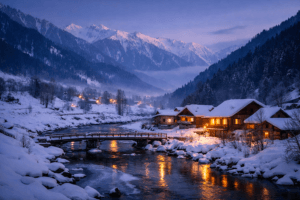
Beyond the Thermometer: Kashmir’s Warming Nights Signal a Shifting Winter Legacy
A slight uptick in the mercury might seem like a welcome respite in the biting cold of a Kashmiri winter. This week, Srinagar recorded a minimum temperature of 2.8°C, over three degrees above the seasonal norm. But this statistic, nestled in a routine weather bulletin, is more than a number—it is a whisper of a larger, unfolding story. The gradual but consistent rise in night temperatures across the Valley, particularly following the austere Chillai Kalan, is not merely a meteorological anomaly. It is a tangible signature of climatic shift, one that is quietly recalibrating the region’s ecological rhythms, cultural calendar, and economic heartbeat.
The Phases of Cold: More Than Just Folklore
To understand the significance of this warming, one must first appreciate the deep cultural meteorology of Kashmir. Winter here is not a monolith; it is a narrative divided into three acts. The just-concluded Chillai Kalan (December 21 to January 29) is the protagonist—40 days of unforgiving cold where temperatures often plunge below freezing, water bodies solidify, and life adapts to a silent, frost-laden pace. It is a period revered and endured, crucial for replenishing glaciers and ensuring spring water levels.
Following it is the ongoing Chillai Khurd (20 days of milder cold), and later, Chillai Bachha (a 10-day “baby cold” spell). This traditional calendar, born of centuries of observation, has historically been a reliable predictor. The reported warming as Chillai Khurd begins is, therefore, a deviation from a deep-seated seasonal script. When Gulmarg, at minus 5.3°C, is two degrees above its average, or Pahalgam sees a four-degree jump to minus 0.4°C, it indicates a fundamental disruption in this ancient cycle.
The Silent Thaw: Ecological and Agricultural Echoes
The immediate human experience might be of a more comfortable night. However, the ecological consequences are profound. Kashmir’s agriculture, particularly its famed horticulture, is intricately tied to winter chill. Apple, cherry, and walnut trees require a specific number of “chilling hours” to break dormancy and ensure healthy, fruitful blossoms. A consistent pattern of warmer nights compromises this vital requirement, threatening bud formation and potentially impacting the yield, quality, and timing of the harvest. For an economy where horticulture is a cornerstone, this is a slow-burning economic challenge.
Furthermore, winter snowfall acts as a vital water bank for the region. Warmer nights can alter precipitation patterns, turning snow into rain even in peak winter at certain altitudes. This affects the slow, sustained melt that feeds rivers and springs through the summer. A reduced snowpack spells trouble for water security, hydropower generation, and the long-term health of the region’s iconic glaciers, which are already in retreat.
Tourism: A Double-Edged Sword
For the ski industry in Gulmarg, the implications are immediate. While the current temperature is still well below freezing, a trend of warmer winters shortens the reliable ski season. The snowpack becomes less predictable, impacting international tourism and the livelihoods dependent on it. Conversely, for the broader tourist circuit, milder nights in Srinagar or Pahalgam might seem to extend the comfortable travel season. Yet, this is a precarious balance. Kashmir’s allure lies in its distinct seasons—the pristine white winter, the bloom of spring, the lush summer. Blurring these lines risks diluting the very seasonal uniqueness that draws visitors.
A Human Perspective: Adaptation and Anxiety
In the lanes of downtown Srinagar or the villages near Kokernag (which recorded 0°C), the change is felt in subtle ways. The elderly speak of winters where the Dal Lake would freeze so thick that people could walk on it, a phenomenon now relegated to memory. The kangri (traditional firepot) might be used a little less, but there is an underlying anxiety about water springs drying up earlier in the summer or the unseasonal blooming of almond trees in late January, making them vulnerable to a sudden frost.
The change also touches cultural practices. The social rhythm of Chillai Kalan—of huddling around samovars, of specific winter foods—adapts imperceptibly. The construction practices, historically designed for severe insulation, might gradually shift. It is a slow, human-scale adaptation to a new normal.
The Larger Canvas: Connecting the Dots
This localised warming in Kashmir is not an isolated event. It fits into the unequivocal pattern of global climate change, where high-altitude regions are often the most sensitive indicators. The Intergovernmental Panel on Climate Change (IPCC) has consistently highlighted the disproportionate warming in mountain ecosystems. The data from Srinagar, Gulmarg, and Pahalgam are local data points on this global chart. They underscore that climate change is not just about polar ice caps or rising sea levels; it is about the altering texture of daily life in the Himalayas, about the fragile sync between climate and culture coming undone.
Looking Ahead: The Need for Conscious Stewardship
The report of rising night temperatures is, therefore, a crucial piece of environmental intelligence. It calls for a multi-pronged response:
- Scientific Monitoring: Enhanced, localized climate studies to model impacts on specific sectors like horticulture and tourism.
- Agricultural Innovation: Research into crop varieties requiring fewer chilling hours and sustainable water management techniques for farmers.
- Policy Integration: Climate adaptation must become central to regional planning, from water resource management to tourism season planning and disaster preparedness for unpredictable weather events.
In conclusion, the story from Kashmir’s weather stations is a quiet alarm. The warmth of a Srinagar night in early February is a small comfort with a large cost. It speaks of a legacy winter that is slowly, inexorably, becoming a memory. As Chillai Khurd unfolds with uncharacteristic mildness, it invites us to look beyond the immediate relief and engage in a more profound conversation about stewardship, resilience, and preserving the fragile, frozen heartbeat of a warming valley. The real insight lies not in reading the thermometer, but in understanding the world it measures is changing.
You must be logged in to post a comment.