
Beyond the Textbook: Why India’s Students Are the Key to a Water-and-Energy Secure Future
At the three-day international conference on Sustainable Materials for Water and Energy Solutions (SuWatE+ 2026) organized by VIT-AP University in Vijayawada, IIT-Madras Professor G. Ranga Rao urged students and researchers to harness advancing technologies to develop sustainable materials, emphasizing that such innovations are crucial for achieving India’s scientific self-reliance and global competitiveness. The conference also featured M. G. Sethuraman from Gandhigram Rural Institute, who stressed translating research into industrial applications and integrating ethics with technical problem-solving, while VIT-AP’s Vice-Chancellor and Registrar highlighted the event’s role in advancing sustainability and energy-efficient campus initiatives.
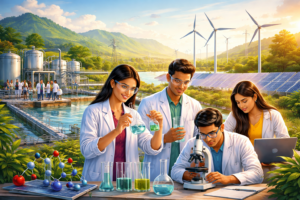
Beyond the Textbook: Why India’s Students Are the Key to a Water-and-Energy Secure Future
In an era defined by climate volatility and geopolitical jostling for resources, a quiet but powerful message is resonating through Indian academic halls: the path to national strength no longer runs solely through military might or economic output, but through the beakers, spectrometers, and innovative minds inside our chemistry labs.
On March 28, 2026, at the VIT-AP University in Vijayawada, a group of students, researchers, and industry experts gathered for the inaugural session of the SuWatE+ 2026 conference—an international meet on Sustainable Materials for Water and Energy Solutions. The headline from the event was crisp, but the underlying narrative was revolutionary. Professor G. Ranga Rao, a distinguished chemist from IIT-Madras, issued a challenge that felt less like a lecture and more like a call to arms.
He urged the next generation to stop viewing technology as a mere tool for convenience or profit. Instead, he asked them to wield it as a scalpel to cut through India’s two most persistent crises: the scarcity of clean water and the volatility of energy security.
The Invisible Crisis on Your Kitchen Counter
To understand the weight of Professor Rao’s words, one must look beyond the jargon of “sustainable materials” and “catalytic converters.” For the average Indian, the water crisis is not an abstract statistic. It is the creeping salinity in a coastal village’s only well. It is the chemical-laden foam floating on the Yamuna. It is the farmer in Maharashtra watching his parched land crack under an unrelenting sun, while miles away, an industry discharges untreated effluent into the same river system.
India is home to 18% of the world’s population but only 4% of its water resources. This mathematical imbalance has long been a death sentence for rural economies. However, Professor Rao reframed the problem. He spoke of the “critical role of water and energy” not as separate issues, but as a closed loop. You need energy to clean water (desalination, pumping), and you need water to produce energy (cooling thermal plants, hydroelectricity, green hydrogen).
The “sustainable materials” discussed at SuWatE+ 2026 are the missing link in this chain. We are not talking about expensive, imported Western tech that breaks down in Indian dust and humidity. We are talking about low-cost, high-efficiency membranes that can filter heavy metals; about photocatalytic materials that use sunlight to destroy industrial dyes; about affordable catalysts that can split water molecules to produce hydrogen fuel using nothing but solar power.
Scientific Self-Reliance: More Than a Slogan
The term “self-reliance” (Atmanirbharta) has been politicized to the point of numbness. But in the context of the chemistry department at VIT-AP, it takes on a tangible, urgent meaning. For decades, Indian laboratories have been excellent at importing solutions. A German filter, an American analyzer, a Japanese catalyst. While these tools are precise, they create a dependency that is both expensive and dangerous.
When a geopolitical crisis disrupts supply chains, or when a patented technology becomes too costly for a small village to afford, the poor suffer first. Scientific self-reliance means building a “Swadeshi” toolkit for the 21st century. It means inventing a water purification tablet that costs ten paise instead of ten rupees. It means engineering a battery electrode from coconut shells or agricultural waste, which India has in abundance, rather than lithium imported from Chile.
Professor Rao’s emphasis on “leveraging advancing technologies” is a nod to the digital twin revolution. Today, a student in Vijayawada doesn’t need to destroy a thousand physical prototypes to test a new material. Using AI and machine learning, they can simulate molecular interactions—how a new polymer will react to arsenic, or how a nano-catalyst will perform under extreme heat. This lowers the barrier to entry for young innovators, allowing them to fail fast, learn faster, and succeed without the massive budgets of Western conglomerates.
Bridging the Valley of Death
One of the most poignant moments of the conference came from M. G. Sethuraman of Gandhigram Rural Institute. He shifted the focus from academic publishing to practical application—what engineers call “crossing the valley of death.”
The valley of death is the treacherous gap between a brilliant lab discovery and a marketable product. Every university has a drawer full of PhD theses that solved a world problem on paper but never left the campus. Sethuraman’s call for “translating research into industrial applications” is a plea to break this cycle.
Consider the alternative energy sector. India has set ambitious targets for 500 GW of renewable energy by 2030. But renewable energy is intermittent. The sun doesn’t always shine; the wind doesn’t always blow. The solution lies in storage: batteries and green hydrogen. While the world races to perfect solid-state batteries, Indian students have a unique advantage. They understand the local context. A battery that works in a temperature-controlled lab in Sweden might explode in the summer heat of Rajasthan. A water filter that works on German tap water will clog instantly in the Ganges basin.
Sethuraman’s “ethical and problem-solving approaches” hint at a deeper truth: sustainability is not just about chemistry; it is about sociology. A technology that is not accepted by the local community—because it changes their taste of water, or requires a literacy level they don’t have—is a failed technology.
The Student’s Dilemma: Coding or Chemistry?
For the average undergraduate scrolling through LinkedIn, the pressure is immense. The market screams for data scientists, AI engineers, and finance bros. The safe path is a desk job. The risky path is a lab coat.
But the message from Vijayawada is that the lab coat is becoming the new armor of the 21st-century economy. As Vice-Chancellor Arulmozhivarman noted, the conference’s goal is to align campus initiatives with “national and international impacts.” This is a subtle but important shift in pedagogy.
We are moving away from the “jugaad” mindset—the hacky, temporary fix—toward a “systemic” mindset. Students are being told to leverage technology. This doesn’t mean every chemistry student needs to become a Python coder. But it does mean they need to be digitally literate enough to use simulation software, to analyze large datasets from water quality sensors, and to use automation to scale up their reactions from grams to kilograms.
A Vision for 2030 and Beyond
As the three-day conference continues, the conversations will inevitably touch on specific pain points: the PFAS contamination in drinking water (forever chemicals), the disposal of solar panel waste, and the energy intensity of producing green ammonia.
However, the lasting takeaway for the reader—the student sitting in a library, the parent wondering what their child should study, or the policymaker drafting the next budget—is one of agency.
The problems of water and energy feel too big for one person to solve. But they are not too big for a generation to solve.
When Professor Rao speaks of “global competitiveness,” he is reminding us that the nations that master sustainable materials will dictate the terms of trade in the next decade. Europe will soon impose carbon borders. The US is subsidizing green tech heavily. India cannot afford to be a consumer of this revolution; it must be a manufacturer.
The students at VIT-AP, and the thousands watching online, are standing at a precipice. The tools are finally affordable. The data is accessible. The government, through initiatives like the National Education Policy (NEP) 2020, is encouraging interdisciplinary research.
The only missing ingredient is the will to look at a bottle of dirty water or a power outage and think, not with despair, but with the curiosity of a chemist: What material can I invent to fix this?
As the Hindu Bureau reported from Vijayawada, the seeds of India’s scientific renaissance are being sown in lecture halls and labs. But those seeds will only grow if the students pick up the trowel. The era of importing every solution is over. The era of self-reliance, built atom by atom, has just begun.
You must be logged in to post a comment.