
Beyond the Tents: How a Single Morning in Amrin Reflects the Systematic Unfolding of West Bank Expansion
Beyond the Tents: How a Single Morning in Amrin Reflects the Systematic Unfolding of West Bank Expansion
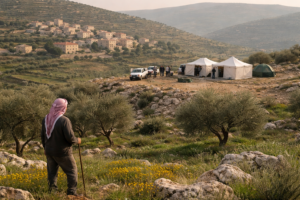
The village of Amrin, a cluster of limestone homes nestled in the rolling hills northwest of Nablus, woke on Thursday morning to the sound of unfamiliar voices and the sight of nylon flapping in the wind. By sunrise, a group of Israeli colonists had traversed the dirt paths leading to a plot of privately owned Palestinian land, unloading metal poles and canvas sheets to establish a new colonial outpost.
According to local sources who spoke with WAFA, the tents were pitched a mere 500 meters from the nearest Palestinian residence—close enough for the inhabitants to see the color of the tarpaulins from their kitchen windows. For the families of Amrin, this was not merely a provocation; it was the latest chapter in a long-running bureaucratic and physical war over the geography of their existence.
While international headlines often focus on the large, established Israeli settlements—the concrete blocs with municipal status and security fences—the story of the West Bank is increasingly written in the quiet, pre-dawn movements of vehicles like the one that entered Amrin this week. The establishment of a “colonial outpost,” a term used by Palestinian authorities and international law experts to describe unauthorized settler structures, represents the sharp end of a strategy designed to fragment Palestinian land, one tent at a time.
To understand the significance of what happened in Amrin on Thursday, one must look beyond the immediate confrontation of land seizure and into the intricate machinery of control that governs the occupied territories.
The Anatomy of a Land Grab
The land in question, according to village elders who spoke to local journalists, is not disputed in the sense of conflicting sales records. It is privately owned—mulk—land, cultivated for generations by families whose roots in the region predate the modern political conflicts that have defined the last century. In the lexicon of the Israeli military administration, which exercises control over Area C (the 60% of the West Bank where Israel retains full security and civil control), such land is often classified as “state land” or “survey land,” a legal maneuver that Palestinian rights groups argue is used to systematically transfer ownership to Israeli control.
The outpost erected on Thursday fits a pattern known all too well to the Palestinian Authority’s Settlement and Wall Resistance Commission. Typically, the process begins not with concrete, but with fabric. A group of settlers, often youth affiliated with radical ideological movements, arrive with tents and portable animal pens. Their stated aim is often “agricultural work” or “historical connection,” but the unspoken goal is to create a physical presence on the ground that becomes nearly impossible to dismantle once it gains traction.
“When you see tents, you are seeing the first stage of urbanization,” explained a local activist from the nearby town of Beita, who requested anonymity due to fear of reprisals. “If they are not stopped in the first 48 hours, the military comes to ‘protect’ them. Then the caravans come. Then the paved road. Then the hill that was yours becomes a closed military zone. We have watched this happen for fifty years.”
The location of the new outpost is strategically significant. Amrin is situated in a vulnerable corridor of the northern West Bank, an area that settlers and Israeli planners have long sought to connect to create a contiguous bloc of Israeli-controlled territory stretching from the Jordan Valley to the Green Line. By establishing a presence just 500 meters from a Palestinian home, the colonists effectively create a “security buffer” around their new position, often restricting the movement of the Palestinian landowners who are then forced to request permits from the Israeli military to access their own fields.
A Community Living on the Edge
For the residents of Amrin, Thursday’s incursion was a jarring reminder of their precarious existence. The village, like many in the Nablus governorate, exists in a patchwork of territorial designations. Much of its agricultural land falls under Area C, making it subject to immediate confiscation or demolition orders for Palestinian-built structures, while settler outposts erected on the same land often receive retroactive authorization.
Fadi A., a 45-year-old olive farmer whose family land lies less than a kilometer from the new tent site, described the morning’s events with a mixture of anger and exhaustion. “I saw them from my roof,” he said over the phone, the sound of sheep braying in the background. “They came in two white vans, the kind without license plates that we have learned to fear. They unloaded the tents so fast, as if they were racing against time. My father told me that when he was a child, the only strangers who came to this land were shepherds looking for water. Now, strangers come to take the land itself.”
The olive tree, a symbol of Palestinian resilience, is often the first casualty of such expansions. While no immediate violence was reported during the tent setup in Amrin—aside from the psychological violence of the intrusion—the aftermath is predictable. In similar incidents across the West Bank over the past year, settlers establishing outposts have often uprooted saplings, blocked access to wells, and intimidated laborers trying to reach their harvests.
The timing of the event is also significant. March is a transitional month in the West Bank; the rainy season is ending, and the land is beginning to bloom. It is a prime time for agricultural work, but also a favored period for outpost establishment because the mild weather allows for easy habitation of temporary structures before the summer heat makes life in canvas tents unbearable.
The Human Cost: Beyond the Headlines
The news brief from WAFA mentions the simple act of “setting up tents.” However, for the families living in the shadow of the new outpost, the psychological toll is immediate and severe. International humanitarian law, specifically the Fourth Geneva Convention, explicitly prohibits an occupying power from transferring parts of its own civilian population into the territory it occupies. Yet, the proliferation of such outposts—often established with tacit approval or willful blindness from Israeli military authorities—continues unabated.
In 2026, the international community has largely watched as the two-state solution, already on life support, faces the amputation of its territorial viability. Every tent erected on private Palestinian land is not just a physical structure; it is a political statement that undermines the possibility of a contiguous Palestinian state.
Local sources in Amrin noted that the land targeted on Thursday is part of a larger area that has been subject to repeated settler incursions over the last five years. Each incursion pushes the villagers further inward, constricting the space they have to live, graze their livestock, and expand their homes. For young Palestinians in Amrin, the sight of settlers moving onto their neighbors’ land reinforces a grim calculus: that their future in their ancestral homeland is subject to the whims of a foreign civilian population backed by the world’s most powerful military.
Official Reactions and the Silence of Enforcement
As of Thursday afternoon, there had been no immediate comment from the Israeli military’s Coordinator of Government Activities in the Territories (COGAT) regarding the Amrin outpost. In many similar cases, the response follows a predictable pattern. If the Palestinian landowners file a complaint, they are often told that the issue is a “civil matter” or that the land is under “survey.” Meanwhile, the settlers remain.
The Palestinian Ministry of Culture, in a separate announcement on Thursday, highlighted the addition of Palestinian olive wood carving and Hebron glassmaking to the ICESCO heritage list—a moment of cultural pride juxtaposed against the harsh reality of land theft. It is a stark dichotomy that defines life under occupation: the preservation of heritage against the erasure of geography.
For the families of Amrin, the fight against the outpost is just beginning. They will likely file complaints with the local Palestinian Authority liaison office, which will pass them to the Israeli military. They will watch the tents, waiting to see if the colonists bring livestock, or if the military arrives to issue a demolition order against the settlers—an increasingly rare occurrence. In the vast majority of cases involving unauthorized settler outposts in recent years, the military has either failed to act or has actively shielded the settlers, sometimes even confiscating Palestinian-owned weapons used by farmers to protect themselves from settler violence.
A Microcosm of a Larger Conflict
The event in Amrin is not an isolated incident. It occurs within a broader context of record settler violence and expansion in the West Bank. Data from Israeli human rights group Yesh Din indicates that the number of settler outposts has steadily increased, often with government support through the retroactive legalization of previously illegal structures.
What happened on Thursday morning is a reminder that the conflict is not merely about high-level diplomacy in Washington or votes at the United Nations. It is about the granular, daily erosion of rights on the ground. It is about a farmer looking out his window at 8:00 AM to see strangers erecting a tent on his neighbor’s land, knowing that if he steps outside to protest, he risks arrest, fines, or violence.
As the sun set over the hills of Amrin on Thursday, the tents remained. The settlers, reportedly, stayed the night. For the villagers, the calculus of survival has once again shifted. They must now decide how to resist—through the courts, through peaceful protests, or through the stubborn act of continuing to till their soil, hoping that international outrage will eventually translate into intervention.
In the meantime, the land sits in limbo. The tents stand as a testament to a system that allows for the silent, steady, and often legalized theft of territory. For the families of Amrin, and for the thousands of Palestinians in similar villages across the West Bank, the struggle is no longer about the grand political solution of the past. It is about the immediate fight to keep their homes from being swallowed by the expanding frontier of settlements, one tent at a time.
You must be logged in to post a comment.