
Beyond the Tarmac: How a Rival’s Crisis Forged an Unlikely Lesson in Aviation Solidarity
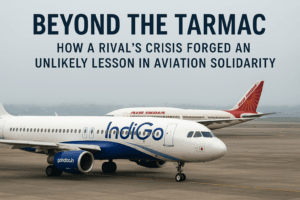
Beyond the Tarmac: How a Rival’s Crisis Forged an Unlikely Lesson in Aviation Solidarity
In the high-stakes world of commercial aviation, where market share is fought over percentage points and on-time performance is a brutal public metric, competition is the default language. Rivals are, by definition, entities to be outperformed, outmaneuvered, and outshone. Yet, in the midst of one of Indian aviation’s most significant operational crises in recent years, a senior voice from a competing airline chose to speak a different, more profound language: that of shared purpose, empathy, and professional solidarity.
As IndiGo, the behemoth controlling 60% of India’s domestic market, grappled with a systemic meltdown—canceling hundreds of flights daily, stranding thousands, and facing intense regulatory scrutiny—an unexpected message emanated from Air India. Jayaraj Shanmugam, the airline’s Head of Global Airport Operations, issued a quiet but powerful internal note, later shared publicly, urging “restraint and professionalism.” His core message was a poignant paradox: “We are rivals in business, but we are partners in the mission of global connectivity.”
This statement, delivered not in a press release but in a professional missive, transcends corporate PR. It offers a rare, human insight into the soul of an industry often seen only through the lens of delays, fares, and baggage claims. It prompts a critical examination of what true professionalism means when a competitor stumbles, and why, in an interconnected ecosystem, the health of one actor ultimately impacts all.
The Crucible of Crisis: More Than Just Operational Chaos
To understand the weight of Jayaraj’s message, one must first appreciate the scale of the IndiGo crisis. Triggered by a perfect storm of stricter pilot rest-rule enforcement and likely internal planning shortcomings, the disruption was not a minor glitch. It was a cascading failure affecting the nation’s major hubs—Delhi, Mumbai, Bengaluru, Hyderabad. For passengers, it translated into shattered plans: missed weddings, compromised business deals, anxious families, and students left in tears, as reports highlighted participants of the Smart India Hackathon 2025 stranded.
The public and regulatory fury was palpable. The Directorate General of Civil Aviation (DGCA) issued warnings and demanded explanations. Social media was alight with frustration. In this volatile atmosphere, the instinct for a competitor could easily be one of quiet opportunism—to capitalize on the disarray, attract disgruntled customers, and highlight one’s own relative stability.
Air India, itself on a ambitious transformation journey under new ownership, could have taken that path. Instead, Jayaraj’s directive to his team advocated for a radically different posture: empathy, self-reflection, and silent support.
Decoding the “Unity Message”: A Three-Pillar Framework for Professional Ethics
Jayaraj’s note wasn’t merely about being “nice.” It outlined a sophisticated framework for professional conduct in a crisis-prone industry:
- Empathy Over Schadenfreude: The immediate, base reaction to a rival’s public struggle can be a mix of relief (“thankfully, it’s not us”) and even subtle glee. Jayaraj explicitly called this out, stating the correct response is “not to criticise or mock.” This is profound. It recognizes that the front-line employees of the struggling airline—the ground staff facing angry mobs, the harried crew, the engineers working overtime—are fellow aviation professionals enduring a nightmare. Mocking their employer’s failure only deepens the industry’s collective stress and erodes public trust in aviation as a whole.
- Internal Review as the Primary Response: The most actionable insight in the message was to “use the event as a catalyst for internal review and team briefing.” This shifts the focus from external blame to internal preparedness. It asks: Are our systems robust enough? Do our contingency plans account for this scale of disruption? How would our teams communicate under similar pressure? This transforms a competitor’s crisis into a invaluable, real-time case study for strengthening one’s own operations. It’s a lesson in turning negative external events into positive internal energy.
- Upholding the Ecosystem’s Integrity: The concept of being “partners in global connectivity” is the philosophical bedrock. Every airline, from the largest to the smallest, is a link in a vast, global chain. A major disruption at one node doesn’t just affect that airline; it congests airports, strains air traffic control, overwhelms shared ground handling services, and shakes overall passenger confidence. When one link fails, the entire chain feels the strain. By acting with dignity and offering behind-the-scenes support (like handling additional passenger loads professionally), airlines help stabilize the ecosystem for everyone, including themselves in the long run.
The Historical Shadow and the New Horizon
This stance becomes even more significant against the backdrop of Indian aviation’s often-cutthroat history. The industry has been witness to fierce fare wars, poaching battles, and public spats. Air India and IndiGo, in particular, represent two different eras and models. For Jayaraj’s message to come from Air India—an airline that has faced its own decades of challenges and is now striving to reclaim excellence—adds a layer of hard-earned wisdom. It suggests a maturation of the industry’s culture, moving from pure, unadulterated rivalry toward a recognition of mutual dependence.
This is not about altruism; it’s about enlightened self-interest. A traveling public that loses faith in aviation’s reliability is a shrinking market for all. A regulatory environment that becomes permanently punitive due to recurring failures hurts all players. By advocating for a united front on professionalism and recovery, the industry safeguards its own social license to operate.
The Passenger’s Gaze: What This Means for the Person in Seat 12A
For the passenger, this behind-the-scenes ethos should be quietly reassuring. It suggests that when things go wrong—and in complex systems, they occasionally will—the industry’s response isn’t universally predatory or gleeful. There exists a professional cadre that understands their fundamental duty is to get you home, regardless of the logo on your ticket. It means that an Air India station manager might, in practice, extend a small courtesy to an IndiGo passenger in dire straits, understanding that roles could be reversed tomorrow. This builds a subtle but critical reservoir of goodwill.
A Universal Lesson in Competitive Dignity
While rooted in aviation, the principle Jayaraj articulated is a universal lesson for any competitive field—be it technology, retail, or automotive. In today’s hyper-connected world, where failures are instantly public and reputations are fragile, how you behave when a competitor falters defines your character more than how you behave when you win.
Do you:
- Exploit or Evaluate?
- Deride or Diagnose?
- Gloat or Gird your own processes?
The “unity message” from Air India’s official argues powerfully for the latter in each case. It champions a competition built on elevating one’s own standards rather than reveling in another’s decline.
Conclusion: The True Altitude of Leadership
The Indian skies are a battlefield for market dominance, and that competition drives efficiency and innovation, benefiting consumers. This reality remains unchanged. However, Jayaraj Shanmugam’s intervention during the IndiGo crisis reminds us that there is a ceiling to how low that battle should go. True industry leadership is measured not only by profit margins and load factors but also by the grace and responsibility shown when the entire sector faces headwinds.
His message underscores that the ultimate competitor is not the other airline on the tarmac, but the systemic failures, the unpredictable elements, and the ever-present challenge of maintaining seamless, safe, reliable connectivity. In that much larger battle, solidarity is not a weakness; it’s the only sensible strategy. By remembering they are “partners in global connectivity,” airlines do more than protect a rival’s dignity—they uphold the integrity of the very network upon which they all, and we all, depend. That is a lesson that soars far above the immediate headlines of cancellations and crises.
You must be logged in to post a comment.