
Beyond the Storm: The Unseen Winter Crisis Deepening Gaza’s Humanitarian Catastrophe
The severe winter storms lashing Gaza, with flooding rains and freezing temperatures inundating the makeshift tents of displaced families, represent far more than a seasonal hardship; they are a direct and deepening extension of the humanitarian catastrophe caused by two years of war and a prolonged blockade. The destruction of infrastructure has turned the landscape into a floodplain of debris and sewage, where inadequate shelter offers no protection, leading to deaths from hypothermia and the rapid spread of disease. This environmental crisis compounds the existing trauma of displacement and loss, creating a relentless cycle of suffering where the struggle for mere subsistence—staying dry and warm—has become a daily fight for survival, even amid a fragile ceasefire that has failed to unlock the aid or reconstruction necessary to provide real safety or dignity.
Beyond the Storm: The Unseen Winter Crisis Deepening Gaza’s Humanitarian Catastrophe
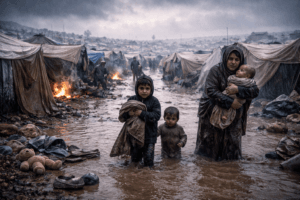
The image is almost biblical in its scale of suffering: tens of thousands of families huddled in ragged tents, not in arid desert, but in a landscape turned to cold, viscous mud. Children’s belongings—a soaked blanket, a single shoe—float in murky puddles invading the only space they call home. This is Gaza in winter 2025, where the weather itself has become a relentless enemy, compounding a man-made catastrophe.
For displaced Palestinians like Mohammed Maslah, who spoke to Al Jazeera from his tent near Gaza Port, and Shaima Wadi, a mother of four in Deir al-Balah, the narrative is not just one of rain, but of a profound, grinding erosion of normalcy. “Every time it rains and the tent collapses over our heads, we try to put up new pieces of wood,” Wadi told the Associated Press. Her statement isn’t merely about weatherproofing; it’s a metaphor for a two-year existence defined by cyclical collapse and fragile, desperate repair.
The Anatomy of a Seasonal Disaster
The immediate trigger is meteorological. As meteorologist Laith al-Allami notes, a succession of polar low-pressure systems is sweeping across the eastern Mediterranean, bringing torrential rains and biting winds—a pattern expected to intensify. But to call this a natural disaster is a profound misdiagnosis.
The preconditions for this crisis were meticulously laid by 24 months of intense bombardment and a 17-year blockade. Gaza’s infrastructure—its drainage systems, its buildings, its electrical grid—was already fragile. The war that began in 2023 did not just damage it; it systematically dismantled it. Where there were once homes and apartment blocks, there is now debris: millions of tons of rubble laced with unexploded ordnance. This rubble chokes waterways and sewers, meaning rainwater has nowhere to go but into the streets and the tents erected on any available patch of land.
The result is a public health crisis unfolding in real time. Stagnant, contaminated water mixes with human waste, becoming a breeding ground for cholera, dysentery, and severe respiratory infections. Hypothermia, as reported by Gaza’s authorities, has already claimed at least 15 lives in December alone, including three infants. For the very young, the elderly, and the chronically ill, a wet blanket in a 4°C (39°F) night is not an inconvenience; it is a fatal threat.
The Sheer Physics of Inadequate Shelter
Consider the material reality of a tent in a winter storm. The shelters provided to most displaced people are designed for temporary summer use in stable climates, not for semi-permanent residence in a coastal winter. The thin plastic sheeting and canvas offer negligible insulation. Winds tear at seams and uproot stakes. The ground, without proper flooring, turns to a cold, sodden sponge.
Ibrahim Abu al-Reesh of Gaza’s Civil Defence describes his teams’ Sisyphean task: rushing to drape new plastic sheets over flooded tents, a stopgap measure that will last only until the next downpour. Each storm erodes not just shelter, but resilience. Families burn whatever they can find for warmth—scraps of wood, trash—filling tents with toxic smoke and risking fires. The choice becomes a cruel calculus: risk asphyxiation and burns, or succumb to the cold.
The Crushing Weight of “And”
This is where insight deepens beyond the headline. The true horror for Gazans is the relentless accumulation of crises, the unbearable weight of the word “and.”
They are displaced and cold. They are hungry (with famine still a looming threat) and wet. They are grieving lost family members and trying to prevent more death from hypothermia. They are traumatized by war and now stalked by the elements.
As Al Jazeera’s Ibrahim Al Khalili reported, “The same misery repeats as each rain fills neighbourhoods with muddy water.” This repetition is key. Psychological studies on trauma highlight that the absence of safety and predictability is deeply corrosive to mental health. There is no postwar “recovery” period; there is only an ongoing, multi-front battle for mere subsistence. The constant state of hypervigilance—once for airstrikes, now also for storm clouds—is unsustainable.
A Frozen Ceasefire, A Thaw in Aid?
The context of a fragile, often-violated ceasefire adds another layer of tragic complexity. While a tentative calm has halted large-scale bombing, it has not unlocked the gates to meaningful reconstruction or even adequate seasonal aid. Aid organizations’ pleas for Israel to allow in proper shelter materials, winter clothing, and fuel for heating have seen limited response.
The ceasefire talks, focused on high-level issues like governing bodies and troop withdrawals, feel galaxies removed from Shaima Wadi’s immediate need for a dry mattress for her children. The disconnect is stark: as diplomats debate the “second stage” of truces, the first stage of human dignity—warmth, dryness, basic shelter—remains utterly out of reach for hundreds of thousands.
The Unseen Legacy: A Generation Shaped by Damp and Cold
The long-term human cost will be measured in more than death tolls. A childhood spent in a perpetually damp, cold tent is a recipe for chronic health conditions—asthma, rheumatic diseases, stunted growth. Education, where it exists, is disrupted as schools are often shelters themselves, now flooded. The mental imprint is one of profound insecurity, where the very sky, a source of rain rather than bombs, remains an adversary.
This winter crisis exposes the stark truth that in Gaza, the end of active bombing is not the end of violence. The violence has simply changed form, from acute kinetic trauma to a slow, pervasive assault by the environment—an environment made lethally inhospitable by war.
A Call for Contextual Compassion
For the global observer, the imperative is to see these images of flooded tents not as an isolated weather report, but as the latest chapter in a continuous story of systemic collapse. Supporting humanitarian aid is crucial, but understanding the root causes is necessary for any lasting solution.
Gaza does not just need tarps and blankets, though it desperately needs those today. It needs the political will to allow the rebuilding of homes, drainage systems, and power grids. It needs the freedom for people like Mohammed Maslah to return to their original homes, not be “forced to stay” in a tent by the port because his neighborhood remains under control or in ruins.
As the fourth polar low approaches, the international community faces a moral weather front of its own. Will the response be more temporary plastic sheeting, or a concerted push to address the foundational devastation that turns every winter rain into a life-threatening flood? The answer will determine whether next winter’s story is one of recovery, or a even more brutal repetition of the same, sodden misery.
You must be logged in to post a comment.