
Beyond the Storm: How Winter’s Fury Exposes the Man-Made Catastrophe in Gaza
Beyond the Storm: How Winter’s Fury Exposes the Man-Made Catastrophe in Gaza
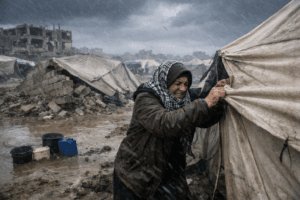
The image is one of desperate resilience: a displaced Palestinian woman, her face etched with exhaustion, struggles to secure the flapping canvas of her family’s tent against a punishing wind. The photograph, taken in Gaza City on December 28, 2025, captures a moment in a larger, unfolding tragedy where extreme weather has become a lethal force multiplier. This week, a winter storm—bringing torrential rain, strong winds, and plunging temperatures—has left thousands homeless within their own homelessness, as makeshift shelters flood and collapse. Amid this chaos, a 30-year-old woman, Alaa Marwan Juha, was killed when a weakened wall crashed onto her tent in Gaza City’s Remal neighborhood. Her death is not merely a weather-related accident; it is a direct consequence of a protracted, human-made crisis that has stripped an entire population of any buffer against the elements.
For the nearly 900,000 Palestinians living in tent camps across Gaza, this storm is not an inconvenience—it is an existential threat. Since late 2023, these tents have been the default “housing” for a population displaced by war. They were never designed for Gaza’s winter rains or Mediterranean winds. As Amjad Shawa, director of the Palestinian NGOs Network, starkly told Al Jazeera, “Tents represent neither a choice nor a solution.” They offer negligible insulation, are prone to flooding, and provide no safety from structural collapses in areas surrounded by the bomb-damaged skeletons of buildings. The current storm has transformed sprawling camps into quagmires of mud and icy water, with families using whatever containers they can find to bail out their own homes.
The humanitarian protocols Shawa references are clear: adequate shelter is a fundamental requirement. The universal call from aid agencies on the ground is for the urgent entry of mobile homes (caravans) and heavy equipment to repair destroyed infrastructure, particularly sewage networks. Without functional drainage, floodwaters mix with untreated waste, creating a perfect breeding ground for disease in an environment where the healthcare system is already in a state of total collapse. The absence of medicine, the scarcity of clean water, and the widespread malnutrition reported by international bodies mean that illnesses like hypothermia, respiratory infections, and waterborne diseases are often a death sentence. Authorities in Gaza report at least 15 lives lost to hypothermia this month alone, including three infants—a quiet, chilling statistic of preventable death.
This is where the natural disaster intersects with the political one. The storm’s impact is so catastrophic precisely because of the devastated landscape upon which it lands. Over a year of intense conflict has left much of Gaza in ruins. There are few intact buildings to which people can evacuate. Emergency workers warn against sheltering in damaged structures, but what is the alternative when your tent is underwater? The collapsed wall that killed Alaa Marwan Juha is a potent symbol: it was likely weakened by earlier violence, finally succumbing to the wind, just as the community’s resilience has been weakened by siege, finally succumbing to the storm.
The term “disaster area,” used by Shawa to describe all of Gaza, takes on a dual meaning. It is a zone of natural calamity, but more fundamentally, it is a zone of man-made catastrophe compounded by severe restrictions on life-saving aid. Despite a ceasefire agreement that ostensibly includes provisions for humanitarian relief, reports consistently detail that the flow of aid remains a trickle, blocked by bureaucratic hurdles and outright restrictions at Israeli crossings. This means not just a shortage of food, but a critical lack of winter-grade tents, waterproof tarpaulins, sturdy blankets, fuel for heating, and the tools needed for basic site repair. The international community’s calls for lifted restrictions have so far failed to alter the reality on the ground, where politics continues to dictate survival.
Meanwhile, the fragile ceasefire itself appears to be cracking. While a first phase involving prisoner exchanges and a partial Israeli withdrawal has been implemented, violations continue. Gaza’s Ministry of Health reports over 414 Palestinians killed since the truce began—a stark reminder that the threat of violence never ceased. This constant insecurity further paralyzes recovery efforts and deepens the collective trauma.
The story of the Gaza storm is, therefore, a story of layers. The top layer is the immediate weather crisis: the wind, the rain, the cold. Beneath it lies the layer of physical destruction: the rubble, the shattered infrastructure, the absent homes. Deeper still is the layer of systemic collapse: the broken healthcare, the crippled economy, the paralyzed governance. And at the foundation lies the layer of political deadlock: the blockade, the restrictions, the stalled diplomacy, and the ongoing violations.
For the reader far removed from this reality, the insight is this: disasters are never equal-opportunity. Their severity is predetermined by the vulnerability of the populations they hit. The storm over Gaza is a meteorological event, but the scale of the suffering it is causing is entirely political. It reveals how, when human action destroys the built environment and dismantles support systems, it also strips away a society’s capacity to endure the natural world. A wall falls in the wind. A baby dies of the cold. These are not acts of God; they are the culminations of a chain of decisions.
The woman adjusting her tent canvas is fighting a battle on all these fronts. She is bracing against the storm, navigating a landscape of ruin, surviving within a collapsed system, and waiting on a political resolution that seems perpetually over the horizon. Until the root causes of Gaza’s vulnerability are addressed—the adequate and unimpeded flow of aid, the rebuilding of durable shelter, and a genuine, sustained move toward peace—each winter cloud will bring with it the promise of renewed tragedy. The storm will pass, but the conditions that turned it deadly remain, waiting for the next rain.
You must be logged in to post a comment.