
Beyond the Stones: Israel’s Seizure of Sebastia and the Fight for the Soul of the West Bank
In a significant escalation of its settlement enterprise, Israel has ordered the seizure of 2,000 dunams (494 acres) of land in the northern occupied West Bank, targeting the historically invaluable archaeological site of Sebastia and adjacent agricultural lands belonging to the Palestinian towns of Sebastia and Burqa. The move, described by Palestinian officials as part of a broader strategy using legal and administrative tools to consolidate Israeli control, extends beyond ancient ruins to encompass vital olive groves, threatening the livelihoods and heritage of local farming communities. This expropriation is coupled with advancing Israeli legislation aimed at placing all West Bank antiquities under Israeli authority, a step critics argue is designed to systematically erase Palestinian claims to the land by controlling its historical narrative and paving the way for de facto annexation, all while the international community remains largely powerless to intervene.
Beyond the Stones: Israel’s Seizure of Sebastia and the Fight for the Soul of the West Bank
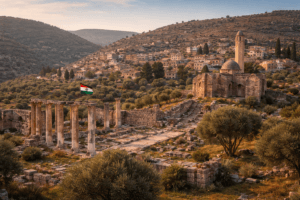
The hills of the northern West Bank have borne witness to empires. For millennia, conquerors from the Canaanites to the Romans, the Byzantines to the early Islamic caliphates, have left their mark on the town of Sebastia. Its very name is a palimpsest of history: the Biblical Samaria, transformed by Herod the Great into a grand Roman city, Sebaste, in honor of his emperor, Augustus. Today, the stones of its colonnaded streets and the crumbling walls of a Crusader cathedral lie quiet under the Mediterranean sun. But the ground beneath them is shaking once more.
On Tuesday, the Israeli government issued an order to seize approximately 2,000 dunams (494 acres) of land in this volatile region, a swath of territory that includes a significant portion of the Sebastia archaeological site and extends into the lush, agricultural lands belonging to the nearby Palestinian towns of Sebastia and Burqa. The order, confirmed by Moayad Shaaban of the Palestinian Wall and Settlement Resistance Commission, is not a sudden development but the culmination of a strategic, years-long campaign to redraw the map of the occupied West Bank.
This is not merely a story about ancient ruins or bureaucratic land expropriation. It is a story about the collision of heritage and sovereignty, the quiet erasure of a living community in the name of preserving a dead one, and the final, frantic push to consolidate Israeli control over the territory before the window of international opportunity closes.
The Layers of a Contested City
To understand what is at stake, one must first understand Sebastia. For Palestinians, it is the twin village of Nablus and Burqa, a place of olive groves and family ties that stretch back centuries. For archaeologists and historians, it is an open-air museum of incomparable value.
“Sebastia is not just a site; it is a chronicle of civilization in stone,” explains a Palestinian archaeologist who has worked in the region but asked to remain anonymous for fear of reprisal. “You can walk from the Iron Age remains of the Israelite kingdom, through the perfectly preserved forum of a Roman city, to a Byzantine church, and then to the mosque of Nabi Yahya, which is believed to house the tomb of John the Baptist. Each layer tells a story. The people of Sebastia have lived alongside these stones for generations. They are the custodians of this history, whether the world recognizes it or not.”
This custodianship is now being legally severed. The expropriation order, first signaled as an “intent to seize” in January 2025, is a classic instrument of Israel’s settlement enterprise. It declares the land “state land,” a legal fiction rooted in Ottoman land law and adapted by Israeli authorities to transfer vast swaths of the West Bank from Palestinian ownership to the control of the Israeli Civil Administration. Once declared state land, it is typically allocated for the exclusive use of Israeli settlements.
The current move, however, has a distinct and worrying character. By specifically targeting an archaeological site of global significance, Israel is weaponizing heritage. The logic is insidious: by framing the seizure as an act of preservation—a desire to protect antiquities from neglect or vandalism—the government can present a land grab as a cultural mission.
The Human Cost: Farmers on the Frontline
While the world’s attention may be drawn to the Roman columns, the immediate human cost of this decision is being borne by the farmers of Burqa and Sebastia. The 2,000 dunams are not barren. They are a patchwork of ancient terraces, many of them cultivated for generations with olives, almonds, and figs.
“My great-grandfather planted those trees,” says Abu Khaled, a farmer from Burqa, his voice trembling with a mixture of anger and grief as he gestures toward a hillside now slated for seizure. We speak over the phone, as he is now hesitant to travel to his land for fear of encountering Israeli authorities or settlers. “Every olive tree is like a member of my family. We know them by their shape, by the oil they produce. They are not just plants; they are our history, our livelihood, our connection to this place. And now, some order on a piece of paper says they belong to someone else?”
This is the quiet catastrophe of the Israeli-Palestinian conflict, the one that doesn’t always make the headlines. It is the slow, systematic dismantling of a rural, agrarian society. The olive tree is the bedrock of the Palestinian economy and identity. To lose an olive grove is not just a financial blow; it is the destruction of a heritage that predates the modern conflict by centuries.
The new seizure will create a contiguous bloc of land under effective Israeli control, extending from the existing settlement of Shavei Shomron, which overlooks the region. For the residents of Burqa and Sebastia, this means more than just lost income. It means being further hemmed into shrinking enclaves, their access to their own lands cut off by fences, military orders, and the threat of settler violence. The main road between Nablus and Jenin, which runs through Sebastia, is already a flashpoint. With the state now effectively owning the hills on either side, the pressure on the Palestinian communities to leave will only intensify.
A Legal and Legislative Onslaught
Tuesday’s land seizure order is not happening in a vacuum. It is one prong of a multi-faceted strategy. As Shaaban noted, it is the “continuation of an earlier notice of intent.” But it also follows a series of legislative and administrative moves designed to cement Israel’s control over West Bank heritage.
In July 2024, the Knesset (Israeli parliament) gave preliminary approval to a bill seeking to apply Israeli law to West Bank antiquities. A more advanced version, introduced in December 2024, explicitly aims to extend the authority of the Israel Antiquities Authority (IAA) into Areas A and B of the West Bank. Under the Oslo Accords, Area A was supposed to be under full Palestinian civilian and security control, while Area B was under Palestinian civilian control and Israeli security control. Sebastia itself lies in Area A.
If this law passes, it would formally abrogate the Oslo framework. It would place all archaeological sites in the West Bank, even those in the heart of Palestinian cities, under the direct management of an Israeli state body. The Palestinians would be stripped of any legal say over their own cultural patrimony.
“This is the final step in the annexation process,” says a Palestinian official in Ramallah, speaking on condition of anonymity. “They have taken the land with settlements. They have taken control of the water and the resources. Now, they are taking our history. They want to rewrite the narrative, to erase any Palestinian claim to this land by controlling the physical evidence of the past. If the IAA is running the excavation and preservation at Sebastia, they will tell a story that is convenient for them. The story of the people who have lived here for the last 1,400 years will be written out of the guidebooks.”
The View from the Settlements
From the perspective of the Israeli settlement movement, the move is a long-overdue correction. For them, Sebastia is not a Palestinian town; it is the ancient capital of the Kingdom of Israel, the heartland of the Jewish people. They see the Palestinian presence as a temporary and illegal occupation of their ancestral homeland.
“This is our history,” says a spokesperson for the Shomron Regional Council, which represents Israeli settlements in the area. “For too long, Jewish heritage sites in Judea and Samaria [the West Bank] have been neglected or, worse, destroyed. The Palestinian Authority has no interest in preserving these sites. We have a responsibility to ensure that the legacy of our ancestors is protected for future generations of Jews and for the entire world.”
This argument, steeped in biblical prophecy and nationalist fervor, is potent within Israel’s current political landscape. It allows the government to portray itself as the defender of Western civilization against those who would let it crumble. It reframes a colonial land seizure as a redemptive act. The fact that the site also contains the remains of every other civilization that passed through—the very essence of its universal value—is rendered secondary to its significance in the Jewish national story.
The International Arena: A Fading Echo
The international response to these escalations has been a study in futility. In July 2024, the International Court of Justice (ICJ) issued a landmark advisory opinion, declaring Israel’s occupation of Palestinian territory illegal and calling for the evacuation of all settlements. It was a sweeping, historic condemnation.
And yet, nearly two years later, settlements are expanding faster than ever, and land seizures like the one in Sebastia continue unabated. The ICJ ruling, for all its moral and legal weight, lacks enforcement mechanisms. The United Nations Security Council remains paralyzed by the U.S. veto power, which has historically been used to shield Israel from punitive measures.
Statements of concern are issued, ambassadors are summoned, and op-eds are written. But on the ground, the bulldozers keep rolling. The Palestinian Authority, weakened, divided, and facing a severe financial crisis, is largely powerless to stop it. Its warnings, like that of Shaaban, are a cry into a void.
The Next Domino
The seizure of Sebastia is a bellwether. It is a test case. If Israel can successfully expropriate land around a major international archaeological site in Area A, the heartland of purported Palestinian self-rule, then no place is safe. The ultimate goal, as many Palestinians fear, is the de facto annexation of all of Area C (over 60% of the West Bank) and the gradual, creeping takeover of Areas A and B.
The new version of the antiquities law is designed to provide the legislative cover for this. By creating a bureaucratic mechanism for Israeli control over heritage, the government can argue that it is not annexing territory in a political sense, but merely managing antiquities in a practical one. It is a distinction without a difference.
As the sun sets over the hills of Sebastia, the long shadows of the Roman columns stretch across the olive groves. For a moment, the ancient and the modern coexist. But that coexistence is under direct assault. The order signed on Tuesday is an axe aimed at the root of the olive tree, and the roots of a people’s claim to their homeland. The world may admire the stones, but for the people of Burqa and Sebastia, the fight is for the soil in which they stand. And it is a fight they are losing.
You must be logged in to post a comment.