
Beyond the Spin: How Precision Godet Technology is Rewriting the Rules of High-Performance Fiber Production
This article explores the critical, often overlooked role of precision godet technology in the production of high-performance synthetic fibers, using Swiss company Retech’s upcoming showcase at Techtextil 2026 as a focal point. It explains how these precision rollers, capable of operating at up to 400°C using advanced induction heating, are essential for aligning polymer molecules during the drawing process to impart strength and consistency to technical yarns used in aerospace, automotive, and protective gear. Beyond mechanical precision, the piece highlights the integration of smart monitoring systems like the UTR-6A, which enable predictive maintenance, closed-loop quality control, and enhanced sustainability by reducing waste and energy consumption, ultimately positioning such machinery as a key enabler for the entire technical textiles industry.
Beyond the Spin: How Precision Godet Technology is Rewriting the Rules of High-Performance Fiber Production
In the quiet, climate-controlled halls of Techtextil 2026 this spring, a piece of machinery that looks, to the untrained eye, like a series of polished metal rollers will likely become a quiet epicenter of interest for the world’s most advanced textile engineers. Swiss industrial specialist Retech is set to showcase its latest generation of precision godet systems and draw frames, and while the technology might not be as visually flamboyant as a 3D-knitted dress or as conceptually futuristic as bio-fabricated leather, its impact on the fabrics that shape our modern world is profound.
In an era where textiles are no longer just about clothing but about enabling flight, protecting firefighters, building lighter cars, and reinforcing critical infrastructure, the machinery behind the fibers matters more than ever. Retech’s upcoming showcase is a reminder that the future of textiles is often forged not in design studios, but on the factory floor, where physics and material science meet precision engineering.
This article delves deep into the significance of this technology, moving beyond the press release to explore the “why” and “how” of precision godet systems and why they represent a critical linchpin in the evolution of the global technical textiles industry.
The Unseen Art of Fiber Formation
To understand the value of a godet, one must first understand the vulnerability of a synthetic fiber in its infancy. Imagine a spider spinning a web, but instead of a gentle breeze, the newly formed silk is subjected to hurricane-force winds while being stretched over hot rocks. This analogy, though crude, touches upon the essence of melt spinning and fiber drawing, the processes used to create synthetic yarns from polymers like polyester, nylon, polypropylene, and advanced aramids.
After a polymer melt is extruded through the tiny holes of a spinneret, it emerges as a thick, gooey, and structurally weak filament. This nascent fiber must be solidified, stretched (drawn), and heat-set to align its long-chain polymer molecules. This molecular alignment is everything. It is the difference between a flimsy thread that snaps at a touch and a high-tenacity industrial yarn capable of reinforcing a tire or stopping a bullet.
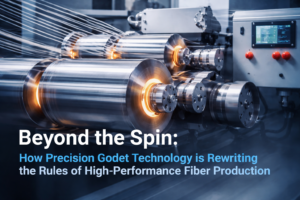
This is where the godet comes in. A godet is essentially a precision roller that guides, stretches, and heats the yarn. A series of these rollers, operating at different speeds and temperatures, form a “draw frame.” The yarn is wrapped around them multiple times, and as it moves from a faster godet to an even faster one, it is stretched to several times its original length. This process, known as drawing, forces the polymer chains to line up parallel to the fiber axis, dramatically increasing the fiber’s strength, reducing its elasticity, and controlling its shrinkage.
Retech’s presence at Techtextil is significant because they are not just making godets; they are perfecting the physics of this critical interaction between machine and material.
Mastering the Extremes: Precision at 400°C
The headline feature of Retech’s showcase is its ability to manage processes at temperatures up to 400°C. This immediately signals their target audience: producers of high-performance and specialty fibers. While commodity fibers like standard polyester require lower temperatures, the realm of high-performance materials demands extremes.
Consider fibers like PEEK (polyether ether ketone), PPS (polyphenylene sulfide), or advanced aramids. These engineering polymers have high melting points and require precise, intense heat to be drawn effectively. A godet surface temperature that fluctuates by even a few degrees can lead to inconsistent drawing. Some sections of the yarn might be perfectly aligned, while others remain amorphous, creating weak spots that lead to breaks during subsequent weaving or, worse, failure in the final product.
Retech’s reliance on advanced induction heating is a crucial differentiator. Unlike traditional resistance heating, which can be slow to respond and create temperature gradients, induction heating generates heat directly within the godet shell. This allows for rapid, precise temperature control. The mention of “single-zone or multi-zone configurations” hints at a high level of sophistication. A multi-zone godet can maintain different temperatures across its width, allowing manufacturers to process multiple yarn ends with slightly different requirements simultaneously, or to create a specific temperature profile along the yarn’s path on a single roller.
This level of control directly translates to yarn quality. By maintaining exact temperature uniformity across the entire godet surface, manufacturers can ensure that every micron of the fiber experiences the same thermal history. The result is a yarn with predictable, uniform properties—consistent tenacity (strength), elongation at break, and thermal shrinkage. For applications like airbags, parachute cords, or composites for aerospace, this consistency is not a luxury; it is a life-saving necessity.
The Digital Thread: The UTR-6A and Industry 4.0 Integration
Perhaps the most compelling aspect of Retech’s technology, and one that aligns perfectly with the Industry 4.0 theme prevalent at shows like Techtextil, is the integration of intelligent monitoring. The UTR-6A non-contact temperature measurement system is a testament to how machinery is becoming smarter and more communicative.
Traditionally, measuring the temperature of a rotating, hot godet was a challenge. You could measure the stationary components, but knowing the exact surface temperature where the yarn is actually contacting the roller was a black box. The UTR-6A solves this by capturing temperature data directly from the rotating godet surface and transmitting it wirelessly to the UCR-6 controller.
This is more than just fancy instrumentation. It is the creation of a “digital twin” for the godet in real-time. Here’s what this enables:
- Predictive Maintenance: The system doesn’t just report the temperature; it monitors the health of the godet, bearing system, and induction heater. By analyzing trends—like a gradual increase in the time it takes to reach set temperature or slight temperature fluctuations that weren’t there before—the system can alert operators to a potential bearing failure or heater degradation before it causes a catastrophic breakdown. This prevents costly, unplanned downtime, which can cost a fiber plant tens of thousands of dollars an hour.
- Closed-Loop Quality Control: Imagine a scenario where the ambient temperature in the plant rises during a summer afternoon. This could subtly affect the cooling rate of the yarn before it even hits the godet. The UTR-6A system, by ensuring the godet surface remains at the exact set point, decouples the process from these external variables. In a more advanced setup, if the yarn properties begin to drift, the control system can make micro-adjustments to the godet temperature to compensate, ensuring the final product remains within spec.
- Sustainability Through Efficiency: By preventing off-spec production and machine breakdowns, this technology reduces waste. Producing a ton of off-quality fiber that must be scrapped or downcycled represents a massive waste of energy, water, and raw materials. By maximizing “first-pass yield”—getting the product right the first time—precision monitoring is a powerful tool for sustainability. The energy-optimized heating systems further reduce the carbon footprint of the manufacturing process.
Why This Matters Now: The Shifting Landscape of Textiles
We are living in a transformative age for the textile industry. The demand is no longer just for cheaper t-shirts. The growth engines are in technical textiles—geotextiles that stabilize railway lines, medtech implants, protective fabrics for electric vehicle battery casings, and lightweight composites for wind turbine blades.
This shift places immense pressure on fiber producers. They must innovate constantly, working with new, often difficult-to-process polymers. They must guarantee absolute quality for safety-critical applications. And they must do it all while improving energy efficiency and reducing waste to meet corporate sustainability goals and regulatory pressures.
Companies like Retech are the enablers of this innovation. When a material scientist in a lab develops a new polymer with remarkable properties, it is the machine builder who must figure out how to scale its production from grams to tons. The ability to offer a godet system that can handle extreme temperatures with microscopic precision, monitor its own health, and integrate seamlessly into a modern digital factory gives those scientists and production engineers the tools they need to bring their visions to market.
Furthermore, the robust mechanical design highlighted by Retech speaks to the realities of modern manufacturing. Fiber production lines often run 24/7 for weeks on end. A godet failure is not just a repair cost; it’s a production line halt. By focusing on long-term reliability and extended service life, Retech is directly addressing the total cost of ownership for its customers, a key factor in capital equipment purchasing decisions.
The View from Techtextil 2026
As attendees walk past the Retech booth at Techtextil, they will likely see engineers in deep conversation with the company’s representatives. They won’t be discussing the color of the machine or its aesthetic appeal. They will be talking about polymer rheology, dwell times, wrap angles, and coefficient of friction. They will be sharing their biggest challenges: “We’re trying to spin a new bio-based polymer, but it keeps sticking.” “We need to increase our line speed by 30% without sacrificing tenacity.” “Our current godets can’t maintain a uniform temperature at the edge of the roller.”
Retech’s ability to answer these challenges with a combination of thermal precision, digital intelligence, and mechanical robustness positions them as a key partner in the technical textile supply chain. Their showcase is a testament to the fact that the most exciting innovations aren’t always the most visible. Sometimes, they are the ones that happen behind the scenes, on a precisely heated, perfectly spinning roller, ensuring that the fibers of the future are stronger, safer, and more sustainable than ever before.
In the grand narrative of textiles, the godet may be a supporting character, but as Retech demonstrates, it is a role that requires the performance of a lead actor. It is a story of heat, speed, and tension, all controlled with a mastery that turns molten plastic into the engineered fabrics that hold our world together.
You must be logged in to post a comment.