
Beyond the Snowfall: How Himachal’s Winter Fury Reveals Nature’s Delicate Balance and Human Resilience
Himachal Pradesh is experiencing a significant winter weather event characterized by widespread snowfall in high-altitude areas like Lahaul-Spiti and isolated rainfall in mid-hills, driven by a western disturbance that has also caused an appreciable rise in minimum temperatures. Beyond creating picturesque scenes, this mixed precipitation is a double-edged sword: it promises vital spring water reserves for farmers but also brings immediate disruption through forecasts of severe thunderstorms, gusty winds up to 60 kmph, and cold-day conditions, testing the resilience of local communities, tourism, and infrastructure. The episode underscores the delicate balance of mountain life, where a single meteorological bulletin connects the beauty of a snow-blanketed landscape to practical challenges of survival and adaptation, all while hinting at the broader patterns of climate variability in the fragile Himalayan ecosystem.
Beyond the Snowfall: How Himachal’s Winter Fury Reveals Nature’s Delicate Balance and Human Resilience
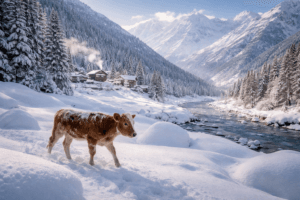
The scene is one of pristine, almost surreal, beauty. A solitary calf picks its way across an untouched blanket of snow, its breath forming tiny clouds in the crisp, thin air. The silence of the high Himalayas is profound, broken only by the soft crunch of hooves on fresh powder. This picturesque moment, captured in Lahaul-Spiti, is the postcard face of a far more complex and dynamic weather event currently reshaping life across Himachal Pradesh.
Over the past 24 hours, the India Meteorological Department (IMD) has reported a significant weather episode: widespread snowfall in the tribal and high-altitude regions, isolated rainfall in the mid-hills, and a palpable rise in minimum temperatures. Gondla received 22 cm of snow, Kukumseri 21.3 cm, transforming these landscapes into winter wonderlands. Yet, alongside this beauty comes a stern warning—the forecast of thunderstorms accompanied by lightning and gusty winds reaching up to 60 kmph, a reminder that in the mountains, nature’s serenity and its fury are two sides of the same coin.
The Data: Decoding the IMD’s Bulletin
At first glance, the IMD’s update is a list of numbers and places. Keylong: 12.5 cm. Kalpa: 5.5 cm. Manali: 6 mm of rain. But each datum tells a story of atmospheric shifts. The “appreciable rise” in minimum temperatures, 2 to 5 degrees Celsius above normal, is a critical detail. It signals the influx of marginally warmer, moisture-laden air, which is precisely what has triggered this mixed bag of rain and snow. While Tabo shivered at -8.9°C, Paonta Sahib basked at a maximum of 23°C, illustrating the dramatic climatic contrasts packed into this one state.
The forecast for “cold-day conditions” in lower hills—where the sun remains hidden, and temperatures struggle to climb despite it being daytime—adds another layer of discomfort for residents. This isn’t just about aesthetics; it’s about the tangible impact on daily survival, agriculture, and infrastructure.
The Human Element: Life in the Wake of the Snow
Behind the statistics lies the real human narrative. For the farmers in Sangla or Kalpa, this snowfall is a delayed but welcome deposit into their water bank. The snowpack that accumulates now will slowly melt through spring and summer, feeding the streams that irrigate apple orchards and terraced fields of peas and potatoes. A good winter snowfall is, for many, a promise of a secure harvest.
Conversely, for the transport and tourism sectors, it’s a period of heightened anxiety and adaptation. The Atal Tunnel, a lifeline to Lahaul-Spiti, sees frantic activity as authorities work to keep it clear. The picturesque town of Manali, with its light rain, might experience tourist delight, but tour operators are nervously watching the thunderstorm warning. The gusty winds of 52 kmph reported in Kufri can lead to fallen trees, power outages, and disrupted travel plans. For the local resident, the shallow fog in Kalpa, reducing visibility to 500 meters, means navigating treacherous roads with extreme caution.
This weather also underscores a profound resilience. Communities in these regions have co-evolved with such capricious climate patterns. Their architecture, with sloping roofs to shed snow, their stocking of winter supplies, and their intimate knowledge of mountain paths are all testaments to generations of learned adaptation.
The Science: The Engine of the Storm – Western Disturbances
The driving force behind this activity is a familiar player for North India: the western disturbance. These eastward-moving, extra-tropical storm systems originate over the Mediterranean Sea, picking up moisture along their journey. As they encounter the formidable barrier of the Himalayas, the air is forced to rise, cool, and condense, leading to precipitation. The type—rain or snow—is determined by the altitude and the temperature profile of the atmosphere.
The IMD’s note about a fresh western disturbance likely affecting the region from January 30 is crucial. It suggests that this current spell is merely an interlude, a precursor to a potentially more significant event. This pattern of successive disturbances is what can lead to extended periods of severe weather, avalanche risks in high passes, and the compounding challenges of isolation for remote villages.
Insight & Value: Navigating the Winter Majesty
For the traveler enchanted by the idea of a Himalayan winter, this news offers both a lure and a lesson. The insight here is that mountain weather is never monolithic. It demands respect and preparation.
- For the Adventure Seeker: This is a time of spectacular beauty, with landscapes transformed overnight. However, it mandates checking forecasts obsessively, carrying emergency kits, and ensuring vehicles are winter-ready with chains. The promise of a thunderstorm means avoiding high ridges and exposed areas during peak activity.
- For the Resident & Farmer: The alternating freeze and thaw, especially with gusty winds, can damage young orchard shoots. Securing property and protecting livestock becomes paramount. The appreciable rise in minimum temp, while still cold, can subtly affect the dormant cycle of crops.
- The Bigger Picture: These patterns feed into the broader discourse on climate variability in the Himalayas. While a single event isn’t attributable to climate change, the increased intensity and unpredictability of precipitation—be it rain or snow—align with wider global shifts. The health of the winter snowpack is directly linked to the water security of millions downstream.
Looking Ahead: A Cycle of Resilience
As the calf in the snow moves towards shelter, and lights flicker on in homes across Shimla amid thunderstorm warnings, life in Himachal Pradesh continues its rhythmic dance with the elements. The current weather is not an anomaly but a chapter in the annual saga of the Himalayas.
The genuine value in understanding this news lies in moving beyond the headline of “rain and snow.” It’s about appreciating the intricate web connecting a meteorological bulletin in Shimla to a farmer’s anxiety in Spiti, a tourist’ diverted itinerary in Manali, and the long-term water security of the northern plains. It’s a story of breathtaking beauty juxtaposed with logistical hardship, of ancient adaptation meeting modern forecasting.
The mountains are speaking—through the whisper of falling snow, the rumble of thunder, and the gust of a 60 kmph wind. The true insight is in learning to listen, prepare, and respect the powerful, delicate balance they maintain. The coming days, with the threat of thunderstorms and the promise of another western disturbance, will be yet another testament to the enduring resilience of both the landscape and the people who call it home.
You must be logged in to post a comment.