
Beyond the Smog Screen: Why India’s Seasonal Pollution Crackdowns Are a Dangerous Distraction
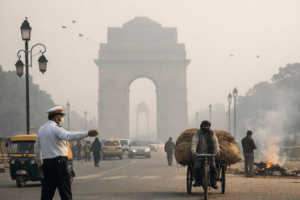
Beyond the Smog Screen: Why India’s Seasonal Pollution Crackdowns Are a Dangerous Distraction
The arrival of winter fog in North India has become more than a meteorological phenomenon; it is a grim, annual ritual of public distress. As visibility drops, a parallel curtain descends—one of policy panic, reactive bans, and public fury. This year’s headlines are a tragic repeat: multi-vehicle infernos on expressways, airports in disarray, and an Air Quality Index (AQI) plummeting into the “severe+” category, a zone where the air is quite literally toxic. Yet, to view this solely as a “fog crisis” is to dangerously misunderstand the problem. The fog is not the cause; it is the revealer. It pulls back the veil on a year-round failure of environmental governance, exposing a system that prefers theatrical, last-minute gestures over the unglamorous, consistent action required to safeguard public health.
The Annual Cycle of Panic and Inaction
Every winter, the narrative follows a depressingly familiar script. As temperatures dip and moisture condenses, the already polluted air—saturated with particulate matter (PM2.5 and PM10), nitrogen oxides, and sulfur dioxide—transforms into a dense, poisonous soup. The science is clear: fog or low wind conditions act as a lid, trapping emissions that are generated relentlessly throughout the year. The result is not a sudden spike in pollution creation, but a catastrophic concentration of pollution that has never been adequately controlled.
The response is equally predictable. Emergency protocols like the Graded Response Action Plan (GRAP) Stage IV are activated. Construction halts, certain vehicles are banned, and schools shift online. Officials hold a flurry of meetings, and threats are issued—like denying fuel to vehicles without pollution certificates. While these measures might offer a marginal, temporary dent, they are fundamentally reactive. They treat a chronic, systemic disease with a band-aid applied only when the wound is gushing. Once the winds pick up, dispersing the smog but not the pollutants, the restrictions lift, and the collective sigh of relief is mistaken for a solution. The underlying emissions continue unabated, banking up for the next seasonal trap.
The Fatal Cost of Reactive Policy
The human cost of this cycle is measured in more than just compromised lungs. It is counted in lives lost on fog-shrouded highways, like the horrific pile-up on the Yamuna Expressway. It is tallied in the economic disruption of hundreds of cancelled flights and delayed logistics. Most perniciously, it is calculated in the long-term health burden of a population perpetually breathing air that exceeds WHO safe limits by a factor of 10 or more. Children develop asthma, the elderly face heightened cardiovascular risks, and healthy adults see their long-term health eroded.
The current strategy of seasonal crackdowns suffers from three critical flaws:
- It Misidentifies the Enemy: By focusing on the fog, it frames the issue as an “act of nature” or a seasonal nuisance, rather than a permanent public health emergency caused by human activity.
- It Encourages Short-Termism: Industries, builders, and transport operators learn to work around the annual “pollution season,” rather than investing in sustainable, cleaner technologies and practices required for year-round compliance.
- It Erodes Public Trust: When citizens see draconian measures enacted overnight, only to be forgotten by spring, they rightly perceive the government’s actions as performative rather than substantive. This leads to compliance fatigue and cynicism.
The Unseen, Unabated Year-Round Sources
To move beyond the fog, we must stare at the hard, everyday sources that form the reservoir of our winter smog. These are not mysteries:
- Transport: Beyond the winter focus on old vehicles, the real issue is the sheer volume of traffic, congestion leading to inefficient combustion, and the critical lack of robust, clean public transportation infrastructure. Electric vehicle adoption, while growing, remains a fraction of the whole.
- Industry: Across the Indo-Gangetic plains, small and medium-scale industries often operate without effective pollution control technology. Enforcement of standards is sporadic and vulnerable to economic pressures.
- Energy: Coal-fired power plants, even those near urban centers, have been slow to adopt stringent emission controls, releasing SO2 and NOx that form secondary particulates.
- Agriculture: The post-monsoon paddy stubble burning in Punjab and Haryana is a potent seasonal contributor, but it is exacerbated by a policy framework that fails to provide farmers with affordable and efficient alternatives for residue management.
- Urban Dust and Waste: Construction without mandatory dust mitigation, road dust, and the open burning of waste are perennial, local sources that municipal bodies fail to address systematically.
Toward a Philosophy of Consistent Action: A Four-Pillar Framework
Breaking the cycle requires a paradigm shift from reaction to relentless, year-round action. This is not merely about stricter laws, but about building a system of accountability, innovation, and public participation that functions in all seasons. Here is a potential framework:
- Empower and Mandate the Guardian Body:The Commission for Air Quality Management (CAQM) must evolve from a crisis-manager to a powerful, independent regulator. Its mandate should be to ensure the AQI stays below a “Very Poor” threshold (301)every day of the year, not just in winter. This requires real-time, transparent tracking of emission sources, the authority to levy significant, non-negotiable penalties on persistent polluters (municipal corporations, power plants, industrial clusters), and the power to direct cross-state resource allocation for clean technology adoption.
- Decentralize the Solution and the Accountability:A one-size-fits-all approach from Delhi won’t work. Each city and region needs a legally binding, granularClean Air Action Plan that addresses its specific emission mix. The Mayor or District Magistrate should be held accountable for delivering on quarterly reduction targets, with performance linked to funding and governance reviews. Public dashboards should display progress on key metrics, making governance transparent.
- Incentivize the Transition, Don’t Just Punish Non-Compliance:Policy must make green choices the easier and more economical ones.
- For Farmers: Move beyond fines for stubble burning. Create a viable market for crop residue by subsidizing and scaling up bio-decomposer technology, establishing biomass aggregation and power generation units at the block level, and providing direct income support for sustainable practices.
- For Industry: Offer fast-tracked clearances and tax benefits for industries that adopt best-available pollution control tech, alongside stricter, unavoidable penalties for those that don’t.
- For Citizens: Dramatically accelerate the rollout of electric buses and metro networks. Make the cost of using public transport negligible compared to private vehicles. Subsidize electric vehicle charging infrastructure not just in affluent enclaves, but in residential colonies and public parking zones.
- Mainline Public Health into Every Decision:The discourse must change from “AQI numbers” to “health outcomes.” Medical associations need a louder voice in policy rooms. Health impact assessments should be mandatory for all large infrastructure and industrial projects. Schools should have air purifiers and scheduled outdoor activities based on real-time AQI, not just in winter but whenever air quality dips.
Conclusion: Clearing the Air Requires Unwavering Vision
The winter fog will return. The question is whether we will continue to be surprised by it, deploying empty threats and chaotic emergency measures, or whether we will finally build a system that renders the fog merely a weather event, not a public health catastrophe.
The true test of India’s commitment to clean air is not taken on a smoggy December day when the world is watching. It is taken on a clear, sunny day in May, when the pressure is off, and the choice is made to still enforce dust norms, still monitor industrial emissions rigorously, still invest in a bus lane, and still support a farmer to not burn his residue. It is in that unglamorous, consistent, year-round work that the battle for breathable air will be won or lost. The need of the hour is not another emergency meeting, but the quiet, determined execution of a plan that never sleeps.
You must be logged in to post a comment.