
Beyond the Sirens: The Hidden Apartheid of Israel’s Bomb Shelter Crisis
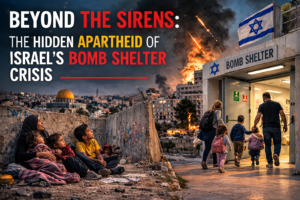
Beyond the Sirens: The Hidden Apartheid of Israel’s Bomb Shelter Crisis
A Nation at War, But Not All Citizens Are Equal
The sirens wailed across central Israel as Iranian missiles streaked through the night sky. For Jewish residents of West Jerusalem, the ritual is familiar—a scramble to the building’s reinforced shelter, the muffled thud of distant impacts, the all-clear signal minutes later. But for Palestinians in East Jerusalem, the experience is fundamentally different. Many have nowhere to go.
“This is the meaning of a supremacist, racist regime,” says Orly Noy, an Iranian Israeli journalist and editor of the Hebrew-language news site Local Call. In a recent interview with Democracy Now!, Noy highlighted a reality that rarely makes international headlines: while Jewish neighborhoods are “well protected” by bomb shelters, Palestinian communities within Israel and East Jerusalem remain dangerously exposed.
The contrast is stark. In Jewish areas of Jerusalem, shelters are integrated into apartment buildings, schools, and public spaces. In Palestinian neighborhoods—officially annexed and considered part of Israel’s capital—such infrastructure is virtually nonexistent. “You cannot find a single—almost single—shelter in the Palestinian neighborhoods,” Noy explains.
A Personal Lens on a Fractured Identity
What makes Noy’s perspective particularly compelling is her own biography. She is an Iranian Jew whose family fled to Israel during the 1979 Islamic Revolution. She embodies the very complexity that Israel’s official narrative often erases—a Jew from an enemy state who now critiques the Jewish state from within.
“Iranian Israeli” is not a common designation. Most Israelis of Iranian descent have fully assimilated into the country’s dominant Jewish culture. But Noy has chosen a different path, using her platform at Local Call and her position as chair of B’Tselem’s executive board to challenge the country’s foundational assumptions about security, identity, and justice.
Her analysis cuts through the fog of war with unusual clarity. While Israeli media celebrates the Iron Dome and military preparedness, Noy forces readers to confront an uncomfortable question: Prepared for whom?
The Geography of Survival
The shelter disparity is not accidental. It reflects decades of systematic underinvestment in Palestinian communities, both within Israel’s 1948 borders and in occupied East Jerusalem. Municipal services, infrastructure, and yes, bomb shelters, flow along ethnic lines.
During the current escalation between Israel and Iran, this inequality transforms from a chronic injustice into an acute life-or-death crisis. Families in Palestinian neighborhoods face a cruel calculus: stay home, unprotected, or crowd into the few available shelters—typically schools, which are now operating during wartime specifically to provide refuge.
“It would be safer for a Palestinian family to send their children to school in the middle of wartime than having them stay at home, where they do not have any shelters,” Noy observes. This inversion of normalcy—where classrooms become safer than bedrooms—reveals the depth of structural discrimination.
Beyond the Shelter Doors
The shelter crisis is merely the most visible symptom of a deeper pathology. Noy points to reports of Palestinians being turned away from public shelters in mixed cities by Jewish residents who refuse to share space with them during attacks. These incidents, while illegal, reflect the social reality of a society deeply divided along ethnic lines.
“When you have a regime that is fundamentally based on the foundations of racism and supremacy, you shouldn’t be surprised to find that these notions of racism and supremacy are being expressed also in, or maybe even particularly in, times of war,” Noy explains.
War amplifies existing inequalities. It also provides cover for other forms of violence. As international attention focuses on Iranian missiles and Israeli strikes, Noy warns that Israel is exploiting the distraction to escalate its campaign in the West Bank.
“Palestinians are being simply executed by settlers, with the support of the Israeli army,” she says. “And it just goes by without any serious repercussions.”
The Political Consensus of War
Perhaps most troubling to Noy is the near-total absence of political dissent within Jewish Israeli society. Opposition leaders who should be challenging Prime Minister Benjamin Netanyahu have instead competed to sound more hawkish. Yair Lapid, head of the opposition, recently called for “the complete destruction of all Iranian infrastructure.”
This reflexive embrace of militarism, Noy argues, is self-defeating. “By supporting, without question, this very strange and unnecessary war, they’re not just committing a moral crime, but also making it for themselves incredibly difficult, if not impossible, to replace Netanyahu.”
War legitimizes the prime minister. It silences critics. It reinforces the very system that produces inequality. And it does so with the enthusiastic participation of those who claim to oppose Netanyahu.
The Erasure of Dissent
Noy’s recent article, titled “We are at war, therefore we are,” explores what she calls “the ritual erasure of political dissent” in Israel. The phrase echoes Descartes—”I think, therefore I am”—but replaces thought with war as the foundation of identity.
For many Jewish Israelis, war is not merely a policy choice but an existential affirmation. To question a war is to question the nation’s right to exist, or so the logic goes. This mindset makes genuine debate impossible and locks the country into perpetual conflict.
The consequences extend beyond Israel’s borders. Agnès Callamard, secretary general of Amnesty International, connects the current escalation to the ongoing genocide in Gaza. “The control over humanitarian organization is very clear,” she says. “It is meant to control those who dare speak up, those who are on the ground and are witnesses to the ongoing genocide.”
As Israel targets Iran and intensifies operations in Lebanon, the humanitarian situation in Gaza deteriorates further. The Rafah crossing is closed. Thirty-seven aid organizations have been deregistered. The witnesses to atrocity are being silenced, replaced by organizations that will not speak truth to power.
A Moral Reckoning
What would it mean for Israelis to confront the reality Noy describes? It would require acknowledging that the state they have built protects some citizens while exposing others to danger. It would require seeing the connection between missiles from Iran and the absence of shelters in East Jerusalem. It would require recognizing that security cannot be purchased with other people’s safety.
Noy’s Iranian Jewish heritage adds a poignant layer to this reckoning. Her family fled the Islamic Revolution, seeking refuge in the Jewish state. Now she watches that state replicate patterns of discrimination she might have expected to leave behind in Iran.
This is not to equate Israel with Iran—the contexts and ideologies differ fundamentally. But it is to recognize that systems of hierarchy and exclusion can emerge anywhere, even in states founded by refugees seeking safety.
The Human Cost
Behind the statistics and political analysis are real people making impossible choices. A mother in East Jerusalem deciding whether to keep her children home or send them to a school shelter. A family in Gaza wondering if today’s airstrike will hit their building. A settler in the West Bank who sees Palestinians not as neighbors but as obstacles to be removed.
War dehumanizes. It reduces complex societies to simple categories—us and them, friend and enemy, worthy of protection and exposed to danger. Noy’s work resists this reduction. She insists on seeing the humanity on all sides, even as she documents the inhumanity of Israeli policy.
Beyond the Headlines
As the Israel-Iran conflict continues to dominate headlines, the stories that don’t make the news are often the most revealing. The Palestinian family huddled in a school corridor during a missile attack. The Jewish resident who refuses to share a shelter with Arab neighbors. The soldier who looks the other way when settlers attack.
These small stories add up to a larger truth about Israeli society—a truth that Noy articulates with unusual clarity. “This is the meaning of a supremacist, racist regime,” she says. Not just the absence of shelters, but the worldview that makes their absence seem normal.
A Different Future
Is another Israel possible? Noy seems to believe so, though she offers no easy answers. Her work at Local Call and B’Tselem is dedicated to documenting the reality of occupation and discrimination in the hope that awareness might eventually lead to change.
But change requires more than documentation. It requires Jewish Israelis to confront their own complicity in systems that privilege them at Palestinian expense. It requires political leaders to risk dissent rather than exploit war for personal gain. It requires international actors to look beyond geopolitics and see the human beings whose lives hang in the balance.
The missiles will eventually stop. The shelters, or their absence, will remain. The question is whether Israelis will use the quiet that follows to build a different kind of society—one where protection is not a privilege of ethnicity but a right of citizenship.
Noy’s voice, inconvenient and necessary, insists that this question cannot be deferred. War is not identity. Survival is not solidarity. And a state that protects only some of its people has already failed the most basic test of legitimacy.
As the sirens sound again over Jerusalem, the unequal geography of safety continues to claim its quiet toll. In Jewish neighborhoods, families descend into shelters. In Palestinian neighborhoods, they wait—and wonder if this time, the missiles will find them.
You must be logged in to post a comment.