
Beyond the Seat: How Affordable Business Class is Redefining the Journey to India
MyFlyYatra is an online travel platform making premium air travel more accessible by offering competitively priced business class flights from major U.S. hubs—including New York, San Francisco, Chicago, and Dallas—to key Indian destinations such as Delhi, Mumbai, Bangalore, and Hyderabad, as well as expanding its affordable service to global cities across Europe, Asia, and the Middle East; by leveraging industry partnerships and technology to lower the cost barrier, the company aims to help travelers—from diaspora families to business professionals—arrive refreshed on long-haul journeys without sacrificing comfort or budget.
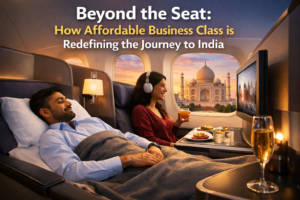
Beyond the Seat: How Affordable Business Class is Redefining the Journey to India
For generations of travelers, the journey between the United States and India has been a test of endurance. The 15-to-17-hour flight from New York to Delhi or San Francisco to Mumbai is the kind of marathon that leaves even the most seasoned travelers bleary-eyed, dehydrated, and desperately seeking a horizontal surface. For decades, the divide between comfort and affordability was stark: you either paid a king’s ransom for a lie-flat bed in business class or braced yourself for a cramped, sleepless night in economy.
A recent announcement from travel platform MyFlyYatra suggests that this binary choice is finally becoming obsolete. By leveraging technology and strategic partnerships, the company is positioning itself at the forefront of a significant shift: democratizing access to premium cabins for the Indian diaspora and global travelers alike. But what does this shift actually mean for the traveler? It goes far beyond the glossy promises of a press release. It’s about the emotional and physical currency of arriving whole.
The True Cost of the “Economy Grind”
To understand the value of what platforms like MyFlyYatra are offering, one must first understand the physical toll of a non-stop flight to the subcontinent. Sitting upright for 15-plus hours is not merely uncomfortable; it is a physiological stress test. The risk of deep vein thrombosis (DVT), severe dehydration from cabin pressure, and the general inflammation caused by restricted circulation can turn the first two days of a vacation or a critical business deal into a recovery period.
“I used to book the cheapest fare I could find,” says Rajesh K., a software engineer from Seattle who travels to Hyderabad twice a year to visit family. “I told myself that the money saved was worth the misery. But I’d land in India and lose a full 48 hours just sleeping and fighting jet lag. By the time I felt human again, half my short vacation was gone. I was physically present but mentally absent.”
Rajesh’s story is the rule, not the exception. For the millions of Indian-Americans and NRIs (Non-Resident Indians) who make up the vibrant diaspora, “going home” is an act of love, but the flight is a gauntlet. This is where the “human insight” of the business class value proposition becomes clear. It’s not about champagne and caviar; it’s about reclaiming your time.
The “Human Insight” of Premium Travel
MyFlyYatra’s focus on competitive business class fares taps into a growing realization among travelers that value is not just about the lowest price, but the best value per mile. When a business class ticket allows you to:
- Arrive Refreshed: You can bypass the “jet lag zombie” phase. A lie-flat seat allows for genuine sleep, syncing your body clock with your destination before you even land.
- Maximize Time: For a business traveler, landing on a Tuesday morning and being able to head straight to a board meeting without a “recovery day” is a game-changer. For a family traveler, it means being able to engage with grandparents and children immediately upon arrival.
- Preserve Well-being: Access to airport lounges (with showers and quiet spaces) and priority security lines reduces the anxiety and physical exhaustion of navigating massive hubs like JFK or Heathrow.
This isn’t just luxury; it’s logistical sanity. By making this tier of travel more accessible, MyFlyYatra is effectively selling back something priceless: time and well-being.
Decoding the “Affordable Business Class” Promise
How do platforms like this manage to offer fares that undercut the sticker shock of booking directly with an airline? The press release mentions “advanced booking technology and industry partnerships.” For the savvy traveler, understanding this can unlock even greater savings.
These platforms often utilize consolidator fares—bulk-bought tickets that airlines sell to wholesalers at a discount, who then pass those savings on to the consumer. They also employ sophisticated algorithms to hunt for mixed-cabin fares or routes with a “business class” product on one leg and a more economical premium option on another, all while maintaining the same booking class comfort.
For the traveler, this means access to a back-end market that isn’t visible on a standard Google Flights search. A route like Chicago (ORD) to Bangalore (BLR) might have a standard business class fare of $5,000, but a consolidator platform might find a creative itinerary using a partner airline that brings the cost down to $3,200.
More Than Just a Seat: The Diaspora Connection
MyFlyYatra’s extensive list of served U.S. and Canadian cities—from Austin to Edmonton—highlights a deep understanding of the North American Indian diaspora map. These are not just random departure points; they are tech hubs (Seattle, San Francisco), medical and educational centers (Chicago, Dallas), and financial capitals (New York) where the Indian community has put down roots.
For these travelers, a trip to India is often multi-generational. A family of four flying economy might face a staggering total price, but the physical toll on elderly parents or young children is even higher. The ability to find an affordable business class ticket for the grandparents, while the younger, more resilient generation sits in economy, is a practical family compromise that was nearly impossible to achieve financially just a few years ago.
“My parents are in their 70s,” explains Anjali M., a doctor in New Jersey. “There is no way they could fly 15 hours to Mumbai in economy. It would be cruel. But paying full price for two business class tickets plus ours was prohibitive. Finding a service that specializes in getting us a reasonable rate for them changed everything. They arrive with dignity and comfort, and we can start our family time immediately.”
Beyond India: A Global Playbook for Comfort
While India remains the core specialty—likely due to the complex web of routes and high demand—the expansion to Europe, Asia, and the Middle East signals a broader trend. The “affordable business class” model is exportable.
Destinations like Tokyo, Singapore, and London are major connecting hubs or final destinations for business and leisure travelers. The same logic applies: the flight to Tokyo from the U.S. East Coast is a 14-hour haul across the polar route. The fatigue is real.
By offering competitive fares to these destinations, MyFlyYatra is positioning itself as a comprehensive resource for the “long-haul premium traveler.” Whether you are a tourist heading to Paris for a honeymoon or a consultant heading to Dubai for a project, the value of arriving rested is universal.
How to Make the Most of This Shift
For readers inspired to explore this option, here is how to add genuine value to your next booking, inspired by the services mentioned:
- Be Flexible with Hubs: If you live near a major city like Dallas (DFW) or Atlanta (ATL), you’re in luck. But don’t be afraid to consider positioning flights. Sometimes, a cheap domestic hop to a major gateway like New York or Chicago can unlock a significantly cheaper international business class fare.
- Consider “Hard Product” vs. “Soft Product”: Not all business class is created equal. A “business class” seat on a narrow-body plane for a short haul is just a larger seat. The holy grail on U.S.-India routes is the “hard product”—specifically, lie-flat seats with direct aisle access. When comparing fares, ensure you know what you’re getting for those 15 hours.
- Look at Mix-and-Match Airlines: Sometimes the best deal involves flying one airline to Europe (like a budget-friendly business class on an airline starting its international expansion) and connecting with a premier carrier like Air India, Lufthansa, or Emirates for the final leg to India. Specialized platforms are often better at navigating these complex bookings than direct airline websites.
- Leverage 24/7 Support: When booking complex international itineraries, things can go wrong—weather delays, missed connections. The mention of 24/7 customer support is crucial. A human being who can rebook you on a new flight from a foreign country is worth their weight in gold.
Conclusion: The Journey as Part of the Destination
The news from MyFlyYatra is a small piece of a larger, exciting puzzle in the travel industry. The gap between the classes is narrowing, not by reducing the quality of the front of the plane, but by using technology to make its pricing more democratic.
For the traveler, this evolution turns the journey from an obstacle to be endured into a part of the experience to be enjoyed. It means landing in Delhi, Mumbai, or Bangalore with your energy intact, your mind clear, and your excitement for the visit ahead undimmed by exhaustion.
In a world where we increasingly value experiences over possessions, investing in the quality of a 17-hour flight is one of the most impactful decisions a traveler can make. Companies that facilitate that decision are not just selling tickets; they are selling the promise of a better arrival. And as any long-haul traveler will tell you, a good arrival is the first step toward a great trip.
You must be logged in to post a comment.