
Beyond the Screen: Why Nothing’s New Bengaluru Store is a Physical Manifesto for the Transparent Tech Brand
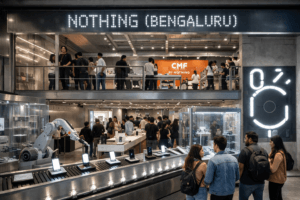
Nothing has opened its first global retail store in Bengaluru, India—its largest market—transforming the space into an experiential “factory floor” that showcases its design philosophy through deconstructed production lines and product testing machinery. The two-story location serves as a physical bridge between the brand’s digital community and its products, housing both its premium Nothing lineup and its budget-focused CMF sub-brand under one roof. By choosing Bengaluru, the company is strategically deepening its connection with India’s tech-savvy early adopters, where it already holds over 2% market share and was the fastest-growing smartphone brand in Q2 2025. The move positions Nothing alongside aspirational retailers like Apple while signaling its long-term commitment to physical retail, with future stores planned for Tokyo and New York.
Beyond the Screen: Why Nothing’s New Bengaluru Store is a Physical Manifesto for the Transparent Tech Brand
The global consumer hardware industry has long operated under a simple, if brutal, axiom: your product is only as good as its last shipment, and your brand is only as strong as your latest online unboxing video. For a new generation of digitally native brands, the physical world has often felt like an afterthought—a costly relic of a pre-internet era. That is, until a brand decides it has something more significant to say.
On a busy Thursday evening in February 2026, Nothing, the London-based consumer tech company co-founded by Carl Pei, made a profound statement about its ambition. It didn’t just launch a new pair of earbuds or tease a flagship phone. It opened its first official retail store in India. Located in the heart of Bengaluru, the country’s Silicon Valley, this two-story space is far more than a point of sale. It is a physical manifestation of a philosophy, a temple to transparency, and a calculated move in a high-stakes game of global brand-building.
To the casual observer, it might seem counterintuitive. In an era where you can buy a smartphone with a single tap and have it delivered in hours, why invest in the heavy, expensive, and logistically complex world of brick-and-mortar retail? The answer lies in the unique position Nothing finds itself in, and the unique challenges of its biggest and most crucial market: India.
The Indian Imperative: Why Bengaluru?
Nothing’s decision to launch its first global retail outpost in Bengaluru—beating out its headquarters in London or a planned flagship in New York or Tokyo—is a data-driven power play. According to recent data from IDC, Nothing already commands over 2% of the Indian smartphone market. While that number may seem small, it’s monumental for a young brand competing against deep-pocketed giants like Xiaomi, Samsung, and Vivo. More importantly, in Q2 2025, it was the fastest-growing brand in the country, with an 85% year-over-year surge in shipments.
This isn’t just a story of volume; it’s a story of community. Bengaluru is the epicenter of India’s tech-savvy, early-adopter culture. It’s a city of engineers, developers, designers, and students who don’t just use technology—they dissect it, debate it, and derive identity from it. This is the audience that understood Nothing’s initial proposition immediately: a design-forward, almost anti-tech aesthetic that champions transparency, both literally (through its iconic Glyph Interface on phones) and metaphorically (through its clean, bloatware-free software, Nothing OS).
“We wanted to create a fun space,” Carl Pei told TechCrunch, but the subtext is far more strategic. By placing the store in Bengaluru, Nothing is doubling down on its most loyal fanbase, turning their passion into a pilgrimage site. It’s a place where the digital community can finally meet the physical product, and more importantly, meet each other.
The “Factory Floor” Experience: Retail as Theatre
Walk into the new Nothing store, and you won’t just find products lined up on minimalist white tables. The design philosophy is a radical departure from the sterile, airport-lounge aesthetic of many premium electronics stores. Instead, Pei describes it as a journey through the “world” of Nothing, inspired by the very factories where its products are born.
Imagine stepping inside and being greeted not by a salesperson, but by a deconstructed production line. A conveyor belt, perhaps a stylized version of the ones in Shenzhen, carries finished products towards the customer. Behind glass, you might see automated machinery performing the repetitive torture tests that every Nothing phone endures: a robotic arm relentlessly plugging and unplugging a USB-C cable to ensure port durability, or jets of water testing the ingress protection that guarantees your phone can survive a monsoon downpour.
This is retail as theatre, but it’s also a brilliant piece of brand storytelling. For a company named “Nothing,” the message is ironically about “everything”—everything that goes into making a product. In an age where manufacturing is often hidden away to avoid scrutiny, Nothing is bringing it into the light, literally and figuratively. It’s a powerful differentiator.
Customers can, of course, buy the latest Phone (3) or the newest CMF Buds. They can browse merchandise and even get select items customized. But the primary function of the store isn’t just transaction; it’s veneration. It’s designed to deepen the emotional connection between the user and the brand. By showing the process, Nothing is validating the product and, by extension, the consumer’s choice to buy it.
The Dual-Brand Strategy: Nothing and CMF Under One Roof
The Bengaluru store also serves as a physical representation of Nothing’s sophisticated dual-brand strategy. On the shelves, you’ll find the core Nothing lineup—the phones with the transparent backs and the Glyph Interface, the Ear and Ear (a) earbuds. Alongside them sits the CMF by Nothing line, its more affordable sub-brand.
The decision to co-locate them is deliberate. CMF, which stands for Color, Material, and Finish, was spun off last year with a distinct mission. Headquartered in India and operating as a joint venture with local ODM Optiemus, CMF is Nothing’s weapon for the mass market.
“Nothing is more niche with a higher price. CMF is more [targeted toward] mass [market],” Pei explained. But he is keen to differentiate CMF from the sea of generic, low-cost electronics that flood the Indian market. “You know it’s mass, but it’s not just off-the-shelf rebrand products that usually [appear] in this price point. They are also products that we put a lot of care into.”
In the store, a student on a tight budget can walk in to check out a CMF smartwatch or neckband. They will experience the same design language, the same thoughtful unboxing experience, and the same brand ethos as a professional picking up a flagship Nothing Phone. This creates a powerful halo effect. The CMF user aspires to the Nothing ecosystem, and the Nothing user respects the CMF line as a legitimate, well-designed sibling, not a cheap knock-off. The physical store cements this relationship, allowing customers to move up and down the value ladder within a single, cohesive brand environment.
A Lesson from Cupertino: The Aspirational Retail Play
Nothing is not pioneering this concept. The blueprint for aspirational tech retail was drawn by Steve Jobs with the first Apple Stores. Apple transformed the retail space from a cluttered warehouse into a town square, a place for learning and community. The parallels are clear, and they are likely intentional.
Pei has never hidden his admiration for Apple’s playbook, and the timing is telling. This month, Apple is set to open its sixth store in India, this time in Borivali, a bustling suburb of Mumbai. The two companies are now engaged in a fascinating, if lopsided, competition for the soul of the Indian consumer. Apple represents the ultimate status symbol, the pinnacle of ecosystem lock-in. Nothing represents the challenger brand—cool, design-forward, but with an underdog spirit that resonates deeply with a generation that values individuality.
By building a physical presence, Nothing is signaling that it is here for the long haul. It’s no longer just an online curiosity. It’s a serious hardware company willing to make the same long-term capital investments as its rivals. The store becomes a billboard, a showroom, a service center, and a community hub all rolled into one, elevating the brand from a digital entity to a tangible part of the city’s landscape.
The Road Ahead: Tokyo, New York, and Beyond
The Bengaluru store is just the beginning. Nothing has announced plans for future locations in Tokyo and New York, though no timelines have been set. Each location will likely be tailored to its city. A Tokyo store might emphasize minimalist design and cutting-edge technology, resonating with that market’s unique aesthetic. A New York store, perhaps in Soho or on the Lower East Side, would be a cultural hub, blending tech with art and music, reflecting the city’s eclectic energy.
But for now, all eyes are on India. The country is not just a market; it’s a manufacturing hub and a design center for Nothing, particularly for CMF. The success of the Bengaluru store will serve as a litmus test for the company’s broader retail ambitions. Can a brand built on digital hype translate its success to the physical world? Can it manage the operational complexities of retail while maintaining its lean, startup culture?
The $450 million Nothing has raised to date, including a $200 million Series C led by Tiger Global last year, suggests its investors believe it can. The funding isn’t just for R&D; it’s for this exact moment—the scaling of the brand.
Conclusion: Nothing is Something
In a world saturated with black slabs and iterative upgrades, Nothing has carved out a niche by being different. Its transparent designs and minimalist software are a breath of fresh air. But with the opening of its Bengaluru store, the company is signaling that its ambition extends far beyond product design. It is building a culture.
The store is a place where the digital tribe can gather, where the brand’s values are encoded into the architecture, and where the future of the company is put on display for the world to see. It is a bold, expensive, and risky bet. But for a company that has built its identity on defying convention, opening a physical store in the world’s most dynamic smartphone market isn’t a step backward. It’s the most forward-thinking move they could make. It proves that in the battle for our pockets and our attention, sometimes the most powerful thing you can be is tangible. Sometimes, Nothing is actually something.
You must be logged in to post a comment.