
Beyond the Screen: How Samsung India Is Rewriting the Story of Progress in 2025
In 2025, Samsung India demonstrated a powerful model of corporate citizenship that moved beyond traditional charity to create systemic, empowering impact. Through its interconnected initiatives, the company addressed India’s development needs at multiple levels: Solve for Tomorrow empowered young innovators to build tech solutions for local problems with mentorship and incubation grants; the Samsung Innovation Campus strategically upskilled tens of thousands of youth, with a focus on women and non-metro regions, in future-ready fields like AI and IoT; the DOST Sales Programme provided critical first-step employment and professional skills for underserved communities, bridging the gap to dignified work; and the Nanum volunteer platform fostered a company-wide culture of shared humanity, turning employees into active participants in social change. Together, these programs formed a cohesive blueprint for leveraging corporate scale and expertise not just to deliver aid, but to build lasting capability, foster inclusive innovation, and invest in the nation’s human capital, ensuring technology serves as a genuine force for empowerment and equitable growth.
Beyond the Screen: How Samsung India Is Rewriting the Story of Progress in 2025
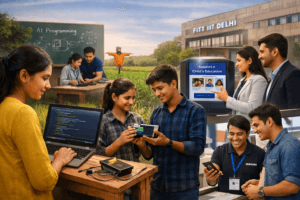
As the final pages of 2025 turn, a quiet but profound narrative is unfolding across India. It’s not just in the gleaming showrooms showcasing the latest foldable phones or cutting-edge appliances. Instead, it’s in a classroom in Uttar Pradesh where a young woman is writing her first line of AI code, in a rural innovation hub where teenagers are prototyping a device to protect crops from wild boars, and in a corporate office where employees are collectively deciding which child’s education fund they will sponsor next. This is the story of Samsung India’s citizenship programmes—a multi-faceted, deeply integrated mission that has, over three decades, quietly touched the lives of 1.5 million people. But 2025 wasn’t about scale for scale’s sake; it was about depth, precision, and creating ecosystems where potential doesn’t just spark—it sustains.
The Catalyst: Solve for Tomorrow and the Art of Listening to Young India
Most innovation contests hunt for the shiniest, most market-ready idea. Samsung’s Solve for Tomorrow starts somewhere more fundamental: with a problem that hurts. In 2025, it became a national listening exercise, tuning into the frustrations and hopes of young Indians. The brilliance of the programme lies in its framework—it doesn’t parachute in solutions but provides the tools (mentorship, design-thinking, access to IIT Delhi’s FITT Labs) for communities to solve their own challenges.
Take the winning teams. Percevia from Bengaluru, NextPlay.AI from Aurangabad, Paraspeak from Gurugram, and Prithvi Rakshak from Palamu didn’t just dream up futuristic concepts. They addressed gritty, local realities: smarter safety, accessible healthcare, environmental protection, and social inclusion through sport. The ₹1 crore incubation grant is significant, but the real value is the message it sends: Your context matters. Your local problem is a national priority.
For the first time, finalists got their hands on advanced R&D infrastructure at FITT before the finale. This critical shift moved projects from theoretical “what-ifs” to tangible “how-tos,” teaching a generation that innovation is as much about iteration and resilience as it is about a eureka moment. The jury—a blend of Samsung leaders, academics, and policymakers—evaluated not just technical feasibility but human impact. This subtle prioritisation cultivates a different kind of innovator: one who is as empathetic as they are engineering-savvy.
Building the Engine Room: Samsung Innovation Campus and the Currency of Skill
If Solve for Tomorrow identifies the pioneers, the Samsung Innovation Campus (SIC) is building the army that will bring their visions to life. In 2025, SIC executed a staggering six-fold expansion, aiming to reach 20,000 students across 10 states. This isn’t just corporate skilling; it’s strategic nation-building in direct dialogue with the government’s Skill India and Digital India missions.
The curriculum in AI, IoT, Big Data, and Coding is rigorous, but the human insight is in the details. A 44% national participation rate for women isn’t an accident; it’s a deliberate design choice to dismantle barriers in tech. By targeting 5,000 students in Uttar Pradesh alone—a quarter of the national target—Samsung is strategically investing in regions poised for explosive digital growth, ensuring talent development isn’t confined to metropolitan hubs.
The real value for students isn’t merely a certificate. It’s the psychological shift from being a job-seeker to a solution-provider. They’re not just learning Python; they’re learning to speak the language of the future economy. In a country where demographic dividend can easily turn into a demographic challenge, SIC is methodically converting youth from a statistical advantage into an operational one.
The Bridge to Dignity: Samsung DOST and the Power of First-Step Jobs
While SIC crafts the engineers and data scientists, the Samsung DOST Sales Programme addresses another, equally critical reality: the need for dignified, first-step employment for thousands from underserved communities. Scaling up to train 9,400 youth in 2025, DOST 4.0 understands a fundamental truth: economic inclusion often begins not with a laptop, but with confidence, communication, and customer service skills.
Partnering with sector skills councils (ESSCI and TSSC), DOST doesn’t just create Samsung salespeople; it creates a professional pipeline for India’s entire organised retail sector. It teaches soft skills, product knowledge, and digital literacy—competencies that are transferable and foundational. For a young person from a community with limited exposure, this programme is a bridge. It transforms uncertainty into a uniform, a hesitant greeting into a confident pitch, and a daily wage into a monthly salary with a career path. This is impact measured not in lines of code, but in household stability and newfound self-worth.
The Heart of the Machine: Nanum and the Culture of Shared Humanity
Technology and skilling are powerful, but they risk feeling transactional without heart. This is where Nanum, Samsung’s global volunteering platform, weaves everything together. In 2025, Nanum moved beyond episodic charity to embedded cultural practice.
The Nanum Kiosk initiative is a masterclass in empathetic engagement. It allows employees to collectively direct funds to cover educational expenses for underprivileged children. This isn’t a distant, faceless donation; it’s a choice, a discussion, a shared commitment to a specific child’s future. When employees participate, they’re not just giving money; they’re investing a piece of their own hope. It fosters a culture where “corporate citizenship” becomes personal citizenship for thousands of Samsung staff.
This internal culture of giving back radiates outward. Employee volunteers mentoring in SIC or guiding Solve for Tomorrow teams bring a practicality and passion that outside consultants cannot. They create a virtuous cycle: the company empowers the community, and the community’s engagement, in turn, empowers and gives purpose to the employees.
The Synthesis: Why This Model Offers a Genuine Blueprint
As we reflect on 2025, Samsung India’s efforts offer more than a feel-good annual report. They present a cohesive theory of change:
- Identify at All Levels: From grassroots innovators (Solve for Tomorrow) to digital creators (SIC) and frontline workforce (DOST), they intervene at multiple points in the talent and innovation lifecycle.
- Equip, Don’t Just Gift: Every programme prioritizes capability building—be it through mentorship, lab access, structured curriculum, or on-the-job training. The goal is self-reliance.
- Integrate for Ecosystem Impact: These programmes don’t run in silos. A SIC graduate might join a Solve for Tomorrow startup. A DOST alum might become a champion for digital literacy in their own community. Nanum volunteers support them all.
- Measure in Lives Changed, Not Just Numbers Reached: The 1.5 million beneficiary figure gains meaning through stories—of the girl who coded an AI model, the boy who became his family’s first salaried employee, the village that now has a prototype to save its harvest.
Looking Ahead: The Lasting Imprint
In 2025, Samsung India demonstrated that the most profound technology isn’t always in a device; sometimes, it’s in a system—a system for human growth. As the company looks forward, the challenge will be to deepen these roots, to ensure the startups scale, the skilled find meaningful work, and the culture of Nanum becomes an industry standard.
The ultimate insight for readers—corporate leaders, policymakers, and citizens alike—is this: sustainable impact happens when a corporation leverages its core strengths (technology, scale, organizational energy) not just to sell products, but to solve persistent human problems. It’s a lesson that the most valuable thing you can build isn’t always for the market; sometimes, it’s for the future, built hand-in-hand with the people who will inhabit it. In doing so, Samsung is ensuring that its legacy in India won’t be defined solely by the gadgets it sold, but by the potential it helped unlock.
You must be logged in to post a comment.