
Beyond the Roller: How Precision Godet Technology is Rewriting the Rules of High-Performance Fiber
RETECH’s upcoming showcase at Techtextil 2026 shifts the focus from the final fabric to the critical, often-overlooked engineering behind it: precision godet technology, which is essential for manufacturing high-performance fibers. By mastering advanced induction heating up to 400°C, the company enables exact control over yarn properties like tenacity, elongation, and shrinkage through uniform temperature profiles. This precision is paired with a robust design and the intelligent UTR-6A non-contact monitoring system, which enhances machine uptime and sustainability by enabling predictive maintenance. Ultimately, RETECH positions its godets not as simple rollers, but as precision instruments where thermal dynamics and data intelligence converge to define the quality and reliability of tomorrow’s technical textiles.
Beyond the Roller: How Precision Godet Technology is Rewriting the Rules of High-Performance Fiber
As the global textile industry turns its eyes toward Frankfurt for Techtextil 2026, the spotlight often shines on the glamorous end-products: the flame-resistant protective gear, the carbon fiber composites for aerospace, and the smart textiles woven with electronics. But behind every high-performance fabric lies a chain of precision engineering, and at the very heart of that chain is a component so fundamental it is often overlooked: the godet.
At the upcoming Techtextil, RETECH is set to change that perception. By showcasing its latest generation of precision godets and draw frames, the company is pulling back the curtain on the unsung hero of synthetic fiber production. This isn’t just a display of rotating rollers; it is a masterclass in thermal dynamics, material science, and the relentless pursuit of uniformity.
The Critical Junction Where Heat Meets Speed
To the uninitiated, a godet might look like a simple roller guiding thread. In reality, it is a precision instrument that dictates the very soul of a synthetic fiber. In the production of technical yarns—from ballistics-grade aramids to melt-spun polypropylene for geotextiles—the godet is the site of alchemy. It is where amorphous, freshly extruded polymer chains are stretched, oriented, and crystallized into fibers with specific, engineered properties.
RETECH’s upcoming showcase centers on its ability to master this process under extreme conditions. With process temperatures reaching up to 400°C, the company is catering to the vanguard of material science: high-performance fibers that must withstand incredible stress, chemical exposure, and thermal loads.
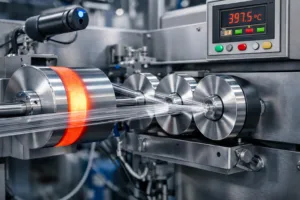
The core innovation on display will be the evolution of their induction heating technology. Unlike traditional heating methods that rely on external heat sources or oil-based systems, induction heating generates heat directly within the godet shell. This is a game-changer for manufacturers. It allows for “single-zone or multi-zone configurations,” meaning a single godet can have distinct temperature profiles across its width. Imagine drawing a fiber that requires a hotter contact point at the entry to initiate orientation, but a slightly cooler surface at the exit to “set” the molecular structure. This level of granular control is what separates commodity plastics from true high-performance engineering materials.
The Pursuit of the Perfect Draw: Tenacity, Elongation, and Shrinkage
Why does this level of precision matter to the end-user? It comes down to three critical yarn characteristics: tenacity, elongation, and shrinkage.
- Tenacity (or strength) is paramount for tire cords, ropes, and composites. If the godet temperature is inconsistent, some filaments in the yarn bundle will draw more than others, creating weak points. RETECH’s uniform temperature control ensures that every filament experiences the exact same stress-strain history, resulting in a yarn that meets stringent strength requirements without weak links.
- Elongation determines how much a fabric will stretch before breaking. In technical textiles like seatbelts or airbags, this must be precisely calibrated. Too much stretch and the safety device fails; too little and the material is brittle. The stable speed control of the godet, synchronized with the draw frame, locks in the exact elongation required.
- Shrinkage is the silent killer of textile quality. When a finished product goes through a coating process or is exposed to heat in its final application (like an engine bay hose), uncontrolled shrinkage can cause delamination or failure. By maintaining an exact thermal profile during production, RETECH’s systems effectively “pre-shrink” the fiber in a controlled manner, ensuring dimensional stability for the life of the product.
Engineering for Uptime and Sustainability
Beyond the raw science of fiber formation, RETECH’s presence at Techtextil 2026 will highlight a growing demand from the industry: sustainability through reliability. In an era of soaring energy costs and a push for circular economies, machine uptime is the ultimate sustainability metric. A machine that is down wastes energy, creates scrap, and disrupts the supply chain.
This is where the marriage of robust mechanical design and intelligent monitoring comes into play. The godet is not just a heated roller; it is a high-speed rotating assembly operating in often harsh industrial environments. RETECH’s focus on energy-optimized heating and efficient drives reduces the carbon footprint of the production line.
The centerpiece of this reliability strategy is the UTR-6A non-contact temperature measurement system. In the past, measuring the temperature of a spinning godet was a challenge. Inferring temperature from contact brushes or ambient readings left room for error. The UTR-6A changes the paradigm by capturing data directly from the rotating surface.
This continuous stream of data, fed into the UCR-6 controller, allows for what industry 4.0 proponents call “predictive maintenance.” The system doesn’t just react to a failure; it detects micro-fluctuations in thermal behavior that could indicate bearing wear or heater degradation. By alerting operators to these anomalies before they cause a breakage, the system prevents catastrophic downtime, reduces waste, and extends the service life of the machinery. For the plant manager walking the floor at Techtextil, this translates directly to a healthier bottom line.
A Glimpse into the Future at Techtextil
As visitors approach the RETECH booth at Techtextil 2026, they won’t just see metal cylinders. They will be looking at the intersection of physics and manufacturing. The display will likely demonstrate how these godets handle a range of challenging polymers—from the high-temperature requirements of LCP (Liquid Crystal Polymer) for 5G applications to the delicate handling of specialty nylons for ultra-fine filtration media.
The conversation at the show is shifting from “what can your machine produce?” to “how consistently can you produce it, and at what environmental cost?” RETECH’s answer, embedded in their godet technology, speaks to a future where textile manufacturing is defined not by brute force, but by precision intelligence. By controlling the variables of heat and speed with microscopic accuracy, they are enabling the next generation of textiles to be stronger, lighter, and more reliable than ever before. In the grand tapestry of Techtextil, these precision godets may just be the most important thread of all.
You must be logged in to post a comment.