
Beyond the Robotic Dog: At India’s AI Summit, a Tale of Two Visions Unfolds
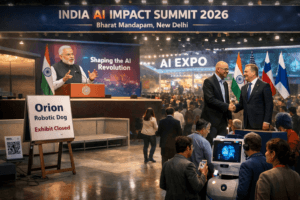
Beyond the Robotic Dog: At India’s AI Summit, a Tale of Two Visions Unfolds
The air inside Hall 4 of Bharat Mandapam on Wednesday morning was thick with a different kind of energy than the day before. Gone was the overwhelming sense of chaotic logjam. In its place was a more controlled, purposeful hum, punctuated by the steady beeps of scanners and the low murmur of delegates navigating a newly streamlined system.
Yet, for all the improved logistics, the real story of Day 3 of the India AI Impact Summit 2026 wasn’t playing out on the main stage or in the newly efficient queues. It was unfolding in a suddenly vacant exhibition space and echoing through the rapid-fire reactions on social media and political podiums. This was the day the summit’s grand narrative of “India shaping the AI revolution” collided head-on with the messy, complicated, and often uncomfortable realities of its execution.
The Fall of ‘Orion’: When Pride Goes Viral for the Wrong Reasons
Just 24 hours earlier, the stall at the heart of the AI Expo was a bustling hub of curiosity. Galgotias University had drawn crowds with a sleek, four-legged robotic dog named “Orion,” which trotted, wagged its mechanical tail, and performed tricks for delighted onlookers. It was a potent symbol of India’s youthful engineering prowess—or so it seemed.
By mid-morning on Wednesday, the stall was empty. The robotic dog was gone. A solitary, hastily printed sign was the only remnant, a silent testament to a firestorm that had erupted online and offline.
The controversy began, as many do today, with a keen-eyed observer who recognized the robot’s distinctive gait and design. It wasn’t an in-house creation from a Uttar Pradesh university lab. It was a Unitree Go2, a commercially available, off-the-shelf product from a Chinese robotics company. The sleek “Orion” branding, it turned out, was little more than a sticker job.
The backlash was swift and unforgiving. “A disorganised PR spectacle,” was how Leader of Opposition in the Lok Sabha, Rahul Gandhi, described it, “where the Indian data is up for sale by showcasing Chinese products.” The accusation cut deep, tapping into a vein of national pride and insecurity about India’s place in the global tech race.
Within hours, sources confirmed that the university had been asked to vacate its stall “immediately.” The message from the organisers was clear: at a summit aimed at showcasing indigenous innovation, such misrepresentation was an unacceptable breach of trust.
The incident, however, is more than a simple case of academic exaggeration. It’s a mirror reflecting the immense pressure cooker environment of India’s AI ambitions. With the Prime Minister himself talking about moving “from participating in the AI revolution to shaping it,” the hunger for tangible, “Made in India” success stories is insatiable. Galgotias University, in its flawed judgment, tried to serve that hunger with a pre-packaged meal, and got burned.
“The desire to project strength is understandable,” commented Dr. Ananya Sharma, a policy researcher specializing in technology ecosystems. “But in the global AI race, credibility is your most valuable currency. Passing off imported hardware as your own innovation isn’t just embarrassing; it signals a weakness in foundational research that can deter genuine international partners.” The incident serves as a cautionary tale for every Indian institution racing to prove its mettle: in the spotlight of a global summit, authenticity is the only thing that matters.
From Chaos to Control: The Logistical Redemption Arc
If the robotic dog saga was the summit’s public relations nightmare, the logistical overhaul was its quiet redemption. Just after 10 a.m., Digital India MD and CEO Akhil Kumar made an announcement that brought palpable relief to the delegate floor: the AI Expo area would remain open until 8 p.m., allowing attendees to finally explore the innovations after a day of being bottlenecked in convention halls.
The contrast to Day 1, which Union Minister Ashwini Vaishnaw had publicly apologised for, was stark. On Tuesday, attendees had described scenes of “utter chaos,” a phrase Congress president Mallikarjun Kharge was quick to seize upon, slamming the “rank mismanagement” of the Modi government. The criticism was a political gift, framing the high-tech summit as a symbol of administrative incompetence.
By Wednesday, the gates had been rethought. More halls were opened. The flow of people, while still heavy, became a current rather than a logjam. The organisers had clearly worked through the night to address the most egregious bottlenecks. It was a testament to the Indian bureaucracy’s capacity for rapid, if reactive, course correction. Yet, the initial impression had already been seared into the public consciousness, providing a potent counter-narrative to the government’s message of seamless progress.
The Vision Thing: Modi’s Words and Microsoft’s Billions
Amidst the logistical scrambling and political point-scoring, the substantive business of the summit continued. Prime Minister Narendra Modi, in an interview released on Day 3, laid out his expansive vision. “We are not just nurturing talent, but we are building the infrastructure, policy ecosystem and skills base required for India to move from participating in the AI revolution to shaping it,” he stated. It was a powerful articulation of intent, painting a picture of a nation no longer content to be a back-office for the world, but a decisive architect of its technological future.
This vision received a powerful, real-world endorsement from Microsoft. The tech giant announced it was on pace to invest a staggering $50 billion by the end of the decade to expand AI across the ‘Global South,’ with India as a central pillar. This followed the $17.5 billion investment pledge made just last year.
Microsoft’s commitment underscores a fundamental truth: global tech capital sees India not just as a massive market, but as an indispensable hub for talent and innovation. Its investment is a bet on the very “talent” and “infrastructure” Modi spoke of. It’s a vote of confidence that transcends the day’s controversies, pointing to a long-term strategic alignment.
The Geopolitical Stage: A Finnish Primer in New Delhi
Adding another layer to the day’s events was the arrival of Finland’s Prime Minister, Petteri Orpo. Greeted at the airport by Minister of State Jayant Singh, his presence was a quiet but significant reminder that AI is not just a technological or economic issue, but a deeply geopolitical one.
Finland, a global leader in education and digital infrastructure, represents a natural partner for India. The focus areas of the visit—digital and AI, sustainability, and education—are precisely the sectors where collaborative breakthroughs are most needed. His presence at the summit, even as the local controversies swirled, signalled that for international partners, the long-term potential of the Indian market far outweighs the temporary disruptions of a poorly managed conference day.
A Summit of Contradictions
As the sun set on Day 3 and the expo halls remained buzzing with visitors until 8 p.m., the India AI Impact Summit stood as a study in contradictions. It was a place where a Chinese robotic dog could spark a national debate on indigenous innovation, while an American tech giant pledged tens of billions of dollars in faith. It was a forum where the Prime Minister could articulate a global vision, even as local logistical failings gave his political opponents a field day.
The Galgotias University incident will likely be remembered as a footnote, a cautionary tale of youthful exuberance misdirected. The political sparring will fade with the news cycle. But the underlying currents are stronger.
The day revealed that India’s AI journey is not a clean, linear path. It is a chaotic, competitive, and sometimes embarrassing process of figuring out who we are and what we can truly build. It involves over-promising and under-delivering, getting caught out, and then scrambling to fix the problem. But it also involves Finnish Prime Ministers arriving for dialogue, global corporations doubling down on their bets, and a national leadership relentlessly pushing a narrative of transformation.
The true test of the summit will not be the efficiency of its queues or the authenticity of its exhibits. It will be whether the vision of “shaping the AI revolution” can survive the messy, human process of actually trying to get there. And if Day 3 proved anything, it’s that the road to that future is paved with both billion-dollar promises and the discarded remnants of a robot dog named Orion.
You must be logged in to post a comment.