
Beyond the Roar of Harleys: How India’s US Trade Deal Reshapes Markets and Geopolitics
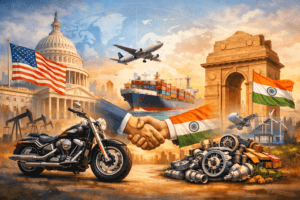
The interim US-India trade agreement strategically opens India’s market by eliminating import duties for Harley-Davidson motorcycles and cutting tariffs for high-end American cars, while deliberately excluding electric vehicles to shield India’s domestic EV industry. In return, India secures preferential access for its auto parts exports to the US, with tariffs reduced to 0% or 18%, and sees a broader rollback of US penal tariffs on its exports. This targeted deal represents a calculated geopolitical and economic realignment, where India protects its strategic manufacturing ambitions (“Make in India”) and boosts exports, while the US gains symbolic market access, together crafting a model of asymmetric negotiation that serves both nations’ core interests beyond simple tariff reductions.
Beyond the Roar of Harleys: How India’s US Trade Deal Reshapes Markets and Geopolitics
The recent US-India interim trade agreement represents far more than a simple tariff adjustment—it signals a profound strategic realignment between the world’s largest and fifth-largest economies. While the headline-grabbing concession of zero import duties for iconic Harley-Davidson motorcycles captures the imagination, the deal is a calculated geopolitical and economic play. It carefully balances market access with domestic protection, advances “Make in India” objectives, and strategically excludes certain sectors to nurture homegrown industries. This agreement marks a decisive pivot from years of tariff skirmishes, resetting a relationship that had been strained by punitive duties as high as 50% on Indian goods . By dissecting its automotive provisions, we uncover a nuanced blueprint for how emerging economies can engage with global trade superpowers on their own terms.
The Core of the Deal: A Strategic Opening for Luxury and Muscle
The automotive concessions are highly specific, targeting niche premium segments while shielding the vast majority of India’s domestic auto market.
For American manufacturers, the key gains are:
- Harley-Davidson Motorcycles (800cc-1600cc): Immediate duty-free access from the day the agreement is signed, expected around March 2026 . This fulfills a long-standing demand from the US, with former President Trump having repeatedly criticized India’s “unacceptably high” tariffs on the brand .
- High-End Internal Combustion Engine (ICE) Cars: A phased reduction of import duties on cars with engine capacities above 3,000cc. Duties will drop from as high as 110% to 30% over a ten-year period . This benefits ultra-luxury and performance models from American automakers.
Crucially, the deal includes significant exclusions and protections for India:
- Electric Vehicles (EVs): Entirely excluded from tariff concessions. This shields India’s burgeoning domestic EV industry from immediate foreign competition .
- Mass-Market Vehicles: Lower and mid-tier automobiles receive no tariff relief, protecting the heart of India’s domestic auto industry, which is dominated by affordable, small-engine vehicles .
Table: Comparison of India’s Automotive Concessions in Recent Trade Deals
| Aspect | US-India Interim Deal | EU-India FTA |
| Luxury Car Tariff | Reduced from ~110% to 30% (for >3000cc) | Reduced from 110% to as low as 10% within a quota |
| Tariff Timeline | Phased over 10 years | Gradual reduction over several years |
| Import Quota | Not specified for cars | 250,000 vehicles per year (for cars >€15,000) |
| EV Treatment | Excluded from concessions | Excluded for 5 years, then phased reductions |
| Key Beneficiary | Harley-Davidson & high-displacement US cars | European luxury brands (Mercedes, BMW, etc.) |
The Calculated Exclusion: EVs and the “Make in India” Shield
The most telling aspect of the deal is the deliberate exclusion of electric vehicles. This is not an oversight but a strategic pillar of India’s industrial policy. India is aggressively building a domestic EV ecosystem through production-linked incentive (PLI) schemes, aiming to become a global hub for manufacturing and exports. Allowing duty-free or low-duty imports of American EVs—most notably from Tesla, which has long sought lower tariffs to enter the market—would disrupt this fragile, investment-heavy build-up .
This move underscores a core principle of India’s trade strategy: calibrated globalization. The market is opened in areas where domestic presence is minimal (e.g., >3000cc luxury cars and large-displacement cruisers) but protected where local ambitions are high (EVs and mass-market vehicles). The message to companies like Tesla is clear: to access India’s vast potential consumer base, local manufacturing is the only viable long-term path.
The Flip Side: India’s Export Engine Gets a Boost
The agreement is profoundly reciprocal. In return for opening its luxury market, India secures vital gains for its export-oriented manufacturing sector, particularly auto components.
- Preferential Access to US Market: India receives a preferential tariff-rate quota for automotive parts exported to the US, exempting them from national security-based “Section 232” tariffs that can reach 25% . Commerce Minister Piyush Goyal stated that about half of these component exports will enter the US at zero duty, with the rest at an 18% tariff .
- Broader Tariff Reset: More broadly, the US slashed its reciprocal tariffs on all Indian exports from 50% to 18% . This restores competitiveness for labor-intensive sectors like textiles, apparel, leather, and gems & jewelry, which had been severely impacted by the earlier punitive duties.
For the Indian auto component industry, which exported $6.2 billion to the US in FY25, this is a major relief and opportunity. As Vikrampati Singhania, President of the Automotive Component Manufacturers Association of India (ACMA), noted, these measures will “enhance export competitiveness and reinforce India’s role as a trusted partner in resilient global automotive supply chains” .
Geopolitics and the Bigger Picture: Beyond Automobiles
The trade deal is inextricably linked to broader geopolitical and strategic realignments.
- The Russian Oil Factor: The US agreement to roll back its additional 25% penal tariff was explicitly tied to India halting direct or indirect imports of Russian crude oil . The deal includes a monitoring mechanism, with the threat of tariff reimposition if India resumes such imports .
- A $500 Billion Commitment: In a striking demonstration of deepened ties, India has expressed its intent to purchase $500 billion worth of US goods over the next five years. This basket includes energy products, aircraft, precious metals, and critical technology like graphics processing units (GPUs) .
- Addressing Non-Tariff Barriers: The framework commits both nations to tackle long-standing regulatory hurdles. India has agreed to address barriers affecting US medical devices and ICT goods and to evaluate accepting US/international standards in key sectors .
Strategic Implications for Key Stakeholders
The ripple effects of this targeted deal will be felt across the global automotive and trade landscape.
For American Manufacturers:
- Harley-Davidson gets a symbolic and commercial victory, potentially reviving its fortunes in a key growth market.
- US Luxury Car Makers (like those from the Stellantis group) gain a new, albeit narrow, pathway to India’s wealthy elite.
- Tesla and EV Makers face a clear, protectionist wall, making local assembly the only credible strategy for the Indian market.
For Indian Industry and Policy:
- The domestic auto and EV sector wins protected space to grow, consistent with the “Make in India” vision.
- The auto component sector emerges as a big winner, gaining assured, competitive access to its largest export market.
- The government showcases a model of negotiating from strength, opening sectors selectively without compromising core industrial goals.
For Global Competitors (EU, UK, Japan):
- European automakers, thanks to a separate FTA, still have a superior tariff arrangement (as low as 10%) .
- However, the US deal proves India is willing to engage bilaterally, offering distinct packages to different partners, thereby encouraging a “competitive engagement” dynamic where each major economy seeks its own optimized deal.
Conclusion: A New Blueprint for Asymmetric Trade
The 2026 US-India interim trade agreement is a masterclass in asymmetric negotiation. It moves beyond the simplistic win-lose paradigm to craft a package where both sides secure their paramount interests: the US gains symbolic and substantive market access in high-profile sectors, while India protects its strategic industrial future and turbocharges its export engine. The roar of duty-free Harleys may capture headlines, but the quieter hum of competitively priced Indian auto parts heading to American factories tells the more economically significant story.
This deal sets a precedent for how large, ambitious developing economies can engage with established trade powers—not through blanket liberalization, but through smart, strategic protection and targeted openness. It reaffirms that in the complex geopolitics of the 21st century, trade policy is less about generic tariffs and more about crafting specific, symbiotic deals that serve long-term national visions.
You must be logged in to post a comment.