
Beyond the Ribbon-Cutting: How Gorakhpur’s New Tech Hub Signals a Silent Revolution in Eastern UP
The inauguration of the 71st Software Technology Parks of India (STPI) centre in Gorakhpur marks a strategic shift for eastern Uttar Pradesh, offering a “plug-and-play” ecosystem where startups can launch with minimal infrastructure barriers. Chief Minister Yogi Adityanath emphasized that technology accelerates development, and this ₹20 crore facility—complete with incubation space, high-speed connectivity, and support for IT-enabled services—aims to curb youth migration by creating local opportunities. With nearly half of Uttar Pradesh’s 20,000 startups led by women, the centre is poised to boost female workforce participation while complementing upcoming initiatives like the region’s first Centre of Excellence at MMMUT and a ₹50 crore Green Hydrogen hub. Beyond the ribbon-cutting, the development represents a foundational effort to transform Gorakhpur from a city defined by its past into a self-sustaining tech and innovation hub that leverages local talent without forcing residents to leave home.
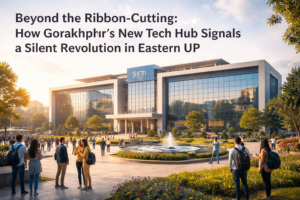
Beyond the Ribbon-Cutting: How Gorakhpur’s New Tech Hub Signals a Silent Revolution in Eastern UP
For decades, the city of Gorakhpur in eastern Uttar Pradesh was known for two things: the hallowed Gorakhnath Temple and the turbulent political legacy it often anchored. It was a city defined by its past—a bustling administrative and educational center that, despite its intellectual capital, consistently found itself on the wrong side of the economic map. The common lament among its youth was a familiar one: “Padhna yahan, bhagna wahan” (Study here, flee from here).
On Thursday, Chief Minister Yogi Adityanath inaugurated the 71st centre of the Software Technology Parks of India (STPI) in the Gorakhpur Industrial Development Authority (GIDA) area, a move that local entrepreneurs and technocrats are calling a deliberate attempt to rewrite that narrative. While the news headlines captured the ceremonial ribbon-cutting and the Chief Minister’s call for linking talent with technology, the event represents something far more significant: a strategic bet on de-urbanizing India’s tech boom and transforming a politically significant region into a self-sustaining economic engine.
The “Plug-and-Play” Philosophy
The new facility, built at a cost of approximately ₹20 crore across 3.5 acres, is more than just a building with high-speed internet. During his address, Chief Minister Adityanath distilled the government’s strategy into a succinct, almost minimalist pitch: “A startup entrepreneur only needs to bring a computer. Space, electricity, and basic infrastructure will be provided.”
This “plug-and-play” ecosystem is the ideological opposite of how traditional Indian bureaucracy has approached industrial development. Historically, setting up a tech unit in a tier-2 or tier-3 city involved a labyrinth of clearances, unreliable power grids, and a lack of incubation support. The STPI model eliminates the barriers to entry. For a young coder in Deoria, Basti, or Gorakhpur proper, the cost of launching a software export venture has suddenly dropped from prohibitive to negligible.
For the youth of Purvanchal (eastern Uttar Pradesh), this is a psychological turning point. It signals that the government infrastructure is finally coming to them, eliminating the compulsion to migrate to Bengaluru, Pune, or the National Capital Region (NCR) to find a stable desk and a reliable internet connection.
From “Riot Zones” to “Code Zones”
To understand the gravity of this shift, one must understand Gorakhpur’s economic geography. For much of the 1990s and 2000s, Eastern Uttar Pradesh was viewed by investors as a “no-go” zone—hampered by poor law and order, chronic power shortages, and a lack of modern industrial land banks. The GIDA itself was often cited as an example of unrealized potential; a sprawling industrial area that housed a few sugar mills and manufacturing units but never managed to attract the white-collar industries that could retain the region’s highly educated youth.
The inauguration of the STPI centre changes that calculus. It places Gorakhpur on the national IT map, not as a back-office extension of a metro, but as a standalone hub. The presence of a state-of-the-art auditorium, conference rooms, and incubation areas allows it to function as a nerve center for innovation, capable of hosting hackathons, investor meets, and global client conferences.
Moreover, the timing aligns with a broader national push for “Vocal for Local” tech solutions. With the central government aggressively promoting the adoption of homegrown software and platforms, a tech park in Gorakhpur isn’t just about servicing foreign clients; it’s about building solutions for the hinterland—agritech for the fertile plains of Purvanchal, meditech for its growing healthcare network, and e-governance tools for local bodies.
The Demographic Dividend: Women at the Forefront
Perhaps the most compelling statistic to emerge from the event was the Chief Minister’s revelation that of the more than 20,000 startups currently operational in Uttar Pradesh, nearly half are run by women. This is not just a political talking point; it is a socio-economic phenomenon that the STPI centre is poised to accelerate.
Eastern Uttar Pradesh has a high literacy rate but traditionally low female workforce participation due to social norms and safety concerns. The STPI model offers a solution to the “last-mile” problem of women’s empowerment. For a woman with a degree in computer applications from DDU Gorakhpur University, working in a secure, government-backed facility with structured working hours, just a few kilometers from her home, is a transformative opportunity.
This is the silent revolution that often gets overshadowed by the political spectacle of an inauguration. When a tech park opens in a city like Gorakhpur, it doesn’t just create jobs; it creates aspirational jobs that keep families intact. It allows parents to feel safe about their daughters working late hours because the workplace is secure and the commute is local. It bridges the gap between educational attainment and economic participation.
Beyond the IT Park: A Vision for a Tech-First Economy
The inauguration of the STPI centre is not an isolated event. Chief Minister Adityanath used the platform to outline a larger infrastructure roadmap for the region’s technological future, revealing that Eastern Uttar Pradesh’s first Centre of Excellence (CoE) will be inaugurated on April 15 at the Madan Mohan Malaviya University of Technology (MMMUT).
The proximity of the STPI centre to MMMUT creates a classic “academia-industry” synergy that is currently the hallmark of successful innovation districts in Hyderabad and Bengaluru. The CoE will focus on specialized fields like meditech, robotics, and agritech, ensuring that the curriculum is aligned with the needs of the startups incubating at the STPI facility just a few kilometers away.
Furthermore, the announcement of a ₹50 crore Green Hydrogen Energy Centre of Excellence signals a forward-thinking approach. By positioning Gorakhpur as a hub for green hydrogen—a sector the central government has identified as critical for energy independence—the state is aiming to attract high-value research and development (R&D) investment. It suggests that the vision for the region extends beyond software coding and into deep tech and sustainable energy manufacturing.
The Human Insight: What This Means for the Local Coder
To appreciate the genuine value added by this development, consider the perspective of a final-year engineering student at MMMUT. Three years ago, their career trajectory seemed linear: graduate, take a train to Noida or Bangalore, pay exorbitant rent in a PG accommodation, and navigate the anonymity of a metro city while sending money home.
Now, with the STPI centre functional and a Centre of Excellence on the horizon, the equation changes. They can intern locally, build a portfolio, and launch a startup without uprooting their life. They can leverage the high-speed internet and infrastructure of the tech park to serve global clients while living in their own home, enjoying a lower cost of living and a higher quality of life.
This is the “multiplying effect” of development that the Chief Minister referred to in his speech. Technology acts as a great equalizer. In the digital economy, a coder in Gorakhpur is as valuable as a coder in California, provided the infrastructure supports them. By removing the infrastructure deficit, the government is effectively unlocking the latent human capital of the region.
Challenges and the Road Ahead
While the inauguration is a cause for celebration, the true test will lie in execution. For the STPI centre to succeed, it requires more than just physical infrastructure. It requires a cultural shift within the local administration to support the fast-paced needs of tech startups, which operate on timelines vastly different from traditional manufacturing units.
Additionally, while the “plug-and-play” model lowers entry barriers, the ecosystem needs active mentorship, access to venture capital, and a mindset shift among local investors who are traditionally more comfortable investing in real estate or agriculture than in software-as-a-service (SaaS) startups.
The success of this 71st STPI centre will be measured not by the number of inaugurations, but by the number of unicorns it spawns in the next decade. If even a fraction of the 20,000 startups the Chief Minister mentioned evolve into global players, Gorakhpur could transition from a political pilgrimage site to an economic powerhouse.
Conclusion
The inauguration of the Software Technology Parks of India centre in Gorakhpur is a watershed moment for Eastern Uttar Pradesh. It is a definitive statement that the state government views technology as the primary accelerator of development—a tool that can overcome geographical disadvantages and historical neglect.
For the youth standing on the sidelines, the message is clear: the future is no longer about leaving home to find opportunity; it is about building opportunity at home. As the Chief Minister rightly noted, avoiding technology leads to decline. By embracing it—brick by brick, line of code by line of code—Gorakhpur is betting on a future where the sons and daughters of Purvanchal no longer have to choose between their roots and their dreams. The 71st STPI centre is not just a building; it is the scaffolding for that new reality.
You must be logged in to post a comment.